
A weekly list of Furtherfield recommendations that we are sharing with others. It reflects the expansive and dynamic culture we enjoy, straddling the fields of art, technology and social change.
Events & Exhibitions
Solo show H4ppy D33p W3b (Happy Deep Web) by Systaime aka Michael Borras, at Watermans Arts centre, London. Systaime is the creator of The French Trash Touch movement, which mixes low and high culture and pop culture with internet folklore, like memes, emojis or GIFs. He offers an explosive mashup of internet aesthetics, where information, images and comments are remixed in an audiovisual spectacle that exposes the language of the internet | 12 June – 28 July 2019 – https://bit.ly/2KfGQWy
Antiuniversity Festival is back 15 Jun – 22 Jun 2019, for the fifth time with events across the UK and internationally. This year’s programme is absolutely bursting with radical education, militant feminism, anarchist tendencies, autonomous organising, shit hot politics, critical analysis and progressive discussions about care and culture and gender and class | Full programme – http://www.antiuniversity.org/
Aaron Bastani in conversation with Dr. Richard Barbrook on his new book ‘Fully Automated Luxury Communism: A Manifesto‘ 2019. This event is hosted by Newspeak House, the London College of Political Technologists. Tue, 25 June 2019 | Virtual Futures partners with Verso Books | Book here – https://bit.ly/31p7Xnv
Take the Money and Run: Power, Money and Counter-Power | Wednesday 19 June, 19.00 – 21.00 | The light recently shone on the sources of money that supports arts organisations – from fossil fuels to deadly pharmaceuticals – has illuminated some corners of the ‘hidden abode of production” (Marx) to valuable effect. Live Art Development Agency (LADA), London | Book here – https://bit.ly/2WBGkUk
West Den Haag – Summer School 2019 Spinoza: Passionate Action | Human Being is a Measure | With: Ewa Majewska (PL), Florence Freitag (DE) , Baruch Gottlieb (CA) and Cassie Thornton (US). In order to keep the discussions and experiences substantive and immersive, this Summer School is limited to 30 participants. There is a fee of € 175 per participant, which includes lunches as well as a reader. The program will be held in English. To apply, please e-mail theo@westdenhaag.nl before 26 June 2018 with a short introduction and a 100-word motivation. If successful, you will receive a confirmation of registration and instructions for payment within the week – https://bit.ly/2IHDg4l
About all things languages of all sorts | lingagens an online ReadingClub ***** session. Duration 20 min | Lai-TzeFan, Abdulmohsen Alonayq, Sören Pold and Andréa Catrópa will rearite a text originally written by Erika Fülöp. June 20, 8:15pm (UTC+01:00) – https://bit.ly/2WktGsM
Books
Vital Forms: Biological Art, Architecture, and the Dependencies of Life | By Jennifer Johung | Shows how the intersection of biotech, art, and architecture are transforming the world we live in. Examining cutting-edge developments in biotechnological research—including tissue-engineering, stem cell science, regenerative medicine, and more—Vital Forms brings biological art and architecture into critical dialogue | The University of Minnesota Press 2019 – https://bit.ly/2KK5nCl
Archives | Authors – Andrew Lison, Marcell Mars, Tomislav Medak, Rick Prelinger, Wendy Hui Kyong Chun, Götz Bachmann, Mercedes Bunz, and Timon Beyes | How digital networks and services bring the issues of archives out of the realm of institutions and into the lives of everyday users. Archives have become a nexus in the wake of the digital turn—electronic files, search engines, video sites, and media player libraries make the concepts of “archival” and “retrieval” practically synonymous with the experience of interconnected computing – The University of Minnesota Press, 2019 – https://bit.ly/2WBWjli
Fucking Law: The search for her sexual ethics | By Victoria Brooks | An urgent call for everyone, not just academics and researchers, to find inventive ways to question the ethics of sexuality. Since a sex life is full of so many diverse moments of joy and suffering, for each and everybody, the book attempts to bridge a gap between philosophical and non-philosophical questioning | Zero Books, 2019 – https://bit.ly/31CMxDs
Articles & interviews
Gadgets, Power and the New Modes of Political Consciousness | By Joss Hands | What impact does our relentless fixation on gadgets have on the struggle for new kinds of solidarity, political articulation and intelligence? Joss Hands, author of Gadget Consciousness: Collective Thought, Will and Action in the Age of Social Media, explores the new political and social forces that are emerging in the age of social media – https://bit.ly/2KJp4Kx
Physical Tactics for Digital Colonialism | Video documentation of artist Morehshin Allahyari and her performance-lecture from February 28th 2019. Commissioned and co-presented by New Museum affiliate Rhizome, presenting her concept of digital colonialism in relation to the technologies of 3-D scanning and 3-D printing. https://vimeo.com/337394969
Allahyari also talks to Hrag Vartanian via Hyperallergic on the subjects of ownership of data, forgotten stories, issues surrounding digital colonialism and her scifi project on a podcast – https://bit.ly/2ZnBJa3
The Data Sublime | Giles Lane, writes about his experience at Act Otherwise as a participant at Blast Theory’s annual two day seminar, ‘Act Otherwise – The Invisible Hand: On Profiling and Personalisation.’ He dscusses issues around the generation and use of “Big Data” in artworks and by artists as well as more generally in culture and society – https://bit.ly/2IbjTS3
Forgiven Not Forgotten? A long and detailed challenge to the modern cult of memory | Book review by Christopher Hale on History Today, of ‘Reckonings: Legacies of Nazi Persecution and the Quest for Justice’ by Mary Fulbrook, recent winner of the Wolfson History Prize 2019, Oxford University press – https://bit.ly/2wOgulR
Doctored video of sinister Mark Zuckerberg puts Facebook to the test | Last month Facebook declined to remove a manipulated video of Nancy Pelosi even after it was viewed millions of times, and now a doctored video of Mark Zuckerberg delivering a foreboding speech has been posted to Instagram, in a stunt that put Facebook’s content moderation policies to the test | Guardian – https://bit.ly/2F72doC
The Past, Present, and Future of AI Art | AI art has a long history that is often overlooked | By Fabian Offert & Andrey Kurenkov | “AI art”, or more precisely art created with neural networks, has recently started to receive broad media coverage in newspapers (New York Times), magazines (The Atlantic), and countless blogs. It has also led to the popularization of an ever-growing list of philosophical questions surrounding the use of computers for the creation of art – https://bit.ly/2wKD7Y3
Waves to Waveforms: Performing the Thresholds of Sensors and Sense-Making in the Anthropocene | By Richard Carter | This paper details the technical and conceptual background for the developing art project Waveform, a creative-critical meditation on the role of digital sensors in monitoring and representing environmental change. It explores the origins and functioning of the global sensory architectures used to detect and assess these changes, deconstructing the connotations of omniscience, abstraction, and control associated with the ‘top-down’, data-driven mappings they generate – https://bit.ly/2MHs8K4
Extra Squeezed
Looking for a MoneyLab intern | The Institute of Network Cultures is looking for an intern with production and research skills for the organisation of MoneyLab #7: Feminist Finance and overall project management support of the MoneyLab project, NL | Internship period: September 1 until December 15 2019 – https://bit.ly/2WJhKWv
transmediale | Work with us! For the preparations of #transmediale2020 we are looking for interns who would like to gain experience in the administration, communication, and production of the festival. https://bit.ly/2MpGv5k
Main image by Michael Borras aka Systaime | NETICONES 2019.
A weekly list of Furtherfield recommendations that we are sharing with others. It reflects the expansive and dynamic culture we enjoy, straddling the fields of art, technology and social change.
Events & Exhibitions
Larry Achiampong & David Blandy: The Grid | Copperfield: Exhibition opens 5 June, 6 – 9pm / Runs until 20 July & Seventeen: Exhibition opens: 27 June, 6 – 9pm/ Runs until 3 August. The Grid is a single exhibition over two sites in London simultaneously; Copperfield and Seventeen – http://bit.do/eTVUX
About all things languages of all sorts | lingagens an online ReadingClub ***** session. Duration 20 min | Lai-TzeFan, Abdulmohsen Alonayq, Sören Pold and Andréa Catrópa will rearite a text originally written by Erika Fülöp. June 20, 8:15pm (UTC+01:00) – https://bit.ly/2WktGsM
I, I, I, I, I, I, I, Kathy Acker | The first UK exhibition dedicated to the American writer Kathy Acker (1947–1997), and her written, spoken and performed work. ICA 1 May – 4 August 2019 – https://bit.ly/2UGEqpv
End of the World Trade: On the Speculative Economies of Art and Extraction | Mute contributors Josephine Berry and Marina Vishmidt are organising and/or presenting at the following conference: End of the World Trade: On the Speculative Economies of Art and Extraction, 21 Jun 2019 – 22 Jun 2019 – https://bit.ly/2wF9Vle
Upcoming Sessions – Culture, Power and Politics — Spring / Summer 2019 Series | All Seminars 18:30 -20:30 (These are all Tuesdays except June 19th, which is a Wednesday) | Ridley Road Market Bar, 49 Ridley Road, Dalston, London, E8 2NP | All free, all welcome, no advance booking – http://bit.do/eTVTX
Plastic-Free Hackney will be talking all things waste-reduction at the Council’s Zero Waste event (times tbc). Please come and meet us with your questions and ideas as to how we can help cut the dependence on single-use plastics in the borough. http://bit.do/eTVVL
Books
Energies in the Arts | Edited by Douglas Kahn | Investigating the concepts and material realities of energy coursing through the arts: a foundational text | (MIT Press) – http://bit.do/eTLh8
Gadget Consciousness : Collective Thought, Will and Action in the Age of Social Media | By Joss Hands | What impact does our relentless fixation on gadgets have on the struggle for new kinds of solidarity, political articulation and intelligence? In this groundbreaking study, Joss Hands explores the new political and social forces that are emerging in the age of social media – https://bit.ly/2wAtDi4
Entry Points | Resonating Punk, Performance, and Art | Stevphen Shukaitis (Contributor); Penny Rimbaud (Contributor); Dharma (Contributor); Awk Wah (Contributor) | An Art-media project exploring resonances between punk and performance in the UK and Southeast Asia. Apr 2, 2019 – https://bit.ly/2WGkYte
Articles & interviews
To Exist is to Resist | Exploring Black feminist politics beyond national boundaries | By Lynsey May | New essay collection reveals the particularities of experiences and understandings of Black feminism in Europe – https://bit.ly/2ERvtzK
What do we do when everything online is fake? | James Ball on the threat posed by the generation of fake news through artificial intelligence and how it risks undermining our trust in everything – https://bit.ly/2W9rt3x
Making Public | Memes as Means | By Sepp Eckenhaussen | Institute of Network Cultures | What kind of meaning is implied in means-being of memes? How meaningful is it to decipher their ever-changing meanings and to partake in the land-grabbing of symbols? – http://bit.do/eTVWE
Towards an anti-fascist AI | By Dan McQuillan | We already know the destructive consequences on the individual and collective psyche of poverty, racism and systemic neglect. We don’t need AI as targeting but as something that helps raise up whole populations. https://bit.ly/2WrSILv
Unraveling the JPEG | By Omar Shehata | “JPEG images are everywhere in our digital lives, but behind the veil of familiarity lie algorithms that remove details that are imperceptible to the human eye. This produces the highest visual quality with the smallest file size—but what does that look like? Let’s see what our eyes can’t see!” – https://parametric.press/issue-01/unraveling-the-jpeg/
Uneven Distribution: An Interview with Ned Rossiter | On logistics and mediated environments | Ned Rossiter and Kenneth Tay — May 31, 2019 | This conversation with Ned Rossiter marks the second in a series of dialogues on the subject of logistics. – https://bit.ly/2HRYAE
The anarchic arts and politics magazine for prisoners and homeless people | Life & Culture Q+A on dazed & Confused | DOPE is now four issues in, with contributions from anarchist writers including Cindy Milstein and Lisa McKenzie, a piece by writer and dub poet Benjamin Zephaniah, as well as work by British Iraqi rapper and activist Lowkey and Sleaford Mods’ Jason Williamson – https://bit.ly/2QHW3zZ
The European Far Right’s Environmental Turn | By Kate Aronoff ▪ May 31, 2019 | As climate change becomes a central concern for voters across the continent, right-wing parties are beginning to incorporate green politics into their ethno-nationalist vision – https://bit.ly/2Mo7Ipb
Extra Squeezed
transmediale, Work with us! | For the preparations of #transmediale2020 we are looking for interns who would like to gain experience in the administration, communication, and production of the festival. https://bit.ly/2MpGv5k
Main Image: Finding Fanon Part 3, 2016-17, 4K UHD Single Channel Video Colour With Stereo Sound. Photo by Claire Barrett.
A weekly list of Furtherfield recommendations that reflects the expansive and dynamic culture we enjoy, straddling the fields of art, technology and social change.
Events & Exhibitions
Towards the Planetary Commons | A new exhibition investigating agency and autonomy in the face of global ecological crises | Arts Catalyst | Free entry! Thu 23 May 2019 – 6.00pm, Sat 3 August 2019 – http://bit.do/eTLtx
Call out | NEoN Digital Arts Festival – REACT 2019 in Dundee, Scotland, exploring how artists use digital systems to effect change within our social and political realities – http://bit.do/eTLqy
Symposium | Digital Ecologies 2: Fiction Machines | The Centre for Media Research at Bath Spa University is proud to host the second Digital Ecologies symposium: Fiction Machines and it will take place on Tuesday July 16th 2019 – http://bit.do/eTLkv
Books
Energies in the Arts | Edited by Douglas Kahn | Investigating the concepts and material realities of energy coursing through the arts: a foundational text | (MIT Press) – http://bit.do/eTLh8
Virtual Menageries: Animals as Mediators in Network Cultures | By Jody Berland | The close interdependency of animal emissaries and new media from early European colonial encounters with the exotic to today’s proliferation of animals in digital networks – http://bit.do/eTLiz
To Exist is to Resist: Exploring Black feminist politics beyond national boundaries | By Lynsey May | New essay collection reveals the particularities of experiences and understandings of Black feminism in Europe – http://bit.do/eTLjz
Articles
What is Ethereum? By Ethan Sidelsky | Created in 2015 by Vitalik Buterin to empower users to build their own applications on the blockchain. It is now both the second most well known cryptocurrency and the second most valuable, behind Bitcoin – http://bit.do/eTLfT
Automatic insect identification for better grasp on biodiversity by Eelke Jongejans, Radboud University. One hundred camera traps, developed specifically for the automatic counting and recognition of insects, will be placed throughout the Netherlands this summer – http://bit.do/eTLfy
Network-ing Does Not Equal Network WEAVING | By Christine Capra | Those of us who work with change networks could sometimes do a better job of clarifying the distinction between ‘networking’ and ‘network weaving’ – http://bit.do/eTLgq
Sell Your Data. Earn Passive Income. What Could Go Wrong? | By Garrett Hazelwood | Your data is not property. It’s a piece of who you are – http://bit.do/eTLgT
Extra Squeezed
The LSD Archive at The Institute of Illegal Images “It kept me from eating it if it was framed on the wall” – Mark Mcloud on his amazing collection of LSD Blotters – http://bit.do/eTLKx
Main Image – Marwa Arsanios: Still from ‘Who is Afraid of Ideology? Part I’ (2017), courtesy the artist. At Arts Catalyst exhibition, Towards the Planetary Commons.
The leaking of the Panama Papers in 2015 (and later the Bahamas and the Paradise Papers), have exposed the extent to which part of the richest world elite has a consolidated habit of avoiding paying taxes. The leaks from the Panamanian global law firm Mossack-Fonseca have uncovered the illegal assets and murky fiscal dealings of hundreds of powerful individuals and corporations, providing detailed information on their bank accounts and shell companies.
Two years after the release of the Panama Papers, the 15th conference of the Disruption Network Lab “DARK HAVENS: Confronting Hidden Money and Power” was held in Berlin Kunstquartier Bethanien, by Disruption Network Lab Berlin, April 5-6 2019. It brought together the researchers and individuals who were part of global investigations, taking severe personal risks to expose the hidden money and power structures. This time, the Disruption Network has focused on the issues of secrecy, financial corruption and tax havens to identify informational, political, technological and artistic countermeasures to such topics.
Tax evasion is a colossal and complicated issue. Several unexpected countries that offer comparatively low corporate tax-rates and protect bank secrecy can indeed be included within a broader definition for tax haven. Many receive information for abroad assets and income but do not share with outside authorities information about what happens domestically, to such an extent that the Caymans and Bahamas are somehow far less permissive than states such as Delaware and Nevada in the US, where shell companies are very easy to open and bank secrecy is essential.
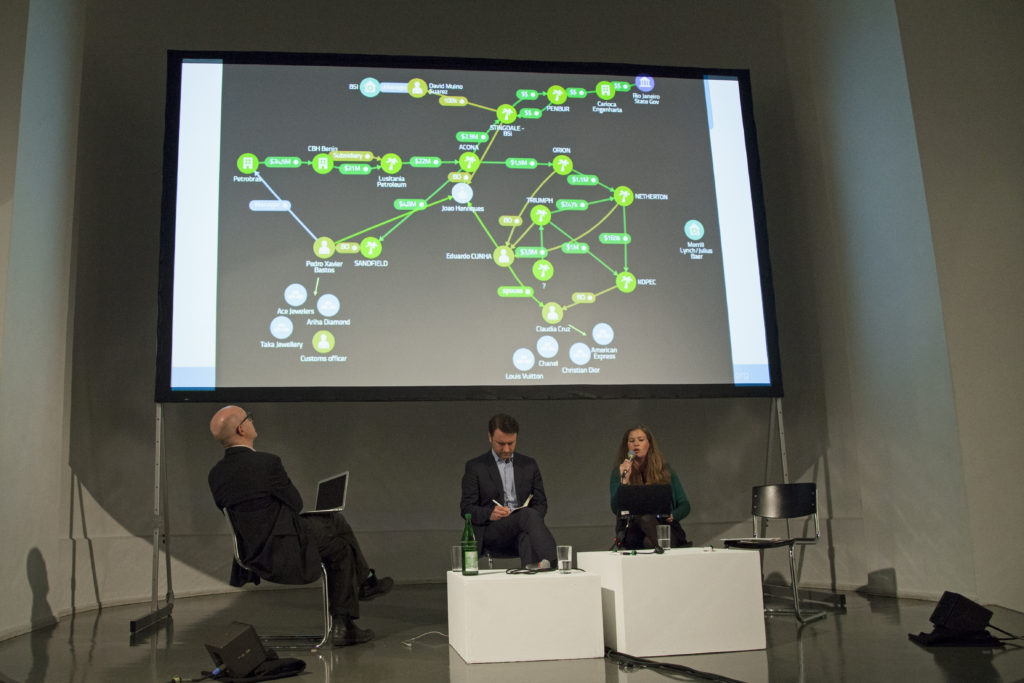
Author and researcher Nicholas Shaxson opened the conference by describing an articulated system that contributes to global inequalities and shifts of wealth from poor to rich. Transparency Internationals Senior Policy Advisor Maìra Martini described the role of banks in cross-border corruption cases, presenting schemes connecting shell companies, multiple offshore bank accounts and money laundering. The panel moderated by Simon Shuster discussed why, despite the global outrage caused by the Papers, the practice of billionaires and corporations stashing their cash in tax havens is still common.
Mossack-Fonseca was indeed just one of the many providers in the off-shore industry of Panama. And Panama is just one of the many tax havens, where complacent governments guarantee international investors that they will neither regulate nor prosecute their conducts, nor share information about their activities.
EU Institutions turn a blind eye to billions of euro’s worth of wealth that disappear not always out of sight of local tax authorities across Europe. The MEPs recently stated that seven member states (Belgium, Cyprus, Hungary, Ireland, Luxembourg, Malta and the Netherlands) “display traits of a tax haven and facilitate aggressive tax planning”. Obviously, tax avoidance is not related just to exotic illegal corporate offshore activities.
The leaks confirmed that several British satellite havens (E.g. Virgin Islands, Cayman, and the Channel Islands) and the City of London are closely linked through commercial and legal ties, with high chances for dark money to flow through the UK’s overseas territories and crown dependencies undetected. As many participants to the conference pointed out, Brexit can just worsen this situation.
The political and economic ramifications of the leeks suggest that such a system is hard to disrupt, since it guarantees the very rich and powerful elite of the world will withhold power. 50% of the wealth held in tax havens belongs to households with more than USD 50 million in net wealth: just ultra-high-net-worth individuals can afford activities in said tax havens as they carry very high fees, although the fees are substantially less than paying taxes owed.
Reporters Ryan Gallagher and Friedrich Lindenberg from the Organized Crime and Corruption Reporting Project (OCCRP) discussed the ethics of massive data leaks, security and secrecy in juxtaposition to openness and transparency, as well as source protection and collective mobilization in the analysis of the material.
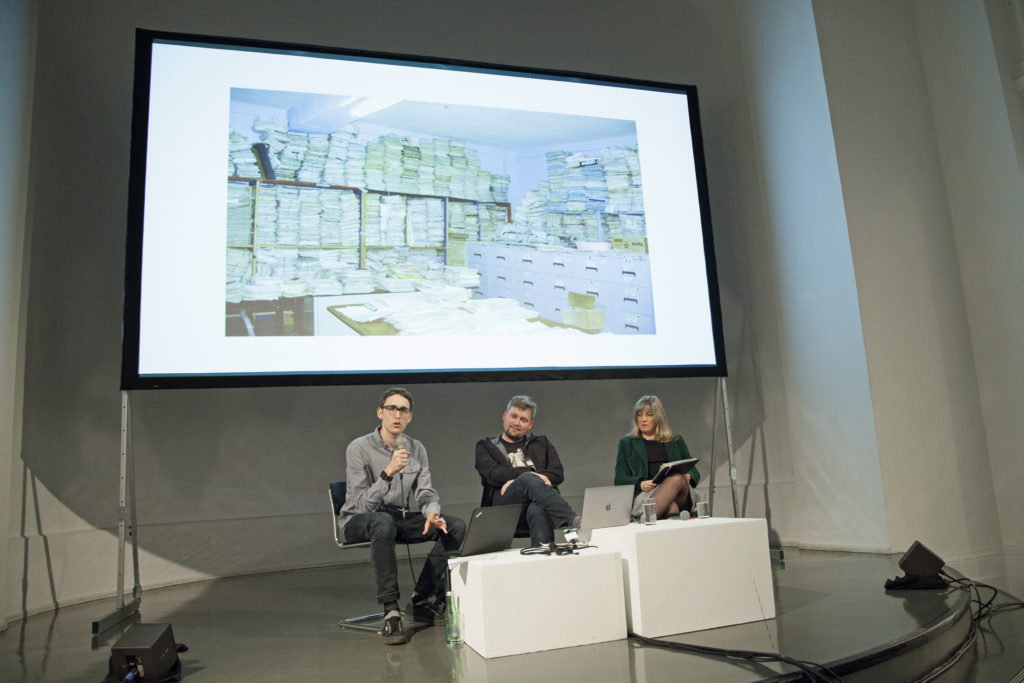
Considering the amount of leaked data (16.8 million financial confidential electronic documents about offshore investments in three years), a collective mobilization is necessary to analyse them all and uncover injustices. By these means people can force companies and privates to end their systematic tax evasion that lies at the heart of the global economic system.
How can we then try to find a road in there? It is important to share information, also creatively, with tools like “The Offshore Tour Operator” a GPS prototype presented during the conference, that guides the walk of the user through the database of the Panama Papers, in search of the physical traces of the offshore banking within the city landscape. A group of twenty people could actually see the tool in action, guided throughout Berlin by two members of RYBN.ORG, the Paris-based collective founded in 1999 that created this project.
Projects and online platforms like this could be part of the solution. They are open to individuals, tax experts and reporters too, not just law enforcement officials and activists and we all shall enhance access and participation.
In 2018, the net wealth of 26 billionaires was the same as the poorest 3.8 billion people of the world (Oxfam). An extreme disparity-rate accelerating year by year, that considers just official capitals and investments, whilst there is a whole universe of dark money stored in tax havens impossible to calculate. The impact of such a private corruption affects public fundamental services like hospitals and schools and is devastating. It’s an inequality comparable to that of Versailles before the French Revolution, as the documentary “Panama Papers,” that had its German Premiere during the Disruption Network Lab conference suggests.
The documentary shows how millions of files were leaked by anonymous whistle-blower John Doe to journalists of the Süddeutsche Zeitung, Frederik Obermaier and Bastian Obermayer, who shared them with the Washington-based International Consortium of Investigative Journalists (ICIJ) and coordinated a worldwide investigation, setting up an incredible enterprise.
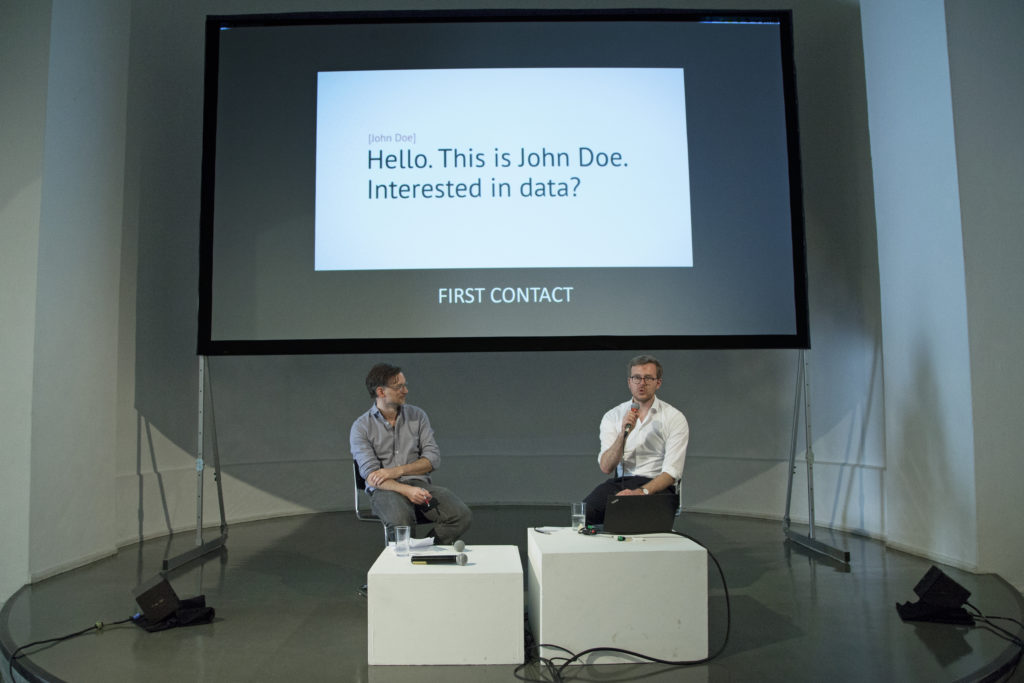
Obermaier described his choice of opening the information to other colleagues as the only possible way of analysing the information, considering that a single person would need 32 years to get through 1.4 Terabyte of leaked data. The efforts of 376 journalists from 76 countries working in secret for two years until the simultaneous publication in April 2016, was awarded with the Pulitzer Prize.
Following the Papers release more than thousands official investigations started and dozens criminal cases have been initiated. Such an activity has brought more than USD 1.2 billion back onshore as governments around the world have recouped money in fines and back taxes (UK 253 million, Germany 150 million). Participation works!
However, whistleblowers and investigative journalists working on tax avoidance and international frauds are criminalised and killed. Obermaier reported that 17% of the countries involved in the Papers has seen backlash against journalists who covered the investigation, instead of offering them effective legal protections.
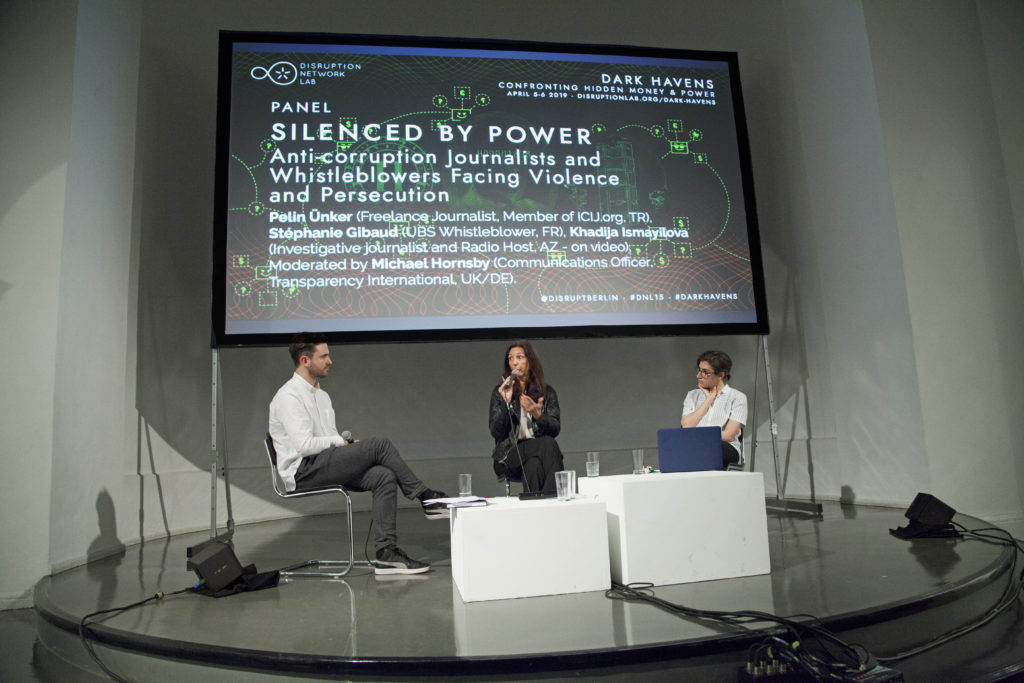
To reverse this trend, the conference focused on the personal impact of investigative journalism and whistleblowing for those who expose offshore corruption and tax havens. The stories of women suffering the consequences of their anti-corruption activities were presented in a panel moderated by Michael Hornsby, communications officer at Transparency International.
The video “Daphne Caruana Galizia. Anti-Corruption Award Winner 2018” directed by David Velduque, opened the discussion with an interview of Paul Caruana Galizia, son of Daphne, talking about the journalist from Malta assassinated in 2017 after she uncovered a thread of hidden connections linking major multinational deals and global money-laundering operations to the heart of Malta’s government.
Exposing injustice caused consequences to the Turkish journalist Pelin Ünker, who – as she narrated – was sentenced to 13 months for writing about the dodgy dealings of the former Turkish prime minister Binali Yildirim and his sons who were found to be stashing cash in a Maltese shell company (Update: one month after the conference, on the 6th of May, Pelin Ünker’s prison sentence was overturned by an appeal court, although she still has to pay a fine).
The experience of Stéphanie Gibaud, a whistleblower from France, who revealed tax evasion and fraud by the investment bank UBS, and Khadija Ismayilova, Azerbaijani investigative journalist and radio host well known for her reports on corruption in Azerbaijan, completed the panel. Due to a a travel ban, this last one could just take part to the Disruption Network Lab-conference with a video, by which she described her case made of trumped up accusations, imprisonment, 3.5 years in probation and a 2-year ban on professional activity. As she narrated, she has been spied and blackmailed by her Government for years, and she is still not free.
The importance of collaborative networks of investigative journalists was something that all those taking part in the conference mentioned. Thanks to organisations like OCCRP, that connects 45 non-profit investigative centers in 34 countries, journalists and activists con work together to turn the tables on corruption and build greater accountability through exposing the abuse of power at the expense of the people.
Transparency could be articulated on open platforms for data sharing and technological tools able to ensure access to relevant information, control and participation, fostering accountability. Documents are still available and the still have a lot to say: a collective mobilization could support the work of investigative journalists and oblige authorities to act.
Estimates report that offshore financial wealth is worth USD 7.6 trillion, the 8% of global household financial wealth (Zucman, 2015) others indicate though that super-rich might hold up to USD 32 trillion in offshore havens, excluding non-financial assets as real estate, gold and other undetectable investments (Henry, 2016). Our economic systems are hostage of these numbers. Banks hold massive amounts of loans in tax-haven-based businesses, a small economic elite makes and escapes rules, undermining democracies via financial deregulations, feeding social injustice.
Financial secrecy is a key facilitator of money laundering, corruption and financial crimes. For too long it’s been clear that corporations simply shift profits to places where taxes are low, whilst ultrawealthy households hide dark money in a handful of tax shelters to avoid paying their fair share. What is then the opportunity connected with the preservation of bank secrecy, considering that it just increases inequalities and violations of human and social rights?
Curated by Tatiana Bazzichelli and developed in cooperation with the Berlin-based International Secretariat of Transparency International, this Disruption Network Lab-conference was the first of the 2019 series “The Art of Exposing Injustice”.
Info about the 15th Disruption Network Lab conference, all its speakers and thematic is available here: https://www.disruptionlab.org/dark-havens
The videos of the conference are on Youtube.
To follow the Disruption Network Lab sign up for its Newsletter and get informed about its conferences, ongoing researches and projects. The next Disruption Network Lab event is planned for June. Make sure you don´t miss it!
The Disruption Network Lab is also on Twitter and Facebook.
Photocredits: Maria Silvano for Disruption Network Lab
Join us in London at the DAOWO ‘Blockchain & Art Knowledge Sharing Summit’
DAOWO (Distributed Autonomous Organisations With Others) Summit UK facilitates cross-sector engagement with leading researchers and key artworld actors to discuss the current state of play and opportunities available for working with blockchain technologies in the arts. Whilst bitcoin continues to be the overarching manifestation of blockchain technology in the public eye, artists and designers have been using the technology to explore new representations of social and cultural economies, and to redesign the art world as we see it today.
Discussion will focus on potential impacts, technical affordances and opportunities for developing new blockchain technologies for fairer, more dynamic and connected cultural ecologies and economies.
Programme
9.00 Registration
9.30 Welcome and Scene Setting
State of the Arts: Blockchain’s Impact in 2019 and Beyond | A comprehensive overview of developments from critical artistic practices and emergent blockchain business models in the arts. DAOWO Arts and Blockchain pdf download (Catlow & Vickers 2019).
Presentation and hosted discussion with Ruth Catlow and Ben Vickers
10.30 Coffee
10.45 Protecting the Rights of Indigenous Australian Artists. What part can Blockchain technologies play?
The Copyright Agency, Australia in conversation with Mark Waugh, DACS UK
11.30 Towards a Decentralised Arts Economy
The launch of Zien, the new dApp for artists will be followed by a presentation and panel discussion with Peter Holsgrove, and artists of A*NA around the implications of tokenising artistic practices.
12.15 Digital Catapult panel
12.45 Wrap up, takeaways and final discussion
Ruth Catlow, Ben Vickers & Mark Waugh
Contributors include:
Ruth Catlow Co-founder of Furtherfield & DECAL Decentralised Arts Lab
Peter Holsgrove, Founder of A*NA
Ben Vickers, CTO Serpentine Galleries, Co-founder unMonastery
Mark Waugh, Business Development Director DACS
Through two UK summits, the DAOWO programme is forging a transnational network of arts and blockchain cooperation between cross-sector stakeholders, ensuring new ecologies for the arts can emerge and thrive.
DAOWO Summit UK is a DECAL Decentralised Arts Lab initiative – co-produced by Furtherfield and Serpentine Galleries in collaboration with the Goethe-Institut London. This event is realised in partnership DACS, UK.
SEE IMAGES FROM THE PRIVATE VIEW
Octavia E Butler had a vision of time as circular, giving meaning to acts of courage and persistence. In the face of social and environmental injustice, setbacks are guaranteed, no gains are made or held without struggle, but societal woes will pass and our time will come again. In this sense, history offers solace, inspiration, and perhaps even a prediction of what to prepare for.
The Time Portals exhibition, at Furtherfield Gallery and online spaces, celebrates the 150th anniversary of Finsbury Park. As one of London’s first ‘People’s Parks’, designed for free movement and thought, it is the perfect location to create a mass investigation of radical pasts and futures, circling back to the start as we move forwards.
Each artwork invites audience participation – either in its creation or in the development of a parallel ‘people’s’ work – turning every idea into a portal to countless more imaginings of past and future urban green spaces and beyond.
Time Portals from Furtherfield on Vimeo.
An interactive wall depicting the urban green space of Finsbury Park as a machine for radical re-assemblage. The external billboard can be scanned with an Augmented Reality app to reveal the secret of realising progressive visions for the future. Scan the message in the Gallery to see the billboard image animated.
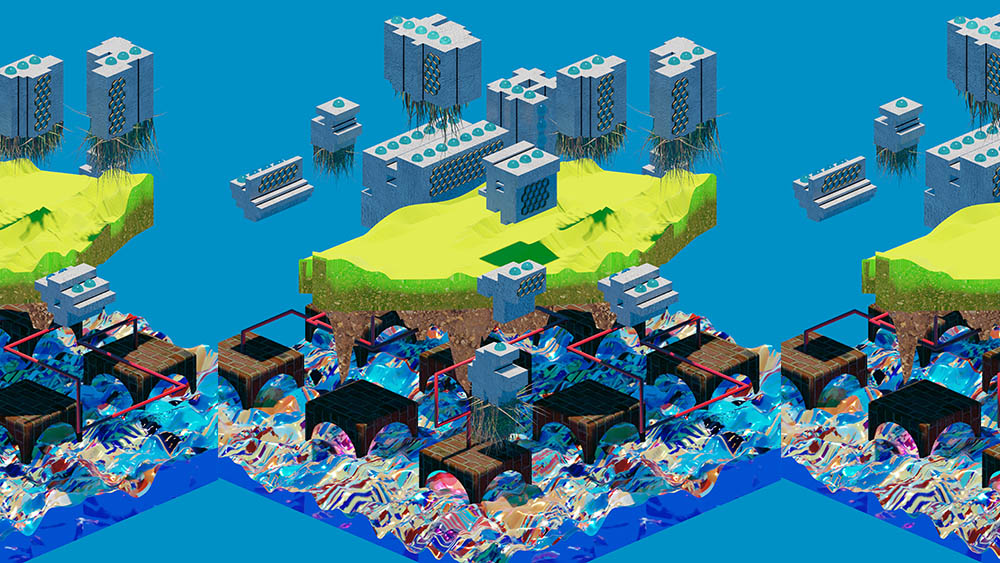
An interactive machine designed and built to respond to environmental change and inspire new rites for our troubled times. A slideshow of the machine as it is imagined and built will be presented alongside a ritualised unveiling in the Autumn.
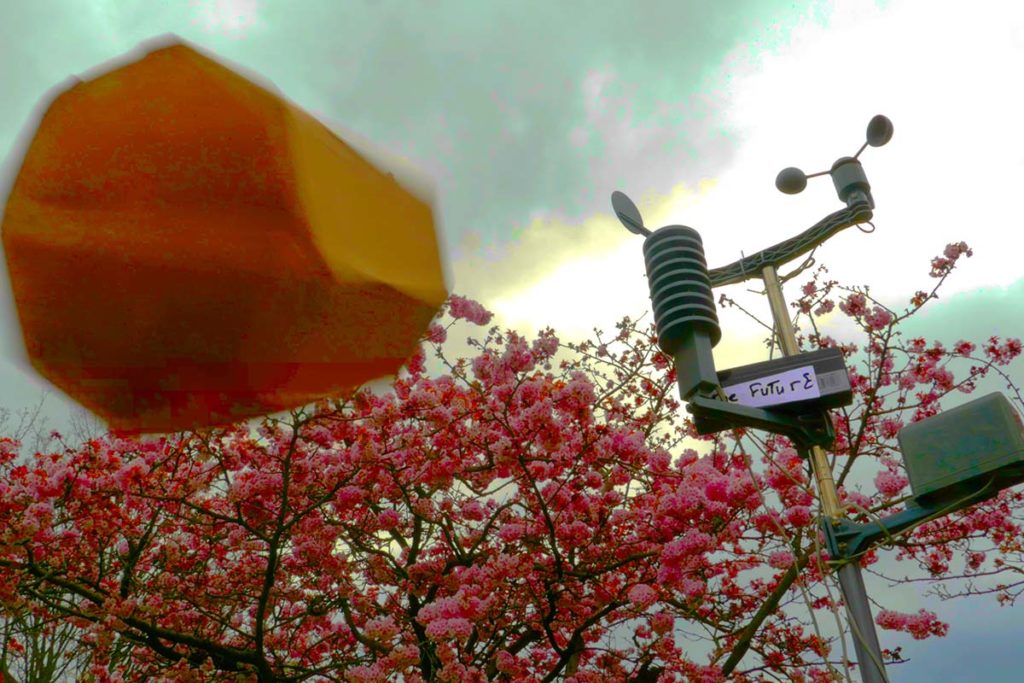
Join the Future Machine design team at Furtherfield Commons in Finsbury Park to build a new artwork that will help us to respond to environmental change…as the future unfolds. Sign up to take part in up to 4 workshops that involve talking, thinking & making, using interactive technology and scientific sensors, helping to design and build the Future Machine itself.
Workshop times/dates and sign-ups:
In collaboration with Amanda Wilson (MARA Project/Imperial College) and Professor Daniel Polani (University of Hertfordshire). Supported by EMAP, Arts Council England, and Haringey Council
An underwater robotic installation which explores what ‘life’ might mean in a future transformed by climate change and artificial intelligence. The work is based on new research into archaea, which are single-celled, ancient microbes that can survive in hot, polluted environments, combined with the latest innovations in machine learning. Now living at Furtherfield Gallery the “ArchaeaBot” is the ‘ultimate’ species for the end of the world as we know it.
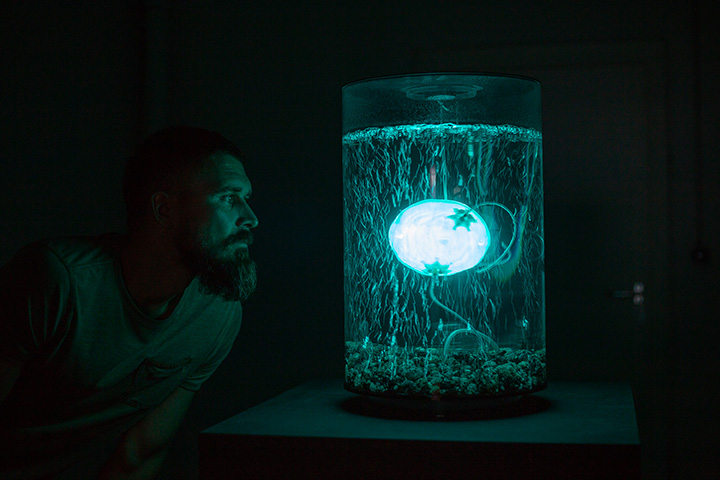
With creative team: Hugo Stanbury, Nick Lambert, Marius Matesan, Carl Smith, James E. Marks, Chris Szkoda
Through in-depth research James revisits a historical black woman who lived in the Finsbury Park area 150 years ago, embodies and reimagines her then and 150 years into the future. Produced together with Ravensbourne University PlayLabZ and Holotronica, experience time travel and holographic mixed reality at the Furtherfield Gallery throughout the summer.
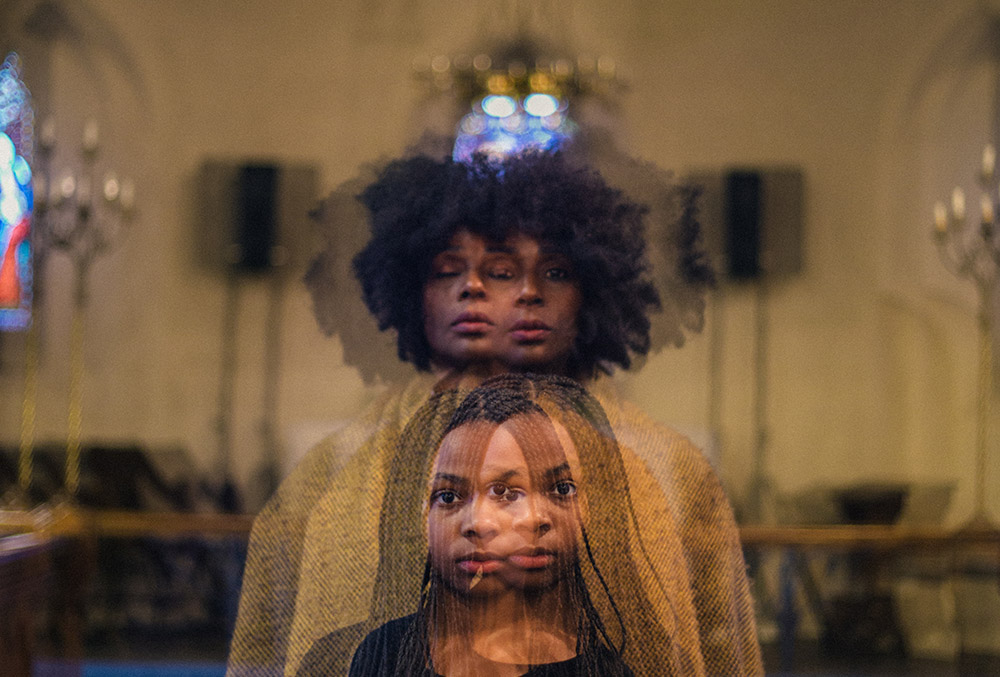
Part 2 of Circle of Blackness will be revealed later in the summer.
This video work is a complete rendition of the 1960s film version of HG Wells Novella re-edited by Thomson & Craighead into alphabetical order from beginning to end. In doing this, the artists attempt to perform a kind of time travel on the movie’s original timeline through the use of a system of classification.
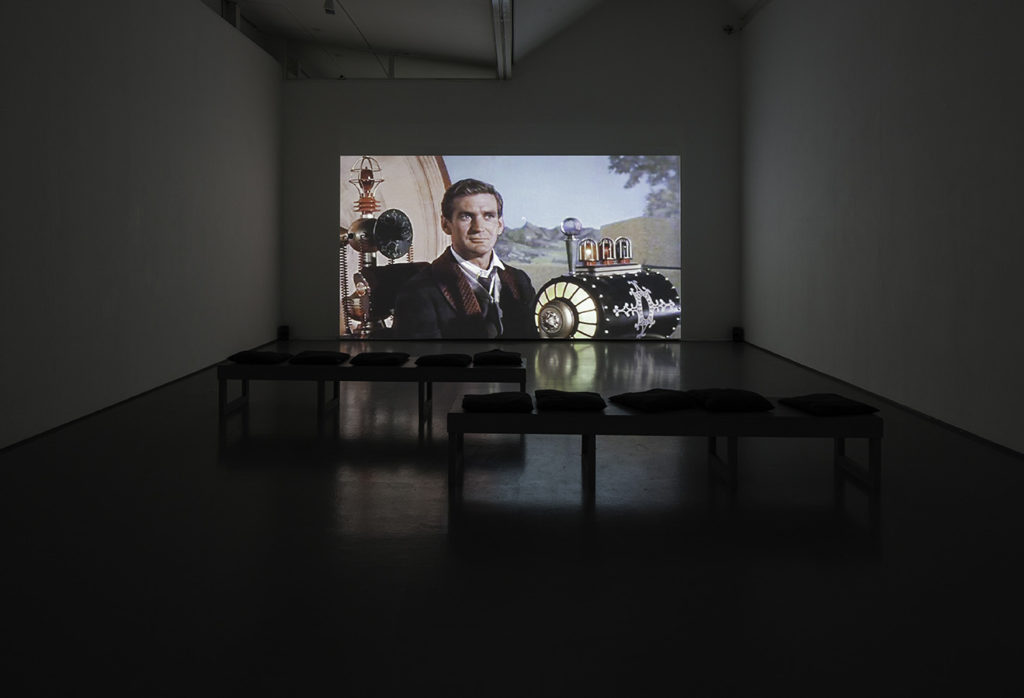
Future Machine Artwork Workshops:
26 Mar, 20 Apr, 11 May, 18 Jun, 13 Jul, Furtherfield Commons
Book Launch Event for Jugaad Time by Amit S. Rai:
27 Apr 14.00-16.00, Furtherfield Commons
Find a Line to Follow and Face The Future! ‘Walkshops’:
5 May 18 May, 10 Aug, Furtherfield Commons
Free, Fair, and Alive! A People’s Park Play Day:
10 Aug 10.00-17.00, Furtherfield Commons
Future of Money Workshops:
10 Aug, 10.00-17.00, Furtherfield Commons, other dates TBC,
Citizen Sci-Fi 3-Day Artworkers Lab Event:
14-15 Sept, time TBC, Furtherfield Commons
Future Machine Procession in Finsbury Park:
12 Oct, 3:00 pm – 8:00 pm, join at any point
This 3-year programme combines citizen science and citizen journalism by crowdsourcing the imagination of local park users and community groups to create new visions and models of stewardship for public, urban green space. By connecting these with international communities of artists, techies and thinkers we are co-curating labs, workshops, exhibitions and Summer Fairs as a way to grow a new breed of shared culture.
#CitSciFi – crowdsourcing creative and technological visions of our communities and public spaces, together.
Anna Dumitriu is a British artist who works with BioArt, sculpture, installation, and digital media to explore our relationship to infectious diseases, synthetic biology and robotics. She has an extensive international exhibition profile including ZKM, Ars Electronica, BOZAR, The Picasso Museum, The V & A Museum, Philadelphia Science Center, MOCA Taipei, LABoral, Art Laboratory Berlin, and The Museum of the History of Science Oxford. She was the 2018 President of the Science and the Arts section of the British Science Association and holds visiting research fellowships at the University of Hertfordshire, Brighton and Sussex Medical School, and Waag Society, as well as artist-in-residence roles with the Modernising Medical Microbiology Project at the University of Oxford, and with the National Collection of Type Cultures at Public Health England. Dumitriu is a renowned speaker and has presented her work at venues including TATE Modern, Princeton University, Imperial College, La Musee de la Chasse et de la Nature, The Mendel Museum and UCLA. Her work is featured in many books including “Bio Art: Altered Realities” published by Thames and Hudson in 2016 and many other significant publications across contemporary art and science including Artforum International Magazine, Leonardo Journal, The Art Newspaper, Art Quarterly, Nature and The Lancet. Dumitriu’s work has a strong focus on the ethical implications of emerging technologies drawing threads across time, exploring future scenarios by reflecting on the past.
Elsa James is a visual artist, activist and producer based in Southend-on-Sea, Essex, who grew up in west London during the 1970s and ’80s. Her solo practice encompasses lens-based performance, language and text, and recently the use of aural and the archive to explore regionality of race; black subjectivity; and the historical, temporal and spatial dimensions of what it means to be black in Britain. She is currently developing work exploring alienation and outsiderness experienced as a black woman living in Essex since 1999. Forgotten Black Essex (2018) embodies two place-specific narratives from our national archives of two overlooked, under-researched and recognised black women in Essex. Her social practice includes advocating for the inclusion of marginalised communities in the arts sector. New Ways of Seeing, Telling and Making (2018), a visual provocation and participatory lab at the Social Art Summit, asked questions about how we can ‘genuinely’ address barriers to participation and involvement in the arts for BAME communities. In 2015 she was commissioned to research the asylum and refugee community in Southend. This culminated in a 38-page report exposing the council’s lack of provision for the needs of asylum seekers, failed asylum seekers and refugees living in Southend.
Rachel Jacobs is an artist, researcher and games designer. She co-founded the artist-led collective Active Ingredient in 1996 and the commercial games company Mudlark Production Company in 2007. She completed a Doctorate in Computer Science in 2014. Rachel is a practising artist exhibiting nationally and internationally, and a Research Associate at the Horizon Digital Economy Institute, University of Nottingham. Her artworks include the award winning ‘Heartlands (Ere Be Dragons)’ one of the first mobile games that took place on city streets in Sao Paulo, Yokhama, Berlin, Paris, Cambridge, Bristol and Nottingham; ‘A Conversation Between Trees’, a touring artwork and schools exchange using environmental sensors to connect forests in the UK and Brazil; and ‘The Prediction Machine’, an interactive installation that predicts the future impacted by climate change. Rachel is currently developing a series of artists interventions ‘Creating Rituals for When The Future Comes’, alongside a mobile interactive artwork the ‘Future Machine’.
Dr Nick Lambert is Director of Research at Ravensbourne University London, where immersive environments and mixed reality experiences are being developed. He researches the application of technology in contemporary art and visual culture. He has written on the history of computer art and engaged with artists and theorists in this field. He has also created artworks for immersive environments including fulldome, and interactive exhibits.
James E. Marks, PsychFi – A natural born new media pioneer, award winning social video, & dimensional computing arts for good maker, curator & speaker. With 4 decades of hands-on experience & experimental knowledge collaborating on Brand / Crowd / Arts Council funded “Sub & Pop Culture Mixed Up Reality Experiences”. Recent collaborations include V&A, London Design Festival, Boomtown Fair, Mobile World Congress, Ravensbourne University, Bethesda, SubPac, Modern Panic, Sci-Fi-London & BBC Click
Marius Matesan is creating narratives using real and virtual installation art, noted mostly for his work on theatre stages across Europe and more recently for his Mixed Reality experiences. Mixing reality with the imaginary, using sound, projection mapping, spatial computing and virtual reality. His work revolves around pushing the boundaries of perception, awareness and reality, creating installations that are often addressing social issues with a psychedelic twist.
Alex May is a British artist creating digital technologies to challenge and augment physical and emotional human boundaries on a personal and societal level in a hyper-connected, software mediated, politically and environmentally unstable world. He works with light, code, and time; notably algorithmic photography, robotic artworks, video projection mapping installations, interactive and generative works, video sculpture, performance, and video art. Alex has exhibited internationally including at the Francis Crick Institute (permanent collection), Eden Project (permanent collection), Tate Modern, Ars Electronica (Austria), LABoral (Spain), the Victoria & Albert Museum, Royal Academy of Art, Wellcome Collection, Science Museum, Bletchley Park, One Canada Square in Canary Wharf, the Museum of Contemporary Art in Caracas (Venezuela), the Science Gallery in Dublin, Princeton University, University of Calgary (international visiting artist 2016), Texas A&M University, and the Beall Center for Art + Technology, University of California, Irvine. Alex is a Visiting Research Fellow: Artist in Residence with the School of Computer Science of University of Hertfordshire, and a Digital Media Arts MA sessional lecturer at the University of Brighton.
http://www.alexmayarts.co.uk
Antonio Roberts is a new media artist and curator based in Birmingham, UK. He uses technology-driven processes to explore issues surrounding open source software, free culture and collaborative practices. His visual and performance work has been featured at galleries and festivals including databit.me in Arles, France (2012), Glitch Moment/ums at Furtherfield Gallery, London (2013), Loud Tate: Code at Tate Britain (2014), glitChicago at the Ukrainian Institute of Modern Art in Chicago, US (2014), Permission Taken at Birmingham Open Media and University of Birmingham (2015-2016), Common Property at Jerwood Visual Arts, London (2016), Green Man Festival, Wales (2017) and Barbican, London (2018). He has curated exhibitions and projects including GLI.TC/H Birmingham (2011), the Birmingham editions of Bring Your Own Beamer (2012, 2013), µChip 3 (2015), Stealth (2015), and No Copyright Infringement Intended (2017).
Carl H Smith is Director of the Learning Technology Research Centre (LTRC) and Principal Research Fellow at Ravensbourne University London. His background is in Computer Science and Architecture. He has 17 years experience conducting R+D into the application of hybrid technologies for perceptual, cognitive and creative transformation. He has worked on a number of large-scale FP7 and Leonardo Life Long Learning European projects. He is currently working on 4 EU projects including the Horizon 2020 project ‘[WEKIT] Wearable Experience for Knowledge Intensive Training’ which aims to create ‘Wearable Experience (WE)’ – an entirely new form of media. His research interests include Embodied Cognition, Spatial Literacy, Perceptual Technology and Hyperhumanism. His other projects involve Context Engineering, Umwelt Hacking, Natural Media, Sensory Augmentation, Memory Palaces, Artificial Senses and Body Hacking. He is co-founder of the London Experimental Psychonautics Club and co-founder of the Cyberdelic Society. Both organisations explore the myriad of ways it is possible to produce and examine Altered States of Consciousness. He has previously worked at the Computing departments at London Metropolitan University, Glasgow University and Sheffield University. The Learning Technology Research Centre (LTRC) conducts design research into the application of information and communication technologies to augment, support and transform cognition.
Hugo Stanbury has worked in the event and entertainment industry for over a decade. Inspired most by the area where cutting edge technology is used for properties rather than purpose, he works hard to balance sound technical delivery with new creative concept. He currently works as Operations Director at Holotronica – the UK company behind Hologauze. Hologauze is the world leading gauze for holographic effects with clients from BMW to Beyonce. Holotronica are specialists in a range of holographic displays, analogue holography and 3D content.
Studio Hyte is a London based multidisciplinary design studio who place research and concept above medium. Working between graphic design, interaction and emergent forms of visual communication, we aim to create meaningful and thought provoking work. Formed of a small group of individual practitioners, Studio Hyte is the middle ground where all of our interests and practices meet. As such our collective practice and research covers a broad spectrum of topics including; language, inclusion & accessibility, egalitarian politics & alternative protest and technology & the human. With an emphasis on process, we often create critical narratives through our work in order to conceptualise through making. Collectively, our visual practice is a means through which we can plot out a conceptual landscape in order to understand and explore real-world scenarios. Studio Hyte works on self-directed research projects, commissions and client-led projects for a small pool of like minded organisations and individuals.
Chris Szkoda, Kaws Infinity – Games Designer/ VFX Artist, works on designing mixed/virtual reality apps for a social mixed reality experience playground at Ravensbourne University London. Keen to support social good & diversity projects, working directly with students and helping them make their creative ideas a reality. He has expertise in immersive technology, VR modelling and painting in Google Tilt Brush and MasterpieceVR software.
Jon Thomson (b. 1969) and Alison Craighead (b. 1971) are artists living and working in London. They make artworks and installations for galleries and specific sites including online spaces. Much of their recent work looks at live networks like the web and how they are changing the way we all understand the world around us. Having both studied at Duncan of Jordanstone College of Art in Dundee, Jon is Reader in Fine Art at The Slade School of Fine Art, University College London, while Alison is a reader in contemporary art and visual culture at University of Westminster and lectures in Fine Art at Goldsmiths University.
http://www.thomson-craighead.net/
Artists Idit Nathan and Helen Stratford are working with Furtherfield to create PLAY THEN NOW OR NEVER! a new playful App and map for Finsbury Park, and inviting you to help in the process.
Book now to join the artists to explore opportunities for free and creative play in Finsbury park. Walk, play and think in past, present and future spaces, in a ‘walkshop’ devised by the artists. Dice will roll, cards will solicit and props will inspire. The walkshops will inform the creation of playful prompts for PLAY THEN NOW OR NEVER! Finsbury Park’s newest and most playful digital mobile App, with its own map, that will reimagine the park and act as provocations for future park users.
Location:
Furtherfield Commons
269-271 Seven Sisters Road
Finsbury Park
N4 2DE
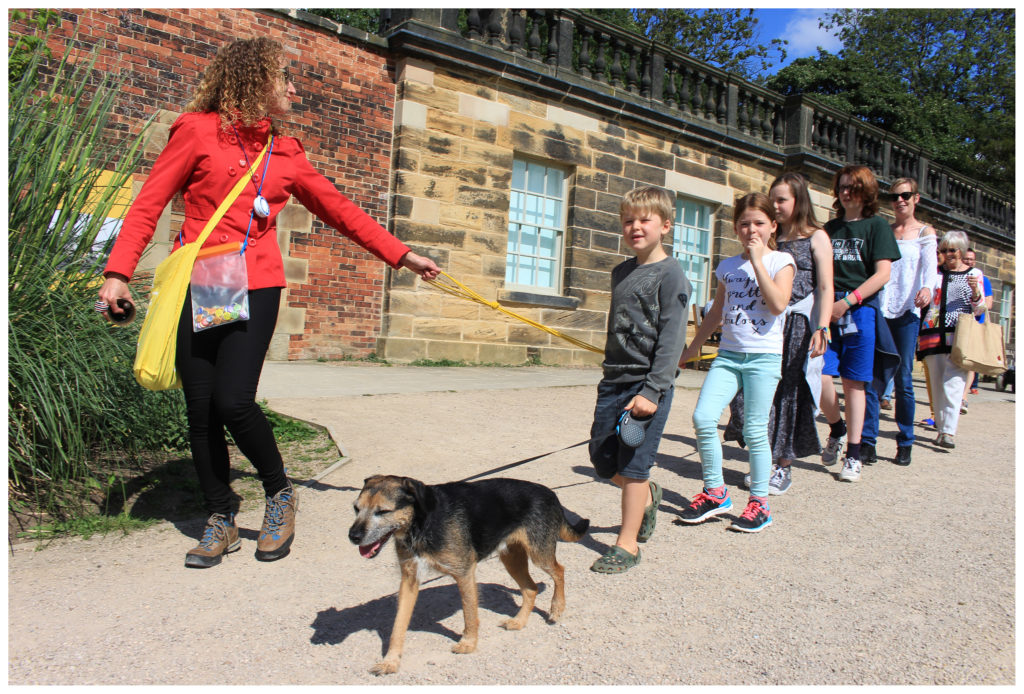
The walkshops are designed to bring together people of all ages and abilities – everyone is welcome! The group will journey through the park for approximately an hour then regroup at Furtherfield Commons for a recall and share session where refreshments will be provided.
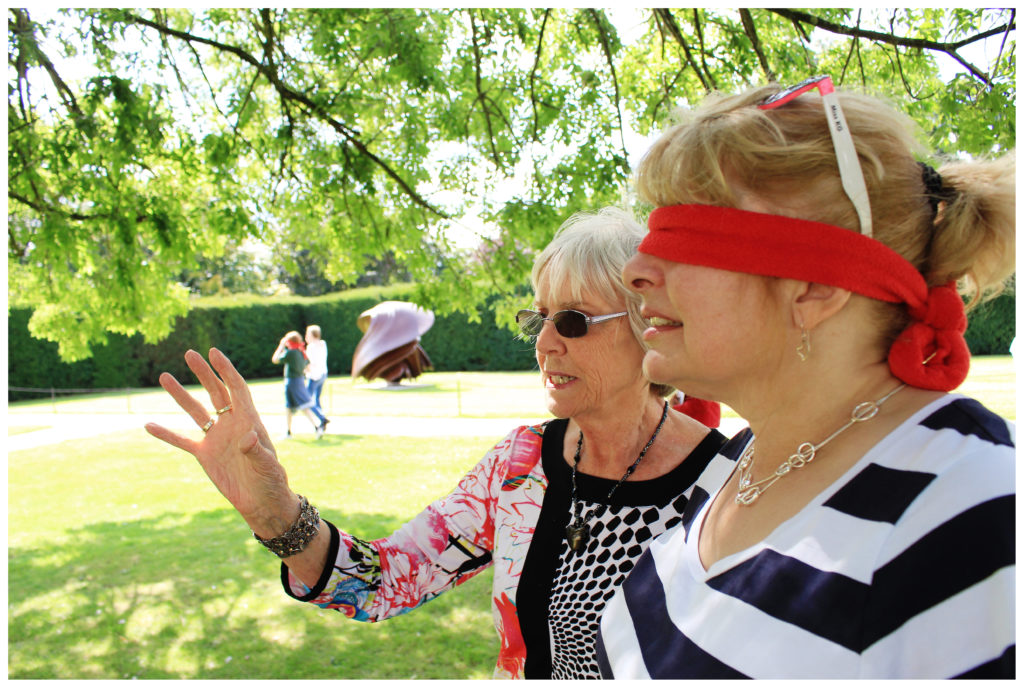
PLAY THEN NOW OR NEVER! is devised by artists Idit Nathan and Helen Stratford (Play Anywhere Now or Never!) who see play as a sophisticated yet highly accessible way to investigate ‘big’ and complex issues that relate to the way we move in and experience the world around us. Their work takes the form of site specific interventions that question and re-imagine these through the prism of play. To find out more about their work see their website.
PLAY THEN NOW OR NEVER is part of Furtherfield’s 2019 programme: Time Portals.
This 3-year programme supports our Platforming Finsbury Park initiative. Between 2019-2021 we will produce exhibitions and events that combine citizen science and citizen journalism by crowdsourcing the imagination of local park users and community groups to create new visions and models of stewardship for public, urban green space. By connecting these with international communities of artists, techies and thinkers we are co-curating labs, workshops, exhibitions and Summer Fairs as a way to grow a new breed of shared culture.
#CitSciFi – crowdsourcing creative and technological visions of our communities and public spaces, together.
The Time Portals exhibition, held at Furtherfield Gallery (and across our online spaces), celebrates the 150th anniversary of the creation of Finsbury Park. As one of London’s first ‘People’s Parks’, designed to give everyone and anyone a space for free movement and thought, we regard it as the perfect location from which to create a mass investigation of radical pasts and futures, circling back to the start as we move forwards.
Each artwork in the exhibition therefore invites audience participation – either in its creation or in the development of a parallel ‘people’s’ work – turning every idea into a portal to countless more imaginings of the past and future of urban green spaces and beyond.
For this Olympic year we will consider the health and wellbeing of humans and machines.
For this year of predicted peak heat rises we will consider how machines can work with nature.
Buy Now and use code: CSF19ASRA for a 30% discount
In India, the practice of jugaad—finding workarounds or everyday, usually non-technical hacks to solve problems—emerged out of subaltern strategies of negotiating poverty, discrimination, and violence. Yet it is now celebrated in management literature as ‘disruptive innovation’. In this book Rai considers how these time-efficiencies always exceed their role in neoliberal and authoritarian postcolonial economies and are put into motion by subaltern practitioners themselves.
On Sat 27 Apr from 14.00-16.00 Rai will introduce this important work to guests followed by a Q and A session with Furtherfield Co-Founding Director, Marc Garrett – with plenty for time for discussion.
This event is hosted at Furtherfield Commons in Finsbury Park* and has been supported by the Borderlines Research Group in Creative Economies and Postcolonial Intersectionality at Queen Mary, University of London.
“This original and innovative work will enable a new and perhaps paradigm-shattering interpretation of the coimplication of digital assemblages, temporality, and affect. Drawing on a rich ethnographic archive, Amit S. Rai is deeply sensitive to how gender, class, and caste are implicated in emergent techno-perceptual assemblages. His invaluable book is also an effective antidote to the Eurocentricity of digital media studies.” — Purnima Mankekar, author of Unsettling India: Affect, Temporality, Transnationality
“Jugaad Time is an important intervention into cartographies of postdigital media cultures. By drawing on the specificity of South Asian cultures, it enriches our understanding of the heterogeneity of these processes. The postcolonial study of media technologies is a vibrant and crucial field of inquiry; Amit S. Rai’s outstanding work is an essential contribution to global approaches to new media scholarship.” — Tiziana Terranova, author of Network Culture: Politics for the Information Age
The event form parts of Furtherfield’s 2019 programme Time Portals.
Octavia E Butler had a vision of time as circular, giving meaning to acts of courage and persistence. In the face of social and environmental injustice, setbacks are guaranteed, no gains are made or held without struggle, but societal woes will pass and our time will come and again. In this sense, history offers solace, inspiration, and perhaps even a prediction of what to prepare for.
The Time Portals exhibition, held at Furtherfield Gallery (and across our online spaces), celebrates the 150th anniversary of the creation of Finsbury Park. As one of London’s first ‘People’s Parks’, designed to give everyone and anyone a space for free movement and thought, we regard it as the perfect location from which to create a mass investigation of radical pasts and futures, circling back to the start as we move forwards.
Each artwork in the exhibition therefore invites audience participation – either in it’s creation or in the development of a parallel ‘people’s’ work – turning every idea into a portal to countless more thoughts and visions of the past and future of urban green spaces and beyond.
*Please not this is a separate building to our Gallery and is at the Finsbury Park station entrance to the Park.
Artist Rachel Jacobs is working in partnership with Furtherfield to build a Future Machine in Finsbury Park and you are invited to help build it.
Location:
Furtherfield Commons
269-271 Seven Sisters Road
Finsbury Park
N4 2DE
Sign up to take part in four workshops that will involve thinking about the future (in response to environmental change) and helping to design and build the Future Machine, towards an unveiling at Furtherfield Gallery this Autumn and tour of England in 2019/2020.
The workshops are designed to bring together people with ALL views on environmental change – denier, worrier, eco-warrior, confused, conspiracy theorist, lover of trees – everyone is welcome! The workshops will involve talking, thinking, making things with all kinds of arts and craft materials, as well as using interactive technology and scientific sensors. You are welcome to sign up to one or all of the workshops, you don’t need to attend them all to take part.
Furtherfield Commons is a wheelchair accessible venue. Please email the artist at: promises@thepredictionmachine.org if you want to discuss any accessibility requirements.
Workshop times/dates:
Book now!
Refreshments will be provided
The Future Machine sits on a hand cart ready for the journey, travels the country and plugs into a greater whole of many parts. It stands as a witness to the places, people, stories and events of these turbulent times, as the Earth changes, and we take a journey into an uncertain future.
The Future Machine is a new artwork, a large interactive machine, built to help us to respond to environmental change as the future unfolds. The machine will record people’s visions of the future, make predictions, facilitate new rituals and helps us to make decisions about the future we want, not one we fear.
The artwork will be created in collaboration with a team of engineers, programmers, climate scientists from the British Antarctic Survey, researchers from the University of Nottingham, and participants in a series of artist-led workshops, scheduled to take place in London and Nottingham in 2019.
The Future Machine will be built by YOU over the coming months and unveiled in an Autumn ritual – details to follow
The Future Machine is part of Furtherfield’s 2019 programme: Time Portals.
Editors present: Yiannis Colakides, Marc Garrett, Inte Gloerich
State Machines: Reflections and Actions at the Edge of Digital Citizenship, Finance, and Art
Today, we live in a world where every time we turn on our smartphones, we are inextricably tied by data, laws and flowing bytes to different countries. A world in which personal expressions are framed and mediated by digital platforms, and where new kinds of currencies, financial exchange and even labor bypass corporations and governments. Simultaneously, the same technologies increase governmental powers of surveillance, allow corporations to extract ever more complex working arrangements and do little to slow the construction of actual walls along actual borders. On the one hand, the agency of individuals and groups is starting to approach that of nation states; on the other, our mobility and hard-won rights are under threat. What tools do we need to understand this world, and how can art assist in envisioning and enacting other possible futures?
This publication investigates the new relationships between states, citizens and the stateless made possible by emerging technologies. It is the result of a two-year EU-funded collaboration between Aksioma (SI), Drugo More (HR), Furtherfield (UK), Institute of Network Cultures (NL), NeMe (CY), and a diverse range of artists, curators, theorists and audiences. State Machines insists on the need for new forms of expression and new artistic practices to address the most urgent questions of our time, and seeks to educate and empower the digital subjects of today to become active, engaged, and effective digital citizens of tomorrow.
James Bridle, Max Dovey, Marc Garrett, Valeria Graziano, Max Haiven, Lynn Hershman Leeson, Francis Hunger, Helen Kaplinsky, Marcell Mars, Tomislav Medak, Rhea Myers, Emily van der Nagel, Rachel O’Dwyer, Lídia Pereira, Rebecca L. Stein, Cassie Thornton, Paul Vanouse, Patricia de Vries, Krystian Woznicki.
Join editors Yiannis Colakides, Marc Garrett, Inte Gloerich, contributors Max Dovey and Helen Kaplinsky, and respondent Ruth Catlow on Tue 23 Apr from 18.00-20.30 for short presentations with plenty for time for discussion.
This event is hosted at Furtherfield Commons in Finsbury Park*
*Please note this is a separate building to our Gallery and is at the Finsbury Park station entrance to the Park.
Furtherfield has worked with decentralised arts and technology practices since 1996 inspired by free and open source cultures, and before the great centralisation of the web.
Visit DECAL website
10 years ago, blockchain technologies blew apart the idea of money and value as resources to be determined from the centre. This came with a promise, yet to be realised, to empower self-organised collectives of people through more distributed forms of governance and infrastructure. Now the distributed web movement is focusing on peer-to-peer connectivity and coordination with the aim of freeing us from the great commercial behemoths of the web.
There is an awkward relationship between the felt value of the arts to the majority and the financial value of arts to a minority. The arts garner great wealth, while it is harder than ever to sustain arts practice in even the world’s richest cities.
In 2015 we launched the Art Data Money programme of labs, exhibitions and debates to explore how blockchain technologies and new uses of data might enable a new commons for the arts in the age of networks. This was followed by a range of critical art and blockchain research programming:
Building on this and our award winning DAOWO lab and summit series, we have developed DECAL – our Decentralised Arts Lab and research hub.
Working with leading visionary artists and thinkers, DECAL opens up new channels between artworld stakeholders, blockchain and web3.0 businesses. Through the lab we will mobilise research and development by leading artists, using blockchain and web 3.0 technologies to experiment in transnational cooperative infrastructures, decentralised artforms and practices, and improved systems literacy for arts and technology spaces. Our goal is to develop fairer, more dynamic and connected cultural ecologies and economies.
For more see our Art and Blockchain resource page.
This year’s festival of “Mine, yours, ours”(Moje, tvoje, naše) puts emphasis on people who are behind the work performance of machines, literally as well as metaphorically, and without whom the machines cannot perform their work.
Automatization, computerization, robotization, mechanization. Recent studies point out that by 2030 as many as 800 million workers throughout the world will lose their jobs to robots. Predictions that already in six years time robots with artificial intelligence will have replaced more than half of the human workforce, and thereby leave 75 million people unemployed, and that the number of robots that perform work of which humans are capable would double from the current 29%, have flooded web portals.
Questioning the status of work conditioned by the relation between man and machines, and observed from the perspective of contemporary artists, was chosen as the theme of the festival “Mine, yours, ours” carried out by Drugo More, held from the 14th to the 16th of February at the building of Filodrammatica in Rijeka. The international festival “Mine, yours, ours” has for fourteen years in a row by the means of art questioned the topics related to the exchange of goods and knowledge, an exchange that today is conditioned by capital and consequently bereft of all the aspects of a gift economy. Exchange via gifts has been replaced by mechanical work whereby the worker is distanced from the very purpose of the work and thereby doomed to a feeling of purposelessness, while the final product and service remain dehumanized. In a world that is mongering fear about robots taking over human jobs, the curator of the exhibition and moderator of the symposium, Silvio Lorusso, decided to give a new perspective on the topic putting emphasis on the people behind the work of the machines, literally and metaphorically, without whom the machines cannot – work.
Like robots that perform work mechanically and lacking intrinsic motivation, people play the roles of robots through various forms of work. The sequence of actions that we observe on the internet are attributed to the work of machines, ignorant of the fact that human work, hidden on purpose, is behind all the exposed data. A human, according to research by artist Sebastian Schmieg, writes the descriptions of the photos that we find on the internet and we are deceiving ourselves thinking that the descriptions are the product of an automatized system. A group of crowd workers creates the database for recognition of pictures, while the neural network of artificial intelligence is shaped with the help of manual work by a collective of people who choose what the machines will see, and what is to remain unrecognized. The role of human work is crucial to the processes that enable self-driving cars. Researcher and designer Florian Alexander-Schmidt explained how the detailed localization of an object is possible exclusively due to a human workforce, not robots. Digital platforms tend to locate vehicles at a precision rate of 99% and this cannot be achieved by an algorithmic system. Alexander-Schmidt points out that the cheapest workers are employed at servicing the digital platforms, such as those from Venezuela, whose work is hidden behind the magical acronym “AI”.
Artificial intelligence operates thanks to the strength and precision of human intelligence, and workers are the slaves of a system that functions like a computer game, demanding that employees score more and thereby perpetuate a game in which, no matter how high they score, they lose. They lose because a cheap labor force, qualified via automatized training, secretly performs the work that consumers consider a product of automatization, and they remain at insecure workplaces whose existence persists due to risky capital and results in constant change of workplaces – virtual migrations. The market of the internet diminishes the global geography of honorary work, while humans play machines performing jobs exclusively for a salary, turning into an invisible, undefined (robotized) mass employed at unstable workplaces and conditioned by risky capital.
The work performed by humans is considered a product of the work of machines, while machines are often replaced by humans. Entering a relationship, developing a sense of connection, characteristic for the human species, is becoming one of the fields in which robots are developing. Chatrooms and platforms for looking for a partner more and more often include programmed robot profiles that engage in communication and emotional bonding with those who sign up, as reported by the artist Elisa Giardina Papa. Robots replace humans, but this change of identity isn’t recognized by the other human – instead, they see a potential partner. In that sense we can speak about a justified presentiment not only of a loss of workplaces and the current modus operandi of the labor market, but of changes in the way emotional relationships are built as well.
Changes in the development of artificial intelligence (AI), virtual reality (VR), robotics, quantum computers, the internet of things (IoT), 3D printing, nanotechnology, biotechnology and the car industry improve some aspects of human life, but place humanity before social, economic and geopolitical challenges. Sustainability of the internet is entirely dependent on humans since the spare time that humans are ready to use for posting content conditions the survival of web portals, video and music channels and social networks. Giardina Papa explained how the spare time of humans has become the time of unpaid work for the internet. Activities that spare time offers – relaxing, self-realization, healthy spontaneous sleep, have been replaced with the production of content for others and posting it on the internet. Creativity, productivity, self-realization are falling into oblivion. Creative work has been replaced by plain performance and we identify more and more often with the byword which the artist Giardina Papa brought up as an example and are becoming “doers, not dreamers”.
Such an approach to life and work affects everybody, and is consciously looked on as a problem by artists in their attempts at a good-quality creative life. The average artists spend their days trapped doing jobs of stocking up shelves in stores, taking in orders, working for telecommunications operators and only at night devote themselves to acting, dancing, painting. Constant financial instability, insecure and temporary jobs, low income, unregistered work and an absence of pension are the conditions of life that the contemporary artist faces. A few European countries are an exception from this. Denmark awards 275 artists an annual scholarship that amounts to between 15000 and 149000 Danish krones. France made sure that every region secures a certain amount of financial support for artists and therefore in for example the region of Ile-de-France are recipients of up to 7628,47 euros for the organization of their workshops. Unfortunately, in most countries artists without rich parents or benefactors can only survive by performing daily work. While spare time is subordinate to work, work is becoming more and more precarious, per hour, without contracts, while full day work time is becoming the lifestyle of the millenium. A way of life where spare time is spent working, subordinated to a mechanical execution of tasks that don’t foster the self-development of the worker, makes man function in a way characteristic of machines.
The individual aspect exposes it’s intimacy in front of a collective audience and thereby diminishes it’s own independence. Simultaneously, via the intrusion of the private into the public, the collective character of the public now becomes more individualized, more personal and strives to be unique. Faced with changes artists are trying out new ways of expressing themselves as a means of enjoying their work. The joy in their work and their artworks stems from the recognition that their activities are actually creative and not plain performance, that is, mass-producing content for others and suitable to others, and such an approach seldom comes to anyone’s (robotized/artistic) mind anymore. Artists are the ones who in times of computerization of work tend to enjoy their work and work in a way to develop oneself.
We are witnessing processes where work is developing via control of people (crowdsourcing), it is transforming and making people similar to machines, and machines to people and making people’s work the work of machines and vice versa. Man is faced with new challenges at the workplace, and with the focus on securing existential necessities as well as necessities conditioned by the contemporary approach to existence, there is no spare time to devote to questioning the position to which he brought himself to. Artists, equally affected by the changes, succumb to them, but also analyze them, deautomatize them and actively do research on them. The international guests to the festival “Mine, yours, ours” have through their works pulled back the curtain to make the supposedly automatized work transparent for people to see that a well hidden group of humans is behind this work. While explaining the results of their research, preceding the artistic exhibition, at a two-day symposium, they gave the public new perspectives on the theme, but also further corroborated the existing view. Where does the robot begin and where does man end and who or what is to whom or to what a robot, and who or what to whom or to what a human are the questions that, concerning the labor market, pave the way for – a new set of sub-questions.
Jelena Uher
In 2019 we celebrate the 150th anniversary of Finsbury Park, and we time travel through its past and future with the launch of our Citizen Sci-fi programme and methodology. Dominant sci-fi franchises of our time, from Black Mirror to Westworld, have captured popular attention by showing us their apocalyptic visions of futures made desperate by systems of dominance and despair.
What is African-American author, Octavia E. Butler’s prescription for despair? Sci-fi and persistence. Sci-fi as a tool for getting us off the beaten-track and onto more fertile ground, and persistent striving for more just societies.The 2015 book Octavia’s Brood honoured her work, with an anthology of sci-fi writings from US social justice movements and this inspired us to try a new artistic response to the histories and possible futures of Finsbury Park.
Furtherfield’s Citizen Sci-Fi methodology combines citizen science and citizen journalism by crowdsourcing the imagination of local park users and community groups to create new visions and models of stewardship for public, urban green space. By connecting these with international communities of artists, techies and thinkers we are co-curating labs, workshops, exhibitions and Summer Fairs as a way to grow a new breed of shared culture.
Each artwork in the forthcoming exhibition invites audience participation – either in it’s creation or in the development of a parallel ‘people’s’ work – turning every idea into a portal to countless more thoughts and visions of the past and future of urban green spaces and beyond.
So where do we start? Last year we invited artists, academics and technologists to join us in forming a rebel alliance to fight for our futures across territories of political, cultural and environmental injustice. This year both our editorial and our exhibition programme are inspired by this alliance and the discoveries we are making together.
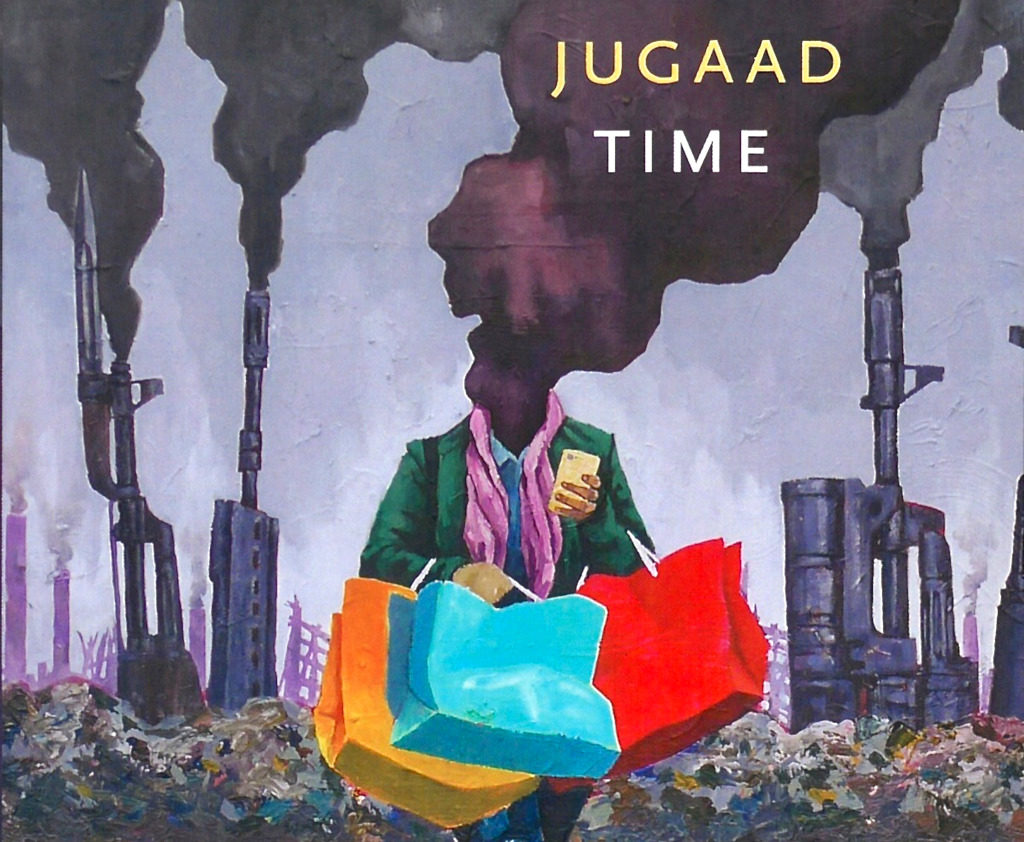
To kick off this year’s Time Portals programme at Furtherfield, in April we will host the launch and discussion around Jugaad Time, Amit Rai’s forthcoming book. This reflects on the postcolonial politics of what in India is called ‘jugaad’, or ‘work around’ and its disruption of the neoliberal capture of this subaltern practice as ‘frugal innovation’. Paul March-Russell’s essay Sci-Fi and Social Justice: An Overview delves into the radical roots and implications of Mary Shelley’s Frankenstein (1818). This is a topic close to our hearts given our own recent exhibitions Monsters of the Machine and Children of Prometheus, inspired by the same book. Meanwhile we’ve been hosting workshops with local residents exploring our visions for Finsbury Park 150 years into the future. To get a flavour of these activities Matt Watkins’ has produced an account of his experience of the Futurescapes workshop at Furtherfield Commons in December 2018.
In May we will open the Time Portals exhibition which features several new commissions. These include Circle of Blackness by Elsa James. Through local historical research James will devise a composite character to embody the story of a black woman from the locality 150 years ago and 150 years in the future. James will perform a monologue that will be recorded and produced by hybrid reality technologist Carl Smith and broadcast as a hologram inside the Furtherfield Gallery throughout the summer. While Futures Machine by Rachel Jacobs is an Interactive machine designed and built through public workshops to respond to environmental change – recording the past and making predictions for the future while inspiring new rituals for our troubled times. Once built, the machine occupies Furtherfield Gallery, inviting visitors to play with it.
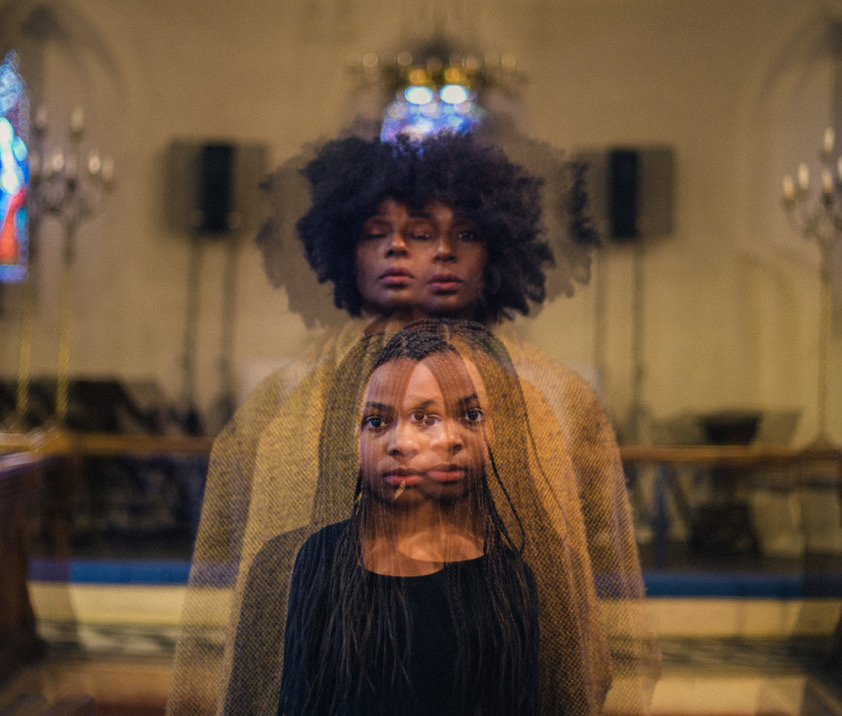
Time Portals opens on May 9th (2019) with other time traveling works by Thomson and Craighead, Anna Dumitriu and Alex May, Antonio Roberts and Studio Hyte. Visitors will be invited to participate in an act of radical imagination, responding with images, texts and actions that engage circular time, long time, linear time and lateral time in space towards a collective vision of Finsbury Park in 2169.
From April onwards, a world of activities, workshops with local families and their enriching noises, reviews, interviews and an array of experiences will unfold. Together we dismiss the dystopian nightmares and invite communities to join us in one of London’s first “People’s Parks” to revisit and recreate the future on our own terms together.
Marc Garrett will be interviewing Elsa James, about her artwork Circle of Blackness, and Amit Rai about his book Jugaad Time. Both will soon be featured on the Furtherfield web site.
On a blustery cold and wet Sunday in the build up to Christmas I joined a group of people at Furtherfield Commons to discuss the future of Finsbury Park. I finally arrived after prowling around their darkened Gallery in the centre of the park, only to discover the event was being hosted in their other space in the far southeastern corner of the park. This brief detour gave me a moment to breathe in one of my local parks and I experienced a familiar feeling of vulnerability as the night drew in and cold drops of rain started to make themselves felt. The few brave families and exercisers were beginning to retreat as I crossed the open stretch of field that runs parallel to the roaring Seven Sisters Road. Drawn by the welcoming light coming from the building in the small gardens behind the legendary Rowans Ten Pin Bowling and guided by the sound of the drumming, a regular feature of this corner of the park, I entered the workshop and was greeted with mince pies, tea and other goodies, and met the 11 other workshop participants.
Timed to coincide with the 150th anniversary of Finsbury Park, this workshop for local residents, aimed to tap into our experiences and imaginations to generate future visions of the park. The event was led by Dr Rachel Jacobs, who is a local with a special affection for the park, and she started by sharing it’s stories and describing some of the features that are no longer in existence including a bandstand and the many trees that have been removed over the years.
We started by identifying features of the park that we would like to ‘lose’ and those we wanted to ‘protect’. Answers were varied but along similar themes. Many people shared a desire to preserve the trees and if possible, have more. The lake featured prominently with many people wanting to maintain the space and the sanctuary it provides for birds. Rose, one of my fellow workshoppers, gleefully called for those people who feed bread to the ducks to be poisoned.
The underground reservoir, a cathedral-like temple to water supply was hailed as a hidden gem that could be utilised as a space during the colder months by Polly a local resident and manager of Space4. Simon, Chair of Friends of Finsbury Park, suggested we consider uses for Manor House Lodge (another building that had escaped my attention). Zeki prioritised the the rocks in the park for protection – especially at the amphitheatre space beside the play park. There were wistful expressions of personal connections to conkers, squirrels and swans. The things that people wanted to lose were more elusive: the atmosphere that the park creates at night; its association with crime and a lack of safety. Gab who overlooks the park from his 8th floor flat, feels the park can be scary and in his words, sometimes ‘sly’. Removing the fences was suggested as a possible remedy.
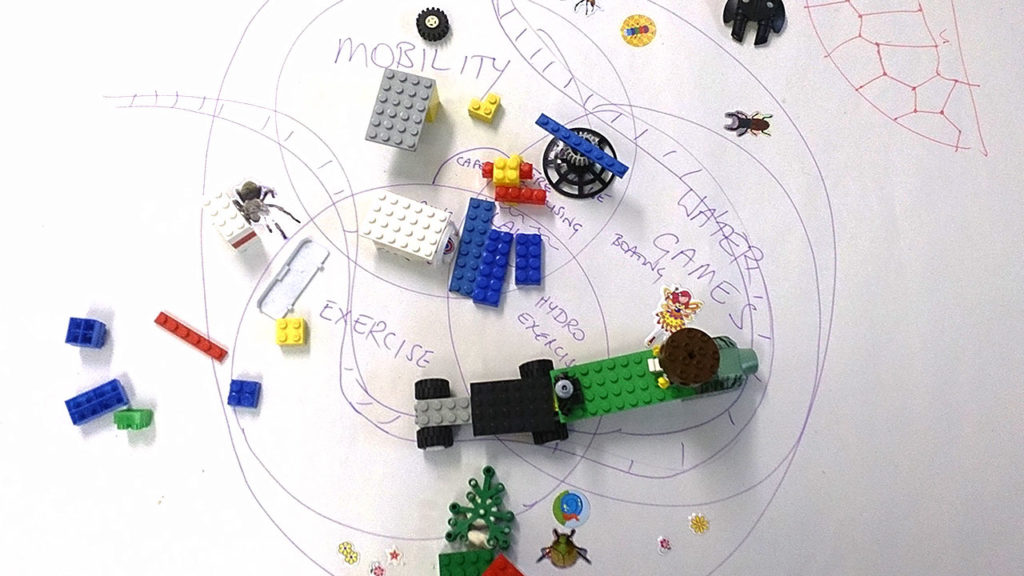
Next, we were introduced to an initially bemusing process based on Play Your Place, designed by artists Ruth Catlow and Mary Flanagan, to introduce playful and game-like activities to public consultation. We were each asked to select different cards with random words that we were told would help us to disrupt our conventional view of problem solving. The cards were divided into provocative statements, for example mine were: ‘London is no longer’ and ‘getaway car’. Then a spinning wheel contained words associated with game features, like ‘mission’, ‘protagonist’, ‘goal’ or ‘reward’. After drawing or writing out our scenarios based on the random words we had to pick a segment of the wheel in which to place our ideas.
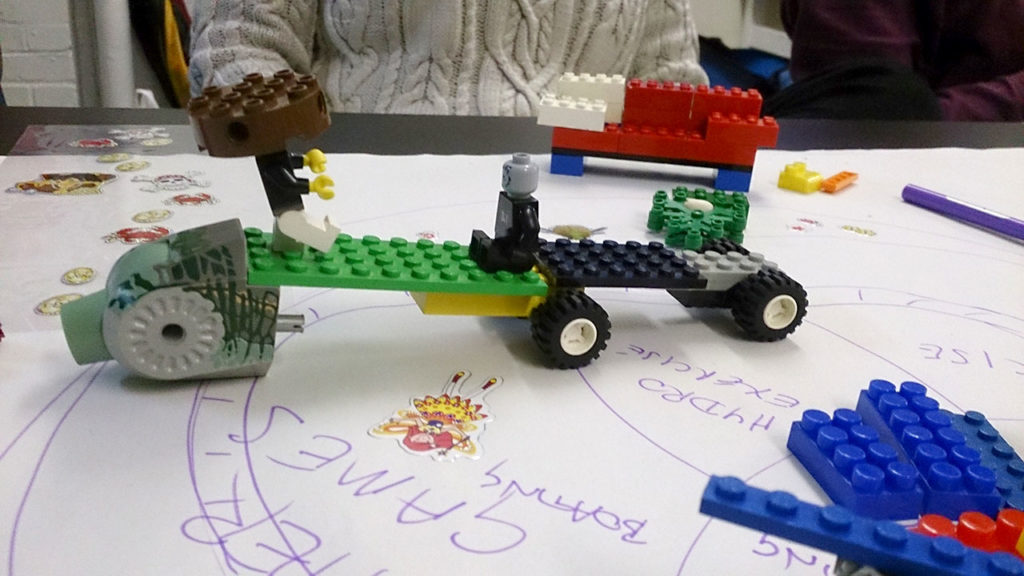
I asked if London is no longer, why is that so? Perhaps the park has eaten London. I was making the park the protagonist, the hero of the story. My ‘getaway car’ card prompted me to imagine Finsbury Park criss-crossed by many roads. So what if a part of the park could move very slowly, a moving park that people could take in the rest of the park from and jump on and off.
Zeki, one of the youngest participants had the cards ‘maps‘ and ‘someone caring for the park’ they assigned it the wheel word ‘reward’. He imagined the rocks in the park could become an area where people could come and paint and draw on the rocks. People will be able to look at the drawings and climb on the rocks. He said this suited ‘reward’ because you get a nice place.
Finally we worked with lego and plasticine, felt and coloured paper, to make a representation of our scenarios. Time flew by before we were then asked to talk about what we had created.
Simon and Talal ended up using a lot of lego. They said they weren’t that confident ‘creating’ but their riotous explosion of lego pieces described the Finsbury Park Lodge with lots of tropical trees growing around them. They included a clocktower which they felt the park needed. Ominously on the edge of their diorama there was, in their words: ‘the threat of a forest fire’.
Ilenia and Gab created intricate visions of the park modelled from tiny pieces of plasticine. Ilenia created crosses to represent all the buildings that she was going to destroy. She said “All the fences will be replaced by nice trees. The lake will be larger than it is now. There will be more people using the park.” Gab described the a tree as becoming “a colourful multi-form creator. It will be very friendly and very different from normal. Everything will be very colourful and this will be linked to representing climate change.” Emma who earlier in the workshop explained her love of conkers ended up building robot conkers.
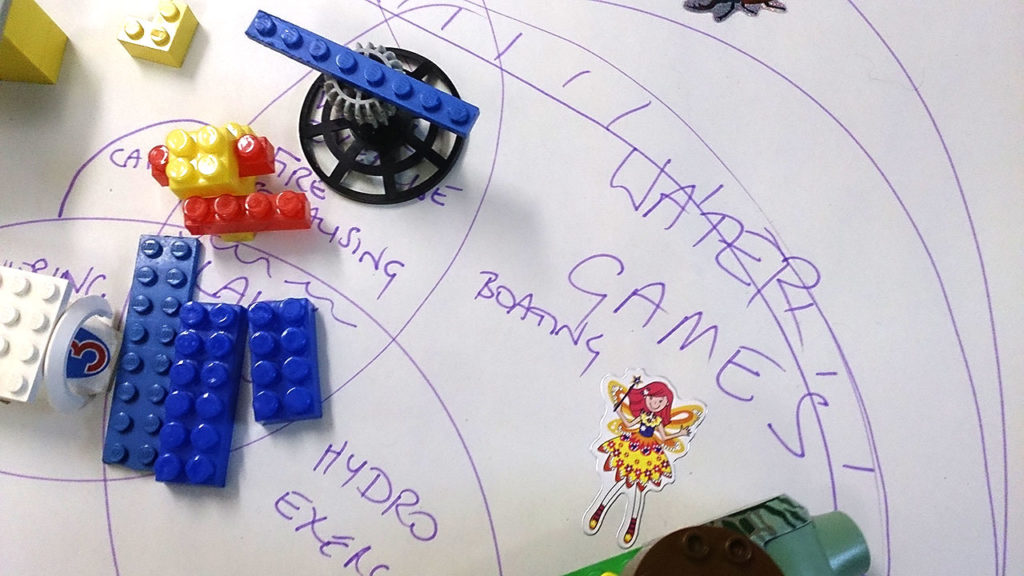
The outcomes were unexpected and realised in a wonderfully ad hoc way with a rich mix of ideas. Rachel and the Furtherfield team were on hand to support and provide more insight. Although the process of drawing cards and selecting from a wheel was initially quite perplexing, staying with the uncertainty of the process meant that we came up with ideas that were novel and unhindered by more formal or conservative notions of preserving or enhancing Finsbury Park. The two hour time limit, meant that everything moved along at pace that kept the idea generation restless. I believe I speak for all who took part in anticipating the results of the wider project.
What can possibly be made from such a kaleidoscope of raw material, I wondered on my way home in the pouring rain? Perhaps my plant car or Emma’s robot conkers will see the light of day or the darkness of the underground reservoir.
Futurescapes is an Innovate UK Audience of the Future Design Foundations project that uses Finsbury Park as a test case to examine the commercial potential for using immersive experiences as a tool for collaborative placemaking for public spaces and integrated public services. Furturescapes is a partnership project with Furtherfield, The Audience Agency and Wolf in Motion.
Join us in Edinburgh at the first DAOWO ‘Blockchain & Art Knowledge Sharing Summit’ of 2019
DAOWO (Distributed Autonomous Organisations With Others) Summit UK facilitates cross-sector engagement with leading researchers and key artworld actors to discuss the current state of play and opportunities available for working with blockchain technologies in the arts. Whilst bitcoin continues to be the overarching manifestation of blockchain technology in the public eye, artists and designers have been using the technology to explore new representations of social and cultural economies, and to redesign the art world as we see it today.
This summit will focus on potential impacts, technical affordances and opportunities for developing new blockchain technologies for fairer, more dynamic and connected cultural ecologies and economies.
Programme
Although the term ‘blockchain’ has trickled downstream into the public domain, the principles behind the technology remain mysterious to many. Embodied within physical assemblages or social interventions that mine, hash and seal the evidence of human practices, creatives have provided important ‘coordinates’ in the form of artworks that help us to unpick the implications of the technology and the extent to which it re-configures power structures.
Hosted by Prof Chris Speed and Mark Daniels with panellists:
Pip Thornton – The Value of Words in an Age of Linguistic Capitalism
Bettina Nissen & Ailie Rutherford – Designing feminist cryptocurrency for Govanhill
Evan Morgan – GeoPact
Jonathan Rankin – OxChain, Pizza Block
Larissa Pschetz – Karma Kettles
Contributors include:
Ruth Catlow, Furtherfield and DECAL
Mark Daniels, New Media Scotland
Clive Gillman, Creative Scotland
Marianne Magnin, Arteïa
Prof Chris Speed, Design Informatics, University of Edinburgh
Ben Vickers, Serpentine Galleries
Through two UK summits, the DAOWO programme is forging a transnational network of arts and blockchain cooperation between cross-sector stakeholders, ensuring new ecologies for the arts can emerge and thrive.
DAOWO Summit UK is a DECAL initiative – co-produced by Furtherfield and Serpentine Galleries in collaboration with the Goethe-Institut London. This event is realised in partnership with the Department of Design Informatics at the University of Edinburgh and New Media Scotland.
OxChain is a major EPSRC research project which explores how Blockchain technologies can be used to reshape value in the context of international development and the work of Oxfam, involving the Universities of Edinburgh, Northumbria and Lancaster.
“À la recherche de l’information perdue” was a performance that Cornelia Sollfrank contributed to the ‘Post-Cyber Feminist International’ event at the Institute of Contemporary Arts in London.1 The event in November 2017 marked the twentieth anniversary of the First Cyberfeminist International (documenta X, Kassel, Germany, 1997) organized by the Old Boys Network, paying homage to its productive format and legacy. In her own words, Sollfrank set out to offer an “one-hour lecture performance that makes a (techno-)feminist comment on the entanglements of gender, technology and information politics,” with the rationale that “with the technological landscape vastly changed since the first Cyberfeminist International, we are living in a time well beyond the imagined future of the early cyberfeminists. Expanding upon this particular genealogy, this convening purposefully constellates thinkers to consider a new vision for “post-cyberfeminism” that is substantive and developed, without being exclusionary of contestation.”
I was surprised at the invitation of the charismatic woman I came to know as “Coco” to attend her performance. My surprise, which I bet is going to surprise Coco in turn, was due to two reasons. I had published two academic papers on WikiLeaks (2012, 2014 with Robinson), later included in a monograph charting on digital activism from 1994-2014 (2015), and at the time I was working on another paper on ‘Leaktivism and its Discontents’ examining the DCLeaks, CIA Vault7Leaks and DNCLeaks (2018). Although I took a critical view of the ideological and organizational conflicts within WikiLeaks as an organization internally, and examined the impact of that organization externally on academic debates in three disciplines between 2010-2012, and followed the leaks religiously in my scholarship, I had not written or commented on the rape allegations against Julian Assange.2 The related legal requirements, however, were what forced him to be stranded in the Ecuadorian Embassy from the 12th of June 2012 to the time of writing in 2018, in the first place. On March 6th, 2016, I was one of the signatories urging Swedish and UK Permanent Representatives to the United Nations in Geneva, to respect the United Nations’ decision to free Julian Assange. Moreover, as my work almost in its entirety has not focused on gender aspects of technology, or gender studies (apart from say examining ethno-patriarchal racist ideologies in anti-migrant discourses on digital networks in 2010-2013 for the Project, see et al. 2018),3 I felt rather intrigued by the invitation to the event, and its technofeminist context and agenda. If Coco was brave enough to invite me to watch her performance and trust me to comment on it, considering both my research (see references), and critical but supportive stance to Julian Assange’s quest for freedom, then I had to also be brave enough to take up the challenge!
As academics we are encouraged not to write in the first person. In fact, “do not use the first person in your scholarship” is served up in higher education establishments around the world, bar in certain sub-disciplines who take a certain pride in reflecting on the situated knower and their reflective positionality. In my own scholarship, I have used the first person sparingly. Here, in this text however, I feel obliged to do so, as I watched an artist perform and I would like to convey the thoughts aroused in the internal empire; and also understand whether and if so, how it has transformed me. After all, that is what art is for, right?
Sollfrank’s performance consists of her reading a text, overlaid by electronic sounds, and the projection of changing images behind her. There are nine images: orange font capital letters on a black and white pixel background: INFORMATION, ORGANISATION, ZEROS+ONES, BINARY WORLDS, PURE DIFFERENCE, CYBERFEMINISM, GENDER+TECHNOLOGY, NAKED INFORMATION, TRANPARENCY. The first image background is a very close zoom in to a black-and-white image and each image background zooms out to the final one. Only the last two images reveal the subject of the image: the photograph of the ripped condom used by Julian Assange during sexual intercourse with one of the women that subsequently accused him of rape, table by the Swedish police and published in their report. This was the final image of her lecture below.
The structure of the lecture is an assemblage really of separate elements she uses to launch her critique. In introducing her performance, she asks:
“On the road to freedom, one has to make sacrifices; but what remains when the way gets swampy and forks into affective structures? Rape can be performed in many ways.
So, what is missing? What are we looking for?
Has it been lost at all? Maybe it just multiplied, and stayed a much as it has gone away? Who knows?
We all create reality collectively and long ago have become zombies of transparency.”
Here, already I am baffled by the sentence “Rape can be performed in many ways.” I hadn’t thought about the “performativity” of rape. I make a mental note of this. Who “performs” during a rape? Can you perform before, during, or after a rape? What are the “many ways” a rape can be performed? This thought grabs me immediately at the start of her performance. But I relieve myself of it, thinking I got to be self-policing: this is the kind of thought that gets you into hot water: she must mean either literally the various categories of rape in Sweden, or this is some kind of allegory on reactive affect, discursive violence, a form of sexual misconduct, or again literally the case of broken trust found in a broken condom? I don’t have time to think, as Sollfrank swiftly moves on to the first section “INFORMATION,” where she talks about theoretical approaches to information: structure, knowledge, signal, message, meaning, process. In the sentence,“Julian Assange is accused of rape,” the information is coded in words and letters, the meaning of that structure is conveyed and at the pragmatic level, the receiver finds value in that information depending on whether he/she is interested in this person, his organization, what he represents, subjectively decoding this information to create meaning. The next piece of the puzzle is, of course, “ORGANISATION.” Sollfrank quotes the WikiLeaks organisation mantra: “One of our most important activities is to publish original source material alongside our news stories so readers and historians alike can see evidence of the truth.” Assange faced criticism for his centralised style of leadership in the organisation, which caused people to leave it. And obviously his political aims are somewhat inconclusive. Here, in this part of the lecture, I recognise my own writing, when Sollfrank says: “Maybe, the man and his organisation are an empty signifier, filled ideologically to reflect the discursive mood of anyone.” I had made that argument in ‘WikiLeaks Affects’ (2012), analyzing the diverse actors who supported Assange and the public feelings of him as a traitor or hero, the overflow of affective structures and the acceleration offered by digital networks (digital materialisation of the revolutionary virtual that may or not happen in the real).
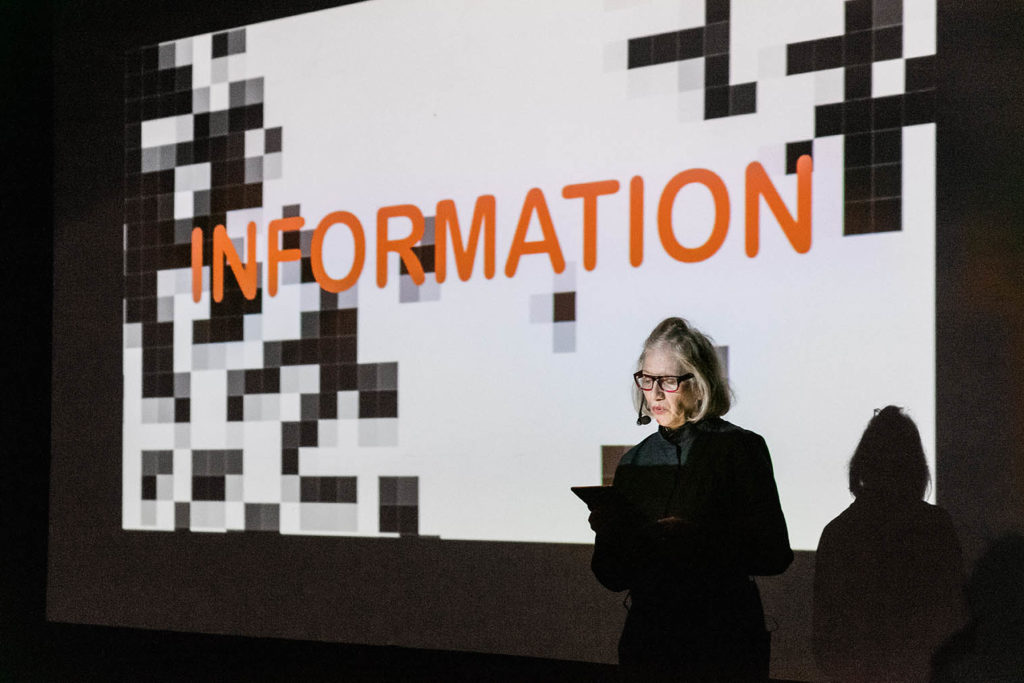
But Sollfrank extends this argument by asking: “Why do they all express their particular feelings, even though these are uniformly rooted in their own individual causes and systems of belief?” Yes, what is at stake when Assange’s organisation jump-scaled globally after the release of the Collateral Damage video in 2010? Would the strong tradition of the women-protective Swedish state have taken on the same exact legal process for someone less than Assange? Letting him leave for the UK, after a police station visit, but then after the leaks occurred, recall him for further questioning? The saga between the Swedish government and Assange,culminated in Swedish prosecutors dropping their investigation into Assange, bringing to an end a seven-year legal standoff on May 19, 2017.4 In February 2018, a judge, nevertheless, upheld the warrant for his arrest. On 28 March 2018, Ecuador cut Assange’s Internet connection at its London embassy refuge “in order to prevent any potential harm,” caused by his social media posts denouncing the arrest of a Catalonian separatist leader, which Ecuador officials claimed “to put at risk” Ecuador’s relations with European countries. Assange might well be an obnoxious bastard to whom rape charges might be thrown at and dropped, but he becomes a target for Sollfrank for another reason…
This is where the performance goes SURREAL. Of the ONE and ZERO, Sollfrank makes beautiful poetry of this, in her “BINARY WORLDS” section:
“The man is the ONE, and ONE is everything. And the female has nothing you can see. Woman functions as a hole, a gap, a space, a nothing that is not the same, identical, identifiable, … a fault, a flaw, a lack, an absence outside the system of representations and auto-representations. Lacan lays down the law and leaves no doubt when he syas: ‘There is woman only as excluded by the nature of things. She is not “all,” “not whole,” “not-one,” and whatever she knows can only be described as “not-knowledge.” There is no such thing as THE woman, where the definite article stands for the universal. She has no place like home, nothing of her own, other than the place of the Other which,” writes Lacan, “I designate with a capital O.”
And it remains up to us, the audience, to make the association she would never express herself: the ONE mal god, is it him?
In “PURE DIFFERENCE,” Sollfrank finally gets irritated herself! “ONE, the definite, upright line; and ZERO the diagram or nothing at all: penis and vagina, thing and hole; a perfect match… Now the only thing that counts is whether there is something to see, and there seems to be something missing with the Zero. What makes the <woman> in this respect? …Why not admit that we are as blind for the invisible sexual difference as between a Zero and a ONE, because we always have to see pictures and that means something else?”
“CYBERFEMINISM” is brought in to help answer some of the questions here, but its focus has been how to use technology to fight “Big Daddy Mainframe,” technology as a way to dissolve sex and gender. The cyberfeminist techno-utopian expectations did not digitally or otherwise materialise, and Sollfrank asks: “What is between your legs NOW? Zeroes and ones? Liberated data? Digital slime? The warm machine still awaits your intention, but never forget the flesh.” What Sollfrank goes on to declare in “GENDER & TECHNOLOGY” is that “Big Daddy rules supreme.” That is my least favorite part of the lecture. Yes, engrained spheres of masculinity are still ubiquitous within all techno-cultures, and Sollfrank offers the GamerGate example with men harassing women, trolling, doxxing, cyberstalking, intimidation and policing experienced by women and queers are real. Indeed.
But here’s also where the binary lures to manifest itself. Extending Assange’s obnoxious techno-geek persona accused of rape and making him the master signifier of patriarchy reproduced in digital networks and especially technoculture would in turn reproduce exactly the same that fills the empty signifier Assange with the baggage of their own beliefs. Watch out and not fall into the same trap here, although it might be beautiful just to fall.
Sollfrank’s contribution here is really not on Assange’s signifier as a male God of ONE the personification of toxic masculinity, it is more her critique of his ideology of TRANSPARENCY, in the last section of her performance.
The inconvenient question remains, what information at which moment and from whom? If it is not related to a political goal, transparency becomes an end in itself – an ideology, and we: its zombies. With transparency as the new imperative: How do we distinguish … between accountability, surveillances and privacy invasion? Liberating public data and protecting private ones? All data are made of similar substance and follow the same logic; who might be able to stop the flow, once it is flowing? Who would want to interrupt the continuum, to crack and leak and disrupt the flow – of capital? No way!
The performance finishes with “Naked information is incapable of generating a myth, I live off that which others do not know about me. And will I ever know myself? In contrast to calculating, thinking is not self-transparent. There is nothing more intransparent than the subject to herself – no matter how much data I have and share. Information is just information, only once you know what you are looking for, the search can begin.”
Sollfrank’s performance approached information from all the sides she started with: structure, knowledge, signal, message, meaning, process. I had to reflect on why I never wrote about the Swedish case in all the scholarship I developed on WikiLeaks over the years. I felt Assange is an easy target to be used as a prop to talk about sexism reproduced in digital networks, techno-patriarchy and cyberfeminism, filling him in as an empty signifier to whatever the pet subject and the ideological discursive purpose happens to be. And yet, I think here Sollfrank does something brilliant, bringing a picture of the ripped condom as a background to her red-font words. Because she is connecting meanings to structures, material, affective, digital and interrogating trust, extending to the trust that a condom should not be ripped, interrogating the winner takes all justification register of transparency as an ideology, surveillance as the normal, and the end of secrecy, the quest of truth at all costs, even disrupting democracy, even the neoliberal capitalist kind. When there is no true self, even in itself, the search for lost information can be the point or utterly pointless, the same way as ZERO and ONE. This is what Sollfrank I think transformed with her art in my (post-cyberfeminist?) soul machinery.
Link to most recent performance at the hacker convention 35c3 in Leipzig:
1 https://www.ica.art/whats-on/season/post-cyber-feminist-international
2 https://diem25.org/urging-sweden-and-the-uk-to-free-julian-assange
4 https://www.theguardian.com/media/2015/oct/12/timeline-julian-assange-and-swedens-prosecutors
Associate Professor in Media and Communication at the University of Leicester. Her work contributes to theorising cyberconflict, and exploring the potential of ICTs and network forms of organization for social movements, resistance and open knowledge production.
artist, researcher and university lecturer, living in Berlin (Germany). Recurring subjects in her artistic and academic work in and about digital cultures are artistic infrastructures, new forms of (political) self-organization, authorship and intellectual property, techno-feminist practice and theory. She was co-founder of the collectives women-and-technology, – Innen and old boys network, and currently is research associate at the University of the Arts in Zürich for the project ‘Creating Commons.’ Her recent book Die schönen Kriegerinnen. Technofeministische Praxis im 21.Jahrhundert was published in August 2018 with transversal texts, Vienna. For more information, pls visit: artwarez.org
In thinking about the relationship between science fiction and social justice, a useful starting-point is the novel that many regard as the Ur-source for the genre: Mary Shelley’s Frankenstein (1818). When Shelley’s anti-hero finally encounters his creation, the Creature admonishes Frankenstein for his abdication of responsibility:
I am thy creature, and I will be even mild and docile to my natural lord and king, if thou wilt also perform thy part, the which thou owest me. … I ought to be thy Adam, but I am rather the fallen angel, who thou drivest from joy for no misdeed. … I was benevolent and good; misery made me a fiend. Make me happy, and I shall again be virtuous.
Popularly misunderstood as a cautionary warning against playing God (a notion that Shelley only introduced in the preface to the 1831 edition), Frankenstein’s meaning is really captured in this passage. Shelley, influenced by the radical ideas of her parents, William Godwin and Mary Wollstonecraft, makes it clear that the Creature was born good and that his evil was the product only of his mistreatment. Echoing the social contract of Jean-Jacques Rousseau, the Creature insists that he will do good again if Frankenstein, for his part, does the same. Social justice for the unfortunate, the misshapen and the abused is what underlies the radicalism of Shelley’s novel. Frankenstein’s experiments give birth not only to a new species but also to a new concept of social responsibility, in which those with power are behoved to acknowledge, respect and support those without; a relationship that Frankenstein literally runs away from.
The theme of social justice, then, is there at the birth also of the sf genre. It looks backwards to the utopian tradition from Plato and Thomas More to the progressive movements that characterised Shelley’s Romantic age. And it looks forwards to how science fiction – as we would recognise it today – has imagined future and non-terrestial societies with all manner of different social, political and sexual arrangements.
Shelley’s motif of creator and created is one way of examining how modern sf has dramatized competing notions of social justice. Isaac Asimov’s I, Robot (1950) and, even more so, The Caves of Steel (1954) ask not only the question, ‘can a robot pass for human?’, but also more importantly, ‘what happens to humanity when robots supersede them?’. Within current anxieties surrounding AI, Asimov’s stories are experiencing a revival of interest. One possible solution to the latter question is the policing of the boundaries between human and machine. This grey area is explored through use of the Voigt-Kampff Test, which measures the subject’s empathetic understanding, in Philip K. Dick’s Do Androids Dream of Electric Sheep? (1968) and memorably dramatized in Ridley Scott’s film version, Blade Runner (1982). In William Gibson’s novel, Neuromancer (1984), and the Japanese anime Ghost in the Shell (1995), branches of both the military and the police are marshalled to prevent AIs gaining the equivalent of human consciousness.
Running parallel with Asimov’s robot stories, Cordwainer Smith published the tales that comprised ‘the Instrumentality of Mankind’, collected posthumously as The Rediscovery of Man (1993). A key element involves the Underpeople, genetically modified animals who serve the needs of their seemingly godlike masters, and whose journey towards emancipation is conveyed through the stories. It is surely no coincidence that both Asimov and Smith were writing against the backdrop of the Civil Rights Movement, but it is also indicative of the magazine culture of the period that both had to write allegorically. In N.K. Jemisin’s Broken Earth trilogy (2015-7), an unprecedented winner of three successive Hugo Awards, the racial subtext to the struggle between ‘normals’ and post-humans is made explicit.
Jemisin, like Ann Leckie’s multiple award-winning Ancillary Justice (2013), is indebted to the black and female authors who came before her. In particular, the influence of Octavia Butler, as indicated by the anthology of new writing, Octavia’s Brood (2015), has grown immeasurably since her premature death in 2006. Butler’s abiding preoccupation was with the compromises that the powerless would have to make with the powerful simply in order to survive. Her final sf novels, Parable of the Talents (1993) and Parable of the Sower (1998), tentatively posit a more utopian vision. This hard-won prospect owes something to both Joanna Russ’s no-nonsense ideal of Whileaway in The Female Man (1975) as well as the ‘ambiguous utopia’ of Ursula Le Guin’s The Dispossessed (1974). Leckie, in particular, has acknowledged her debt to Le Guin, but whilst most attention has been paid to the representation of non-binary sexualities in both the Ancillary novels and Le Guin’s The Left Hand of Darkness (1969), what binds both authors is their anarchic sense of individualism and communitarianism.
Whilst sf has, like many of its recent award-winning recipients, diversified over the decades, there is little sense of it having abandoned the Creature’s plaintive plea in Frankenstein: ‘I am malicious because I am miserable.’ It is the imaginative reiteration of this plea that makes sf into a viable form for speculating upon the future bases of citizenship and social justice.
When I first heard about MoneyLab, it was back in 2013 or the beginning of 2014, when I was doing my masters in London. A friend of mine handed a flyer to me and I was intrigued by the strange typography and the combination of bright colours. However, I didn’t quite believe that any kind of initiative could really start an alt-economy movement. Not that I didn’t believe in local currency or creative commons, but those gentle approaches generally seemed to lack traction, just like liberals do with voters. I naturally thought MoneyLab was one of those initiatives.
However, as Bitcoin was becoming a hype, the name popped up again; MoneyLab itself was also becoming a hype. While bitterly regretting not being able to be associated as the first wave of participants, I started to think that maybe MoneyLab might be the framework that can really push out alternative economic attempts as mainstream culture. My stance towards economic shifts was somewhat similar to that of William Gibson’s; he said in an interview with the British newspaper The Guardian, ‘What would my superpower be? Redistribution of wealth’. How did that change after reading the MoneyLab Reader 2?
Before going into the details of what blockchain technology can really do, it is crucial to understand a new “unit of value” created in modern society (Pine and Gilmore 1999). Since the most prominent piece of technology of our era is undoubtedly smartphones (with Apple being the first 1 trillion dollar publicly listed company in the US), a lot of transactions are inevitably conducted through apps and web services. The proliferation of the so-called “payments space” signifies the era of UX design, which is the third paradigm of HCI (Human-Computer Interaction), “tak[ing] into account…affect, embodiment, situated meaning, values and social issues” (Tkacz and Velasco 2018). In other words, experience has become the deciding factor of customers’ choices. With vast amounts of data generated at the back of sleek interfaces, one can precisely oversee the users’ behaviour, which then is fed back into the system.
All the payments spaces are essentially digital. This means transactions leave digital traces whether you like it or not. The idea of a cashless society exactly stems from this interest, the authorities can have better understandings of how people make money; in other words, where black money flows. Brett Scott has been pointing out the danger of a cashless society for quite some time now, I saw another variation in this book.
According to Jaya Klara Brekke, blockchain technology can make money programmable, “allow[ing] for very fine-grained (re)programming of the medium of money, from what constitutes, and how to measure, value-generating activity to the setting of parameters on the means and conditions of exchange – what is spendable, where and by whom” (Brekke 2018). The overall impression I got from the MoneyLab Reader 2 about what blockchain technology can really do is basically this. Making a currency programmable using smart contracts.
More than a couple of authors discuss how “contingency” should take place in designed currencies. Contingency is different from randomness; in fact, it could mean exactly the opposite. For example, when coins are distributed in a perfectly random manner, you have absolutely no control in the handling process. If contingency is embedded in a system, it means there are exploitable gaps, which seem to almost randomly benefit people. On the other hand, some individuals would find ways to make use of these gaps, which are considered to be legitimate. Brekke discusses how the way in which contingency is programmed into a currency will be a key for the future of finance, both in terms of experience and redistribution of wealth. Therefore, currency designers will be the next UX designers.
A number of ideas applying blockchain technology to both physical and cultural objects are mentioned in this book, from a self-maintaining forest to blockchain-based marriage. “Terra0” is the concept of an autonomous forest which can “self-harvest its own value” (Lotti 2018). Utopian views of a human-less world are prevalent, but in reality, a healthy forest requires an adequate amount of human intervention. In addition, the value of a forest cannot be determined by itself; trade routes, demand and supply, they are all drawn by human movements. For example in Japan, domestic wood resources are generally not profitable because of the expensive labour costs. Illegally cut trees without certification from Southeast Asia dominate the market, putting domestic ones in a bad position. When a forest itself is not profitable, how can it accumulate capital autonomously? Besides, the oracle problem has not been discussed at all. Unless everything is digital in the first place, there always needs to be somebody to put data onto the blockchain. In other words, the transcendence of the boundaries between the physical and the digital is not possible without human intervention. Blockchain marriage would face a similar problem; who might be the witness if circumventing the government official? Max Dovey investigates the notion of “crypto-sovereignty” while introducing an example of a real blockchain marriage where they “turn[ed] ‘proof of work’… into ‘proof of love’”(Dovey 2018). Just as the sacramental bond between spouses can be broken before Death Do Them Part, so can any cryptographic marriage unravel despite having been recorded in an immutable ledger. Whatever repercussions may exist for divorce, there are no holy or technological mechanisms to prevent it.
Platform co-ops is one of the largest topics in the book besides Universal Basic Income (UBI). A platform co-op is often a cooperatively owned version of a major platform that is supposed to be able to pay better fees to the workers. Also, a platform co-op is often associated with “lower failure rate”; 80% of them survive the first five years when only 41% of other business models do (Scholz 2018). While embracing the positive aspects of platform co-ops, I have this question stuck in my head: can you not make a platform co-op based on a new idea rather than copying existing ones?
Most platform co-ops seem that they are looking at already successful and established concepts such as rental marketplaces for rooms and ride hailing services. As a result, platform co-ops are considered more to be a social movement than an innovation. Why not just run a business right at the centre of Capitalism without being motivated by profit? Many platform co-ops challenge the main stream services such as Airbnb or Uber, however those services operate based on scale; if they have the largest user base, it will be very difficult to take them on, unless they die themselves like Myspace… Moreover, more hardware side of development can be happening around co-ops, but I don’t hear anything except for Fairphone. When can I stop using my ThinkPad with Linux on it?
After reading the MoneyLab Reader 2: Overcoming the Hype, now I’m thinking of how I should design my own currency. Of course whether cryptocurrencies are actually currencies is up to debate; depending on who you ask, Ethereum is a security (SEC), a commodity (CFTC), taxable property (IRS) or a currency (traders).
MoneyLab 2 authors overall suggest that we should not limit our imagination to fit in the existing finance systems, but think beyond. You don’t necessarily need to cling to cryptocurrencies but they may help you shape your ideal financial system.
Futurescapes connects local groups with our wider team of designers, researchers, techies and visionaries, to co-create new visions of Finsbury Park using immersive technology.
Furtherfield disrupt and democratise arts and technology so that more people can be involved in the business of shaping their cultures and places. Our current focus is on ways to connect the governance and funding of culture to the communities that they serve.
We are currently developing a three year programme called Citizen Sci-Fi, in the heart of Finsbury Park where we have 2 venues: a gallery and a lab. Using the model of citizen science and citizen journalism we are crowdsourcing the imagination of park users and local community groups to create new visions and models of stewardship for public, urban green space.
Like many other public spaces, Finsbury Park has immense economic, social and natural value, yet there is a disconnect between the ‘owners’ of public space and the people that use (or should be) using them. Local councils have limited funds, the ‘superdiverse’ local population are not engaged in public consultations; and there are conflicts between park users and stakeholders.
Immersive models can be used as a tool for engagement through co-design, to discover how the council, park stakeholders including nearby property developers, and park users imagine its future and their involvement with it. Placemaking is recognised as a core part of regeneration, requiring a foundation of strong partnerships cutting across the public and private sectors, where social, cultural and ‘natural’ capital interleave to create stronger bonds and local identity.
We aim to co-design an immersive platform to facilitate the co-design of development in and around public spaces. It will engage with and directly benefit a number of stakeholders:
By coordinating and connecting Furtherfield’s international community of artists, techies and thinkers, and the groups that we work with in Finsbury Park, we have the opportunity to combine the powerful insights of grounded communities with experimental practitioners. We want to find a way to empower a long term collaboration across all these layers.
Futurescapes is an Audiences of the Future Design Foundations project, funded by Innovate UK (part of UK Research & Innovation)
ART AFTER MONEY, MONEY AFTER ART is a workshop with Max Haiven, author of Art After Money, Money After Art: Creative Strategies Against Financialization.
In a world turned into a casino is it any wonder that corporate gangsters increasingly run the show? What are the prospects for a democratization of the economy when new technologies appear to further enclose us in a financialized web where every aspect of life is transformed into a digitized asset to be leveraged? Ours seems to be an age when art seems helpless in the face of rising authoritarianism, or like the plaything of the worlds speculator-plutocrats, and age when “creativity” has become the buzzword for the violent reorganization of work and urban life towards an endless “now” of competition and austerity.
And yet… we are witnessing an effervescence of imaginative struggles to challenge, hack and reinvent “the economy.” Artists, technologists and activists are working together not only to refuse the hypercapitalist paradigm but reinvent the methods and measures of cooperation towards different futures. This workshop brings together many of these protagonists and their allies for a discussion on the occasion of the publication of Max Haiven’s new book Art After Money, Money After Art: Creative Strategies Against Financialization.
Haiven will kick off the conversation with a short presentation of key themes in the book as they impinge upon the question of working at the intersection of “art” and new technologies (including but not limited to blockchains) to create alternative economic paradigms. The central question is, to what extent can these efforts surpass the (important) desire to redistribute wealth in a world of growing inequalities and, additionally, aim for a much more profound and radical collective reimagining of who and what is valuable.
Austin Houldsworth
Dan Edlestyn
Brett Scott
Cassie Thornton
Kate Genevieve
Emily Rosamond
Jonathan Harris
Ruth Catlow and Martin Zeilinger will chair discussions and the event is sponsored by Anglia Ruskin University
Pluto Press are happy to offer a Furtherfield discount on the book. Add Art After Money to the cart and use the discount code ART15 to get the book at £15.
On the 7th September, the Disruption Network Lab opened its 14th conference in Berlin entitled “INFILTRATION: Challenging Supremacism“. The two-day-event was a journey inside right wing extremism and supremacist ideology to provoke direct change, second appointment of the Misinformation Ecosystems series that began in May. In the Kunstquartier Bethanien journalists, activists, researchers, and infiltrators had the chance to discuss the increasing presence of movements that want to oppose immigration, multiculturalism and political correctness, sharing their experiences and proposing a constructive critical approach, based on the motivation of understanding the current debates in society as well as transforming mere opposition into a concrete path for inspirational change.
“How can you hate me when you don’t even know me?” With this question Daryl Davis tried to crumble the wall of ignorance and fear that he believes to be the basis of racial hatred. This 65 year-old author, activist and blues man, who played for decades with Chuck Barry, Jerry Lee Lewis and B.B. King, has spent 35 years studying race relations and befriending members of the Ku Klux Klan to turn them away from racism. In the context of increased supremacist ideologies and right-wing extremism, the Disruption Network Lab invited Davis to speak about racism and his interactions with individuals holding racist beliefs.
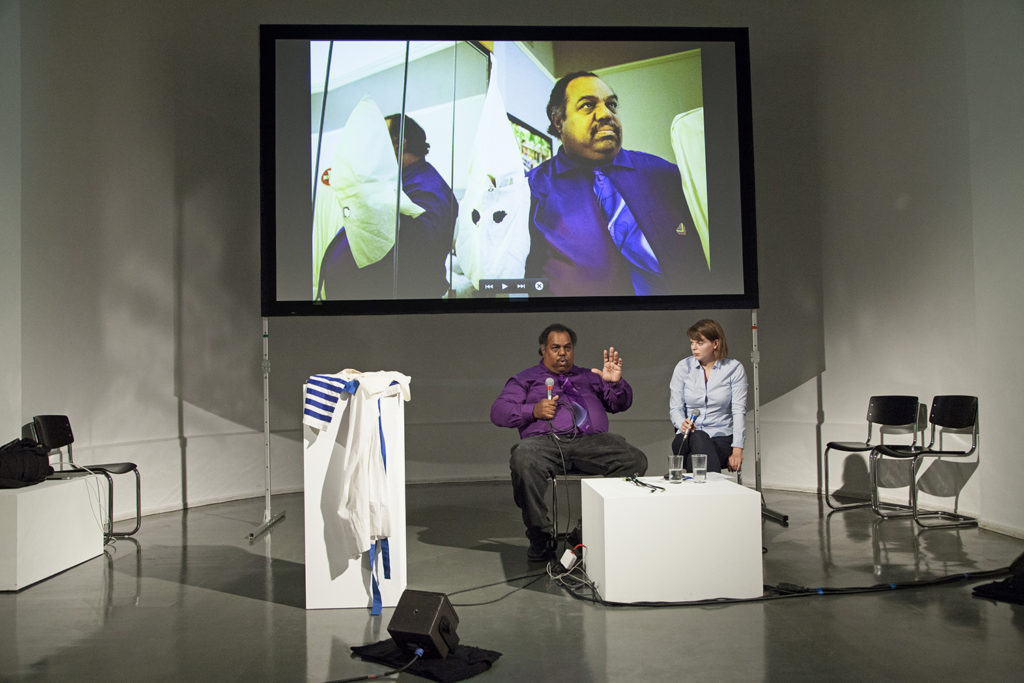
Growing up, Davis lived a privileged life as the son of a U.S. Foreign Service officer, travelling around the world and studying in an international context surrounded by children of other Foreign Service workers. His first shocking encounter with racism occurred when he was 10 years old in a 1968 Massachusetts. He was marching in a parade carrying the US- flag in front of his scouting group as people yelled racial epithets and threw rocks and bottles at him. His parents later explained that those people were targeting just him because of the color of his skin. Someone who knew absolutely nothing about his person and his life wanted to inflict pain upon him for no other reason than that. Because of this hateful reaction from so many white spectators along the route, Davis started wondering the fatidic question.
Ignorance causes fear and obviously the theses of supremacists and racist groups are built on these two components. Many years ago Davis decided to sit with them and listen to their point of view, contradicting their falsehoods using dialogue. Davis is convinced that if we do not fight ignorance it will escalate to destruction, “ignorance breeds fear; fear breeds hatred; hatred breeds destruction” as he previously stated. So, when someone says he thinks white people are superior, Daryl faces them and answers: “we are equal.” On this basis, Davis befriended hundreds of KKK-members and convinced them to rethink their choices. According to the media, he has persuaded more than two hundred of them to throw away their hoods and robes, their stereotypes and beliefs. His activity became national news as he befriended the KKK-member Roger Kelly and CNN broadcasted a story on their unusual relationship. When they first met, Kelly was “Maryland’s Grand Dragon”. Kelly didn’t know Davis was a black man and agreed to meet him. During their first meeting he spewed a lot of stereotypes, but – as Davis narrates – by the end of the evening they could agree on a few topics. The Grand Dragon told Davis they would never agree on racial issues; he said his Klan views on race and segregation were “cemented.” They continued to meet and converse about difficult and controversial matters for a long period: Kelly would attend Davis’s house and Davis would go to KKK-rallies. It took a few years but Kelly’s cemented beliefs got weaker, until he decided to quit the Klan and run for local elections. He had meanwhile become “Imperial Wizard” – which means national leader of the Klan.
During his key note Davis explained that his search for the answer to his question began one night in 1983. After having played in a country music bar a white man approached him and offered him a drink. The man later told him that it was the first time he had ever sat down and had a drink with a black man because he was a member of the Ku Klux Klan. Davis thought at first that the man was joking, but he wasn’t. The bluesman decided to talk to him, focusing on the fact that “they are just human beings,” he says “I respect these people when they sit, talk and listen. It’s just about difference of opinion. If you talk with them you can find things in common.” Someone might disagree with Daryl Davis that Fascism, Racism, Supremacism cannot be considered opinions, that they are crimes and that normalizing their cult is dangerous. But Davis prefers dialogue to posturing and fights. Davis believes in addressing ignorance through communication and education, to ease fear and prevent destruction. His efforts at dialogue are represented by his collection of hoods and robes from former Klan members he has befriended over time. Davis thinks that society should give these people a chance to express their views publicly to challenge them and force them to actively listen to someone else, dialoguing, to passively learn something. Many of them are anti-Semitic, neo-Nazi, Holocaust-denial and racist white supremacist, but he sees them mostly as victims of ignorance, fearing something that they just do not know. For these reasons he talks with them trying to overcome their prejudices. “Always keep the lines of communication with your antagonist open, because when you’re talking, you’re not fighting.”
Davis offers an extreme example of breaking down stereotypes to change the minds of white supremacists. It can be deeply understood only in the context of his US-American background and cultural formation. His keynote speech tended to get soaked in clichés, enriched by several “I am proud of my country” and “my country is great.” Maybe it is just a way to subtract right winged racists the monopoly over the patriotic discourse, through a moderate and gentle approach, to disrupt their one-way narrative, that conflates patriotism with rabid nationalism, showing them that he has traits in common with them. All in all his underlying convincement is that racism comes from a lack of personal knowledge of the African American experience and history, for example in music, and from a lack of personal relationships of a certain part of the white community with human beings that are not white. He thinks that by befriending ignorant racists they could relent, change their minds, have a change of heart and learn how to respect others. Davis is conscious about the fact that such an uncommon approach can be considered, at least, controversial. Many disapprove of it, pointing out that he is offering them a prominent stage in the national and international spotlight.
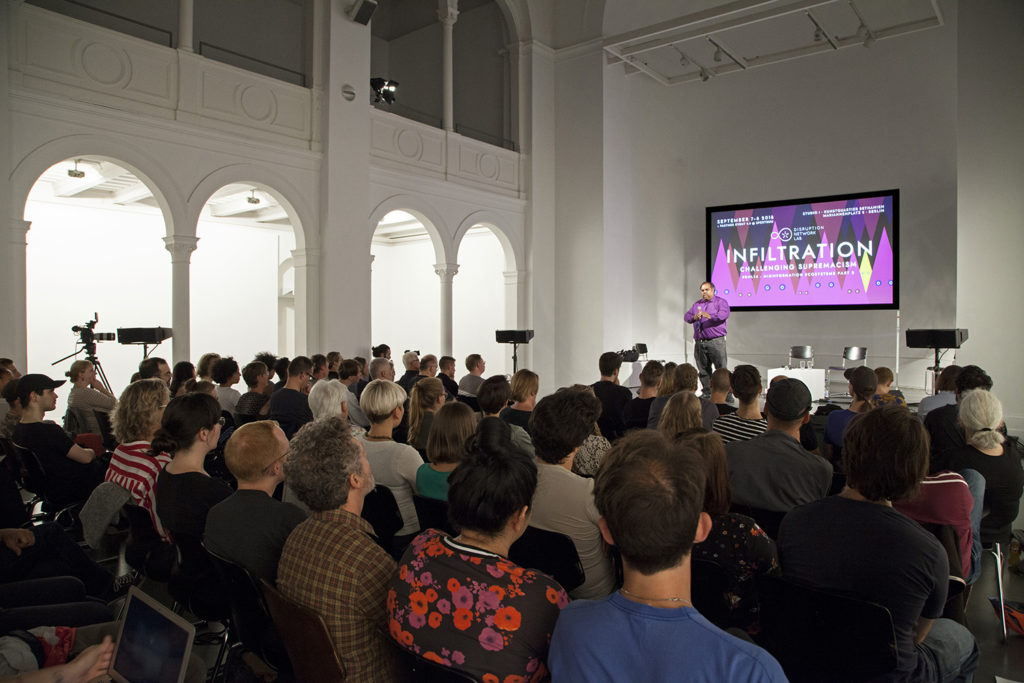
Davis´ activity can also be dangerous. In the past thirty years he has been attacked because of what he does. However, he is not afraid of the Klan or of racist groups. He has cultural tools to face dialectics, he has a strong identity and doesn´t want to fight against someone´s else idea of identity. On the contrary he is convinced that people of all backgrounds shall come together, getting along without losing their sense of identity or individualistic dimension, as no one shall be forced to accept an idea. Matt Ornstein has directed a documentary about Daryl Davis, that the Disruption Network Lab decided to screen during the third day of this 14th Conference. Entitled “Accidental Courtesy: Daryl Davis, Race and America.”
In Germany, individuals and organizations have been mobilizing to prevent the access of neo-Nazi to public platforms and media to spread Negationism and racist propaganda, in a collective lucid reasoning. Dialoguing with neo-Nazis, allowing them to exhibit symbols and to represent reactionary bigotry and hatred as something normal is not accepted by many people in Germany and the audience of the Conference showed reservations about Davis ‘words. Davis replied that his approach pays back. To those who tell him that he is giving racist and violent groups a platform to be normalized and to be part of the public discourse, he reminds them that most of those KKK-members that he approached decided afterwards to quit the group. It took him courage and dedication, he went to KKK-rallies, listened to their hymns, watched them set on fire giant wooden crosses during liturgical rites, witnessing moments of collective frenzy, delirium and hatred.
The documentary shows the efforts to dialogue with representatives from the movement Black Lives Matter too, that sadly ended up in a moment of misunderstanding and dramatic confrontation. Davis and Black Lives Matter have met again and have found a way to work together, going the same way approaching the issue of racism and discrimination with two alternative techniques, that are not mutually exclusive. However, Davis approach is markedly distant from this grassroots movement that organizes demonstrations and protests.
The audience of the 14th DNL Conference challenged Daryl Davis as his approach “we are all human beings” looks fragile in days of uncertainties, when extreme right movements are gaining consensus upon lies and discrimination. Inevitably, the debate after Davis ‘speech focused on the cultural shift represented by Donald Trump´s election and what came after that on a global scale. Davis said that in his opinion what is happening works as a bucket of cold water, that wakes people up and makes them engage and fight for change, reacting with indignation. Davis explained that in his opinion the #MeToo campaign came out as a positive consequence to Donald Trump´s election. “Obama was not elected by black people, who are all in all 12% of the US-population. Things change if we dialogue together, creating the bases for that change. In this way we can accomplish things that just few decades ago were thought to be unachievable.”
The panel of September the 7th represented a cross-section of the research being conducted by journalists, researchers and artists currently working on extreme-right movements and alt-right narrative. By accessing mainstream parties and connecting to moderate-leaning voters, right wing extremists have managed to exercise a significant influence on social and political discourse with an impact that is increasingly visible in Europe. The speakers on this first day of the Conference reported about their experiences with a focus on what is happening in their countries of origin: Sweden, Germany and Slovenia. Interconnecting three methodologies of provoking critical reflection within right-wing political groups, the panel reflected on possible strategies of cultural and political change that go beyond mere opposition.
Recalling all this, the moderator Christina Lee, Head of Ambassador Program and Hostwriter, introduced Mattias Gardell, first panelist of the day, Swedish Professor of comparative religion at Uppsala University, who dedicated part of his studies to religious extremism and religious racism, addressing groups such as the Nation of Islam and its connections to the KKK and other American racist activists, to focus than on the rise of neo-Paganism and its meaning for the radical right. Among his publications, a book on his encounters with Petter Mangs, “the most effective and successful racist serial killer” Sweden has ever encountered, as he writes, and recent analyses of the “lonely wolf” tactic of militant action and groups from the extreme right and the radical Islamism, that are operating under the radar, to avoid being detected and blocked by authorities.
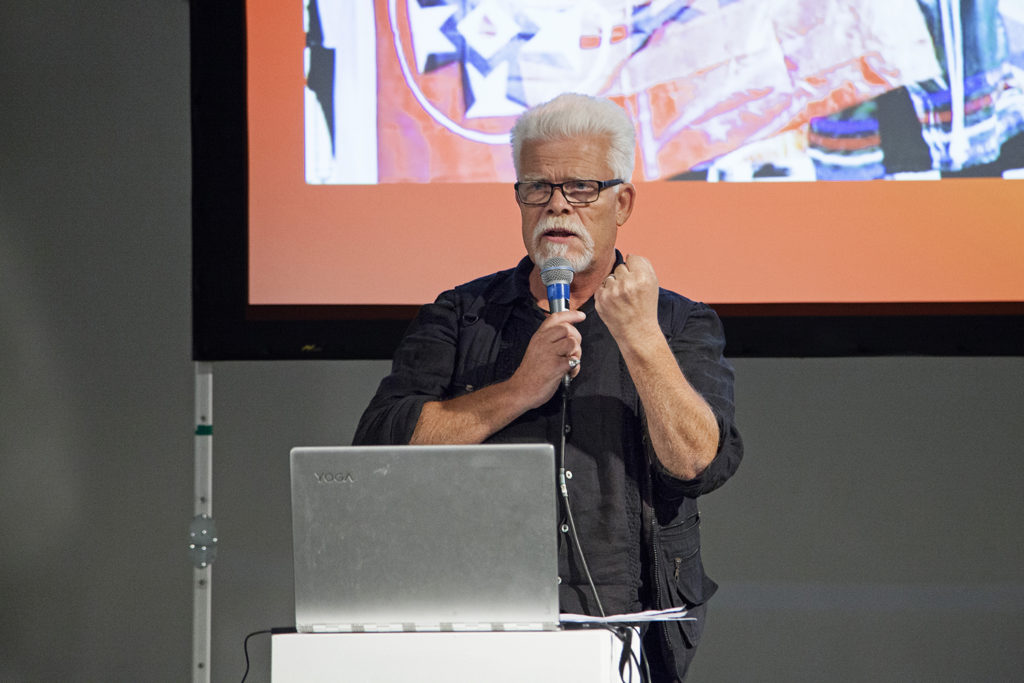
At the time of the Conference, parliamentary elections were about to take place in Sweden. The country was then set for political uncertainty after a tight vote where the far right and other small parties made gains at the expense of traditional big parties. Gardell reported that in Sweden the political and social climate of intolerance has risen. More than half of the mosques have been assaulted or set on fire and minorities are continuously under threat. During his speech he focused on how new radical nationalist parties and movements are investing in narratives built on positive images of love and community, nostalgic sentiments and promises to return the once good society and its original harmony. They are nationalist and ‘identitarian’ groups (as they call themselves), from different nations and united under their belief in separation on the base of national identities. They often portray themselves as common citizens, worried about the vanishing of their country and identity due to a program of multicultural globalism that aims at substituting national identities and people by means of a white genocide: a constant sense of paranoia, that Gardell also perceives in a country like Sweden, where the economy is flourishing, and inequalities hit mostly migrants and non-white population.
These groups work to spread the idea of a “white nostalgia”, a rhetorical discourse based on their efforts to reiterate a rosy, but hazy period, when life was better for the white native population of a certain territory. They ambiguously evoke a moment in history, that has probably never existed, at which national identities were free from external contaminations and people were wealthy sovereign citizens. This propaganda emerges into a multi-faced production in music, film and visual arts. It is not the “angry white men” image alone that can contain such a new fragmented and liquid reality; in fact, explained Gardell, the opposite is true. They often offer a narrative, that appears to be built on love rather than on hate. Love for their nation, love for their hypothetical race, for their selected groups and communities. It is not an imaginary love, it is a deep true feeling that they feel and upon which they construct their sense of collectivity.
Gardell underlined the importance of studying every-day-Fascism, focusing on its essence made up of ordinary individuals that like football, accompany children to school, listen to music and therefore have things in common with their neighbors and colleagues to whom they might appear as moderate people. “You can’t defeat national socialism with garlic. You have to face the fact that Fascism has been supported by millions of ordinary people who considered themselves to be good and decent citizens” he said. It is necessary to unveil the false representation of a political view, evoked through posters of blonde children and pictures of smiling women, that are designed to embody a bright future and a safe homeland. It is necessary to oppose the program of selective love and restricted solidarity that extreme right and nationalist groups promote. Therefore, says Gardell, we need to challenge those representations of love for nation, homeland and family built on a language that is impressive-sounding but not meaningful or sincere at all. And not just because “white nostalgia” is a fictional invention, but – more important – because on the collective and public sphere, love and solidarity are meaningful only if they are universal and express the value of equality unless they are just synonyms for privilege from which just few people can benefit.
At the moment, ultra-nationalist and radical right parties assembling the new political scene, appear to be able to influence traditional parties and vast parts of the population using love as a political weapon, affecting the social and political landscape in many countries, succeeding in making those traditional parties copy their agenda. Their recurrent themes exploit desire for individual social retribution, the tradition of a misogynic masculinity, the enhancement of self-government tendencies and isolation in opposition to openness and solidarity. A rhetoric that exploits the presence of nonwhite minorities and economic instability of this late capitalism, creating hateful propaganda. An intense online activity of manipulation supports the point of view of these ultra-nationalists. As the DNL Conference “Hate News” (May 2018) showed, online facts can become irrelevant against a torrent of abuse, memes and hate.
Online and offline, right extremists can easily find supporters in isolated realities, in the countryside or in close web-communities. Consequently, it is important to act locally and be focused, disrupting their ability to contaminate small groups. Young people are still intrigued by the gruesome and brutal part of the black metal scene, by the fringes of anarcho-fascists and by hooligans, feeding into an international network of neo-Nazi black labels and groups. But there are now also presentable faces, new political formations with attractive slogans supported by glossy music bands and influencers that are building a narrative of love. Mattias Gardell concluded his intervention saying that these groups are currently on the rise throughout Europe, whilst a storm of Fascism is coming again, widely, to hurt exposed individuals and communities, as it is already doing. He is disillusioned and reminded the audience of the Disruption Network Lab that it is necessary to focus and act to defeat it, knowing that it will cause blood.
The analyses of Mattias Gardell introduced topics covered by the second panelist of the day Richard Gebhardt, political scientist and journalist, who gave an insight into Hooliganism based on his direct researches from the last four years in Germany and England, where the Football Lad’s Alliance established itself as a complex reality. He focused on the reasons that pushed this violent collective to become a political movement, connected in Germany to the foundation of Pegida (Patriotic Europeans Against the Islamisation of the West), and the increasing popularity of the parliamentary party AfD (Alternative for Germany), which is today – according to opinion polls and surveys – the second biggest political formation in Germany.
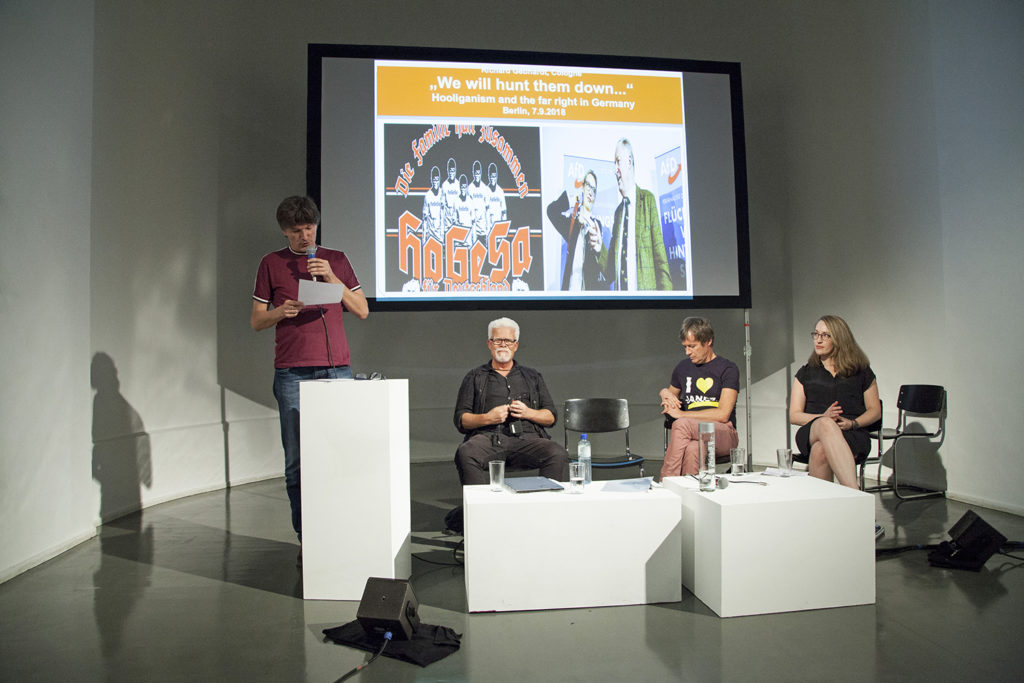
Gebhardt’s intervention began indeed with a quotation by the leader of the alt-right party Alternative for Germany: “We will hunt them down.” The parliament member was suggesting that the new members of parliament from his political formation would use their new powers to hold Angela Merkel’s government to account for its refugee policies “to reclaim their country and people.”
At the time of the Conference only a few days had passed since right-wing extremist thugs and neo-Nazis organized an assault on foreigners in the German city of Chemnitz on the 26th and 27th of August, in reaction to a murder that happened a few days before. It was a shocking moment for many Germans. However, in the following days politicians and members of the German government have tried to downplay the events, showing that big moderate parties tend to favor a certain kind of narration. Far-right violence in Germany has indeed seen a sharp rise in the last period. In this context the guest talked about the group “Hooligans gegen Salafisten” also known as HoGeSa (Hooligans against Salafists) and its origins.
On October 26, 2014, in Cologne the HoGeSa organized its first rally against Salafism. The number of participants can be ultimately estimated around 4.000 people, violent hooligans, who threw stones, bottles and firecrackers. They gathered in Cologne Central Station, with several speakers and live music, and to later march through the streets of Cologne. Xenophobic and neo-Nazi slogans were frequent, and so was the Hitler salute. During the riots dozens of police officers were injured and several police cars were damaged. Police were surprised by the inclination to excessive and unpredictable use of force. In that year thousands of refugees were traveling to Germany from conflict-ridden Middle Eastern countries and the HoGeSa was already targeting them.
In the days immediately after the demonstration, leading German politicians and prominent jurists sought to give a lighter representation of the events. The first official comments to the HoGeSa demonstration were not referring to it as a neo-Nazi demonstration, stressing the fact that hooligans are “for the most part politically indifferent” and that “they are not political but antisocial. They meet just to fight and drink.” The motto “Fußball ist Fußball und Politik bleibt Politik“ (football is football, politics stays politics) was repeated often but did not sound convincing at all. The Hooligans gegen Salafisten represented undeniably a new network of neo-Nazis, that had joined forces with football hooligans, nationalists and other right-wing extremists. Thousands of football supporters appeared to have left their football clubs of choice behind in favor of uniting against a common enemy: Islam. They chose their name HoGeSa hoping to receive popular support by recalling the fight against Islamist extremists.
Nonetheless, not every hooligan is a neo-Nazi. Press reported that in Hannover, for example, hooligans and ultras distanced themselves from the demonstration of HoGeSa and non-fascist football Ultras and that groups in Aachen, Dortmund, Duisburg, Braunschweig and Düsseldorf say they have been threatened, chased down and beaten by these Nazi-hooligans. Gebhardt suggested to the audience of the Conference a book, “Among the Thugs” by Bill Buford, to better understand the dynamics behind hooliganism. The book follows the adventures of Bill, an American writer in England, as he explores the world of soccer hooligans and “the lads”. Setting himself the task of defining why young men in England riot and pillage in the name of sports fandom, Bill travels deep into a culture of violence both horrific and hilarious.
Gebhardt portrayed these extreme right-wing rioters from HoGeSa as men, claiming to be equally distant from conservative and progressive parties, who want to be seen just as football supporters that are not carrying any ideological content, neither that of the Left nor of the Right. However, the nonpolitical hooligan is a myth: they are the heirs of a fascist tradition based on prevarication, arrogance and violence, that plays with the aestheticization of fighting and war, the glorification of militarism and pseudo-heroism. They are not worried citizens, they are thugs “ready for a civil war.” They claim to speak for the silent majority of their community, defending their country and their people. The work of Gebhardt can be seen in a documentary “Inside HoGeSa” (2018) and in his articles online.
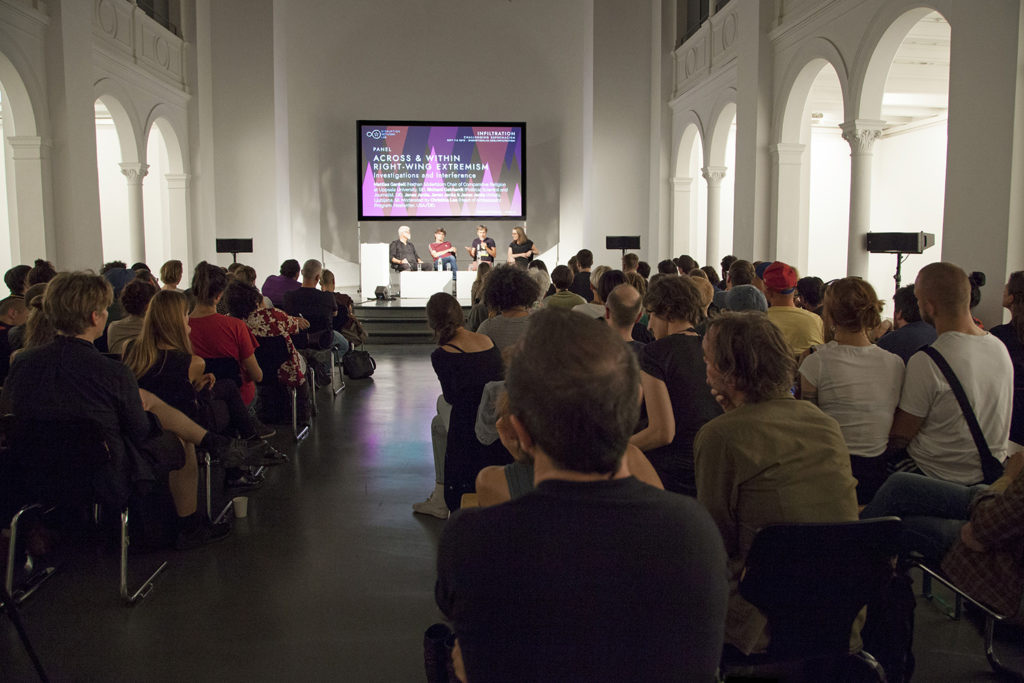
The last guest of Friday’s Conference was a member of the project ”Janez Janša, Janez Janša and Janez Janša,” who run for office in Slovenia at the last 2018 elections, confronting the leader of the conservative Slovenian Democratic Party (SDS), and former Prime Minister, Janez Janša. “Old names, new faces” was their motto.
In 2007 three artists decided to legally change their name to Janez Janša and joined the right conservative Slovenian Democratic Party (SDS, which was originally a moderate political formation). Janez Janša is also the name of the former President of Slovenia. All of a sudden, there were at least four Janez Janšas in the country: the three artists and the politician famous for his aggressiveness and contentiousness with the opposition and anyone who dares to criticize his choices. At the time President Janša made a public statement about the artists and pro-government media started to comment on their name change criticising their “politicized art”. The activity inside the SDS of the artists served to explore the bureaucratic and political systems of their home country. Their work of investigation is instead much more complex. It reveals how the perceptual influence of a name can interfere with social dynamics. Both on a collective and subjective dimension, they researched the meaning of identity and sectioned how their private life was affected by such name change. They proved that names are just a convention, an instrument, but with a relevant role. Janša remembered as an example that the Slovenian Democratic Party, despite this name, turned into a radical, right and conservative party between 2000 and 2005. Nowadays it is engaged in anti-migrant rhetoric and populist right-wing propaganda.
The artist illustrated how, in the last decade, the Janšas responded with art, cleverness and culture to campaigns of hate and propaganda, an approach that is the base for their political interventions. Their experience was the subject of the documentary from 2012, “My Name Is Janez Janša” and is internationally known. Artists and academics are still pondering about the meaning of the Janez Janšas experience, political critique, art work, activism, provocation or never-ending joke.
During the conclusive debate all panellists agreed that the world they have been in touch with and that they described in the Conference is mostly a world of men. Women are generally present as an accompaniment and/or an accessory. It is certainly a characteristic of Fascism, described in literature and art, as designated in the book “Male Fantasy” by Klaus Theweleit, where the author talks about the fantasies that preoccupied a group of men who played a crucial role in the rise of Nazism. Proto-fascists seeking out and reconstructing their images of women. Another aspect that all three guests agreed on, is the fact that individuals are massively not voting or taking part in public life, since they are increasingly distrustful of traditional media and politicians. European moderate politicians have on the other side the responsibility of a systematic dismantlement of social rights, they justified and supported an unequal economic system of wealth distribution for too many years. Now, scandals and arrogance in public and institutional life do not seem to affect the popularity of extreme right parties, that are ridiculing the excess of fair play and the interests of those moderate politicians.
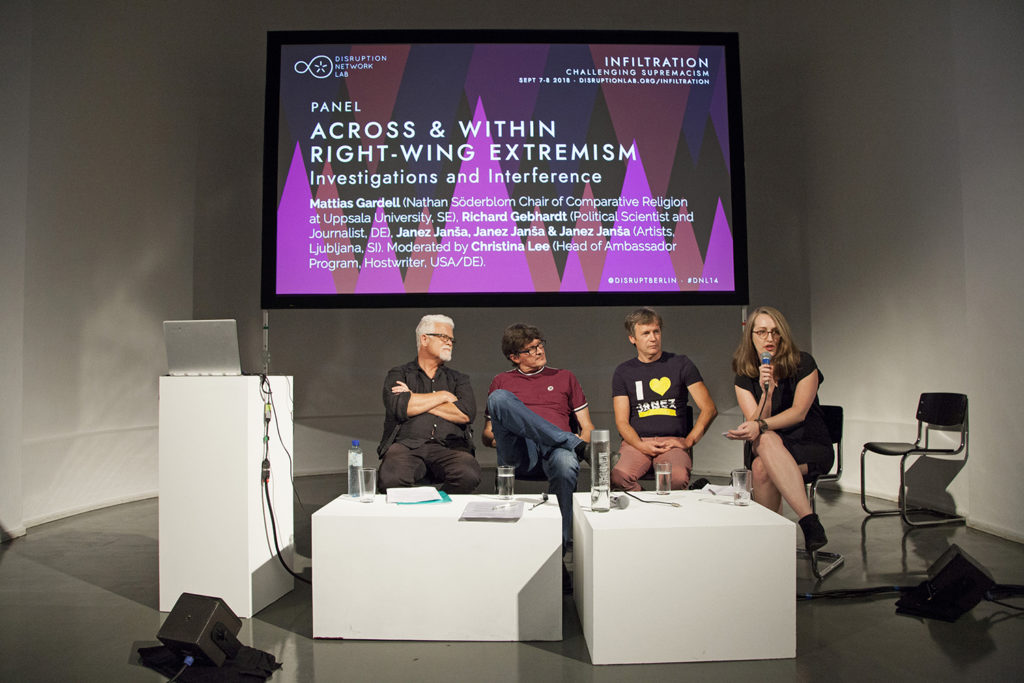
Focusing on new strategies to directly provoke change, the Conference on the 8th of September began with a performative conversation between Stewart Home (artist, filmmaker, writer, and activist from London), and Florian Cramer, (reader in 21st Century Visual Culture at Willem de Kooning Academy in Rotterdam), moderated by Tatiana Bazzichelli, artistic director of the Disruption Network Lab. The universe of the extreme-right seems to have embraced a path of transgression, arrogance and nonconformity, employed to suggest that its members are holders of a new alternative approach in cultural, political and social criticism. What comes out from such a wave of counterculture is an articulated patchwork that flirts with violence, discrimination and authoritarism.
Bazzichelli asked the audience to question the nowadays extreme right self-definition of their political offer as an “alternative,” considering that the issue of transgression and counterculture has been widely developed by academic and artistic Left, and that experimentation, theorisation and political antagonism have been growing together in the left-leaning universe. In such a perspective, “working on something alternative” – explained Bazzichelli – is supposed to be synonymous with creating a strong criticism of media and society, through political engagement, art and intellectual efforts. An alternative that could enhance a positive, constructive contribution in the collective socio-economic discourse. Today, words like “infowar” and “alternative” tend instead to be associated with a far-right countercultural chaotic production. On this basis, Bazzichelli introduced the lecture by Stewart Home and Florian Cramer, that investigated if and to which extent it is possible to affirm that ideas and values driven from the Left are now reclaimed and distorted in an extreme-right alternative narrative.
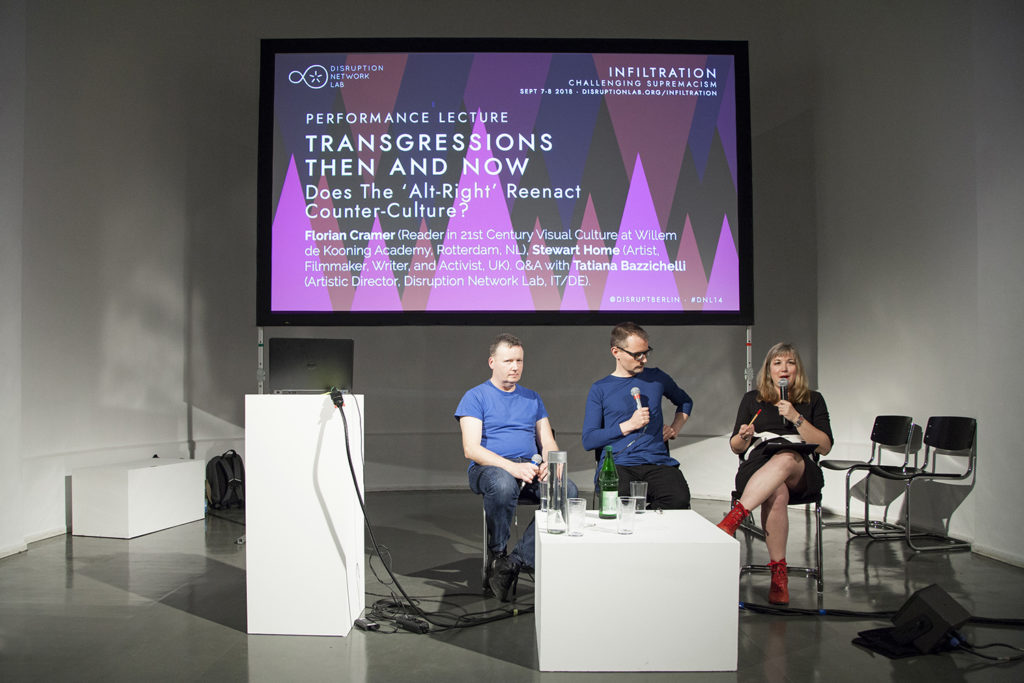
In an historical excursus on art, literature and subcultures, the two speakers focused on the 1970s-1990s counter-cultural currents that used radical performance, viral communication and media hoaxes and examined the degree to which they may be seen as playbooks for the info warfare of the contemporary extreme right. With their presentation they suggested that it is improper to state that the alt-right has now occupied established leftist countercultural territories. There have been several examples of a parallel development and interpenetration of very opposite points of view over time. Tommaso Marinetti, father of Futurism and its Manifesto about “War, the World’s Only Hygiene,” mixing anarchist rebellion and violent reaction became then a fervent supporter of the Italian Fascism, that glorified the new futuristic approach. However, Futurism means also sound poetry, since discordant sound had a vital role in Futurist art and politics; an experience that developed into the noise movement with an influence that reached post-industrial musicians and further.
Cramer remembered that Futurism represents also an avant-garde and counterculture from the 1900s, that had similarities with Dadaism. In fact, though Dadaism was anti-war and antibourgeois, they shared a spirit of mockery and provocative performances, mixing distant genres and a massive use of communication, experimental media and magazines. Always considering the beginning of the 20th Century, the lecturers recalled the production of the painter Hugo Höppener Fidus, expression of the Life Reform Movement, linked both to the left- and the right-leaning political views, that strongly influenced Hitler and Nazism, showing roots of an alternative counterculture that went both into the political extreme right and left.
In the 1970s and 1980s, in subcultural production and artistic performances it was frequent the use of fascist symbols as provocation and transgression, for example in the punk scene, which ranged notoriously from left wing to right wing views as pseudo-fascist camp in post-punk culture turn into actual Fascism. A conscious ambiguity, part of experimentation, that – particularly in the U.S. – meant also leaving space to things that were in contrast to each other. In the context of US underground culture, the speakers mentioned publications like those from Re/Search “Pranks!” on the subject of pranks, obscure music and films, industrial culture, and many other experimental topics. Pranks were intended as a way of visionary media manipulation and reality hacking. Among the contributors, you could find artists from the industrial movement, like the controversial Peter Sotos and Boyde Rice, who became today established part of right-winged countercultural movement.
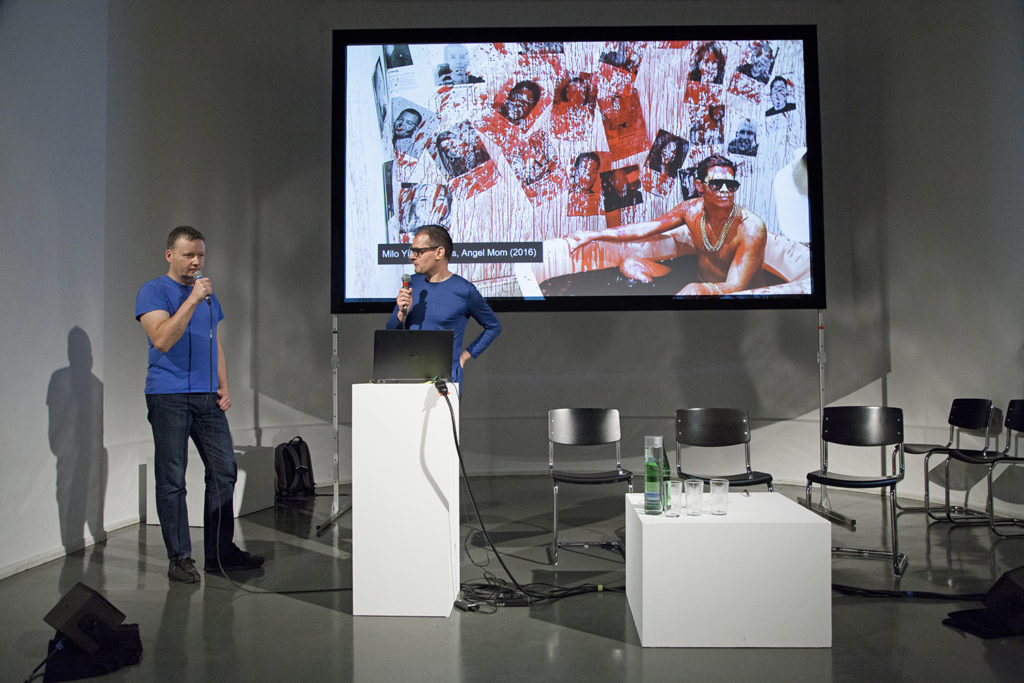
Talking about the present, Cramer and Home also mentioned Casa Pound, a neofascist-squat and political formation from Rome, that adopted the experience described by the anarchist writer Hakim Bey of the “temporary autonomous zones,” that redefined the psychogeographical nooks of autonomy – as well as appropriated the name of Ezra Pound, a member of the early modernist poetry movement.
All this suggests that the so-called alt-right has probably not hijacked counterculture, by for example deploying tactics of subversive humour and transgression or through cultural appropriation, since there is a whole history of grey zones and presence of both extreme right and left in avant-garde and in countercultures, and there were overlooked fascist undertones in the various libertarian ideologies that flourished in the underground. Home and Cramer reminded their common experience in the Luther Blissett project, based on a collective pseudonym used by several artists, performers, activists and squatter collectives in the nineties. The possibility to perform anonymously under a pseudonym gave birth to a mixed production, with undefined borders, in few cases expression of reactionary drives. An experience that we can easily reconnect to the development of 4chan, the English-language imageboard very important for the early stage of Anonymous, that today is very popular among the members of the Alt–Right scene,
Cramer illustrated so how Libertarianism can sometimes flip into a reactionary ideology. The same can be for Anarchism (with the Anarcho-Capitalism) and Cyberlibertarianism, just like for the subcultures. In the Chaos Computer Club – explained Cramer – there is a strong cyberlibertarian component, but we might find also grey zones where a minority of extreme-right can find ways to express itself. Spores of extreme-right and fascist-anarchical degeneration can so be found in the activities of political and art collectives from the Left and, in this sense, it looks necessary to expose their presence in relation to those grey areas, that could become a context for spreading ambiguous points of view within cultural production.
Marinetti, Pound, Heidegger, have a general relevance that cannot be denied. Home and Cramer underlined that, at the moment, nothing of what we see internationally in the extreme-right panorama can be considered culturally relevant. The alt-right is not re-enacting counterculture. This “alternative” of the extreme right consist mostly of a cluster of media outlets producing hate and propaganda, within a revisionist narrative. It picks up an old rhetoric about heroic rebellion, arrogance, overbearing masculinity, mythization of war and the use of violence, in most cases using new definitions for old concepts. Home and Cramer concluded that there is no intrinsic value in being transgressive, and transgression alone cannot be enough to gain any kind of attribute of quality. Because transgression is just a tool. Artists and activists cannot stop experimenting and using the tool of transgression to criticise society, building alternatives and being alternative. The moderate approach in an era of political correctness is a way to enchain the Left; moreover people have the right to hate their condition, hate their job and the inequalities that affect their lives. This feeling is legitimately generated by a critical thinking.
The panel of the second day of the conference reflected on the practice of political, journalistic and activist infiltration as a way of better understanding extremist groups. The moderator explained how from one side infiltration maps extremist groups from the inside, and from the other, it analyses how extremist groups are building their networks, becoming widespread in online and offline. The aim is to explore such groups from within, analysing the reason for people to join them, as well as understanding their inner dynamics.
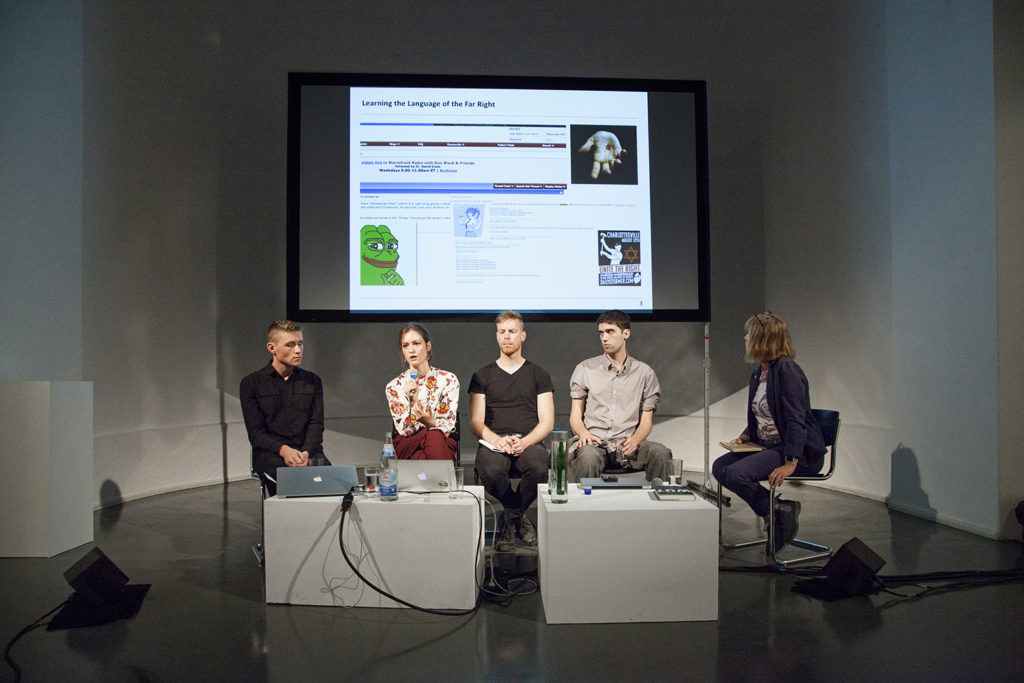
Rebecca Pates, Political Anthropologist from the University of Leipzig, moderated the discussion and introduced the four guests, commenting that a number of different things can be done when infiltrating. The activities and the achievements can differ, and so the technique, from total concealment in infiltration to openness about it. Pates suggested that from the inside it is possible to understand for example the reason why young people are attracted by groups that from the outside look so angry and violent, and it could be defined the sense of comradeship and belonging that convinces individuals to participate into these movements.
Julia Ebner is a Research Fellow at the Institute for Strategic Dialogue (ISD) and author of the bestselling book The Rage: The Vicious Circle of Islamist and Far-Right Extremism. She opened the panel explaining how, after the terroristic attacks from right extremists in Europe and in the US, she decided to get a better understanding of the world of the far-right and their narrative. She infiltrated both online and offline, undercover, with fake identities and avatar accounts, changing her appearance. Her goal was to get into groups that are very different ideologically one from the other, like the neo-Nazi, the old conservative fascist movements and the counter Jihad movement. During her speech she described how she built up a new identity and made connections necessary to her purpose.
To get in touch with active members she used some social media and crowdsourcing platforms available for the extreme-right, such as “Gab”, the alt-right equivalent of twitter, “Wasp love”, a place to date “reformed Christians, confederate, home-schooled, white nationalists, alt-right and sovereign singles.” She was asked to send a full account of her genetic ancestry to be accepted or to share a picture of her skin colour. She had voice chat interviews to enquire about her ideological background or sexual orientation. Ebner entered an alternative universe of disinformation ecosystems and accessed subcultures that interact in parallel as a part of a same bigger network. When she was asked to justify fresh profiles, that she just created, she could benefit from the fact that many far-right users are removed and banned for what they post. She started frequenting all the different tech platforms considered a safe environment for far-right extremism, where they could very openly cultivate antisemitic and conspiracy theories, anti-left rhetoric, coordinate doxing and harassment activities. In 2016 the writer and researcher joined undercover the English Defence League and went to a rally of theirs against what they would call Muslim grooming gangs. A year later she was then recruited into the movement Generation Identity or Identitäre Bewegung, always as part of the new European alt-right (alternative right) and was invited to join them in public and private meetings, like a secret meeting in an Airbnb location in Brixton. In that occasion she was sitting among 20 white nationalists discussing their strategies to launch a British branch of their group, with a manifest focus on optics and media strategy briefings, to learn how to deal with tough questions from journalists about anti-Semitism and racism. They discussed about their political background and their selection procedures in order to achieve a good branding and quality in their membership. The obsession of appearing as decent citizens in public was and is very important in rallies like Charleville. Reports attest indeed that far right groups were concerned about how to dress and even told some people, not particularly good looking, that they could not join the event as they would not make a good impression. Events like Chemnitz, Charlottesville’s “rally to unite the right” or the experience of Defend Europe – an illegal far right ship that sought to hamper the rescue of refugees in the Mediterranean in 2016 – represent a cross-border collaboration between movements that until few years ago were not communicating. These events bring them together on the basis of their lowest common denominator for the sake of having a bigger impact.
After Ebner wrote an article for the Guardian and for the Independent she got backlash from the far-right and the English Defence League. Its founder, Tommy Robinson, ended up storming into her office with a cameraman, filming the whole confrontation and live streaming it to Rebel Media, a far-right news outlet in Canada. The influencer has 300.000 followers and these channels are very popular too. They gave immediate resonance to the aggression and set off a long chain reaction among other far-right and alt-right news platforms, globally. Her whole life got under attention, they used all available data to publicly discredit her. The researcher realised how much it is possible to do with online data to intimidate political opponents or people who criticize. Ebner and her colleagues experienced the hate campaign machine. She noticed that women are more attacked and threats, symptom of the wide anti-feminist and mesogenic culture. It seemed to her that the whole universe was against her activity of infiltration and that she had no supporters. Many different groups and networks were creating a distorted representation of her engagement, and this pushed her to embark on a research project about the interconnectedness of the variegated far-right media galaxy.
With other colleagues Ebner analysed about 5.000 pieces of content, accomplishing a lot of linguistic analysis, and studying interactions with social media monitoring tools. Thanks to this work the researcher can describe the mainstreaming strategies of the extreme right and how its members try to create compelling and persuasive countercultural campaigns using humour, satire and transgression and co-opting Pop Culture. An attitude common with the fundamental Islamism is they are creating content that has appeal on young people on the Internet but they are also concentrated on the traditional media, to make sure that they pick up on their provocations or fake news. They trigger media to report on them by staging online complaints that would go viral. Ebner has also started a project in collaboration with the organisation #ichbinhier e.V., discovering that this technique of coordinated interactions often creates the illusion that they represent the majority of the users. The research shows something different: 50% of the interactions or of the hateful comments below news articles, that they analysed, came from just 5% of all active accounts. A small but very loud minority of people that is now dominating the whole discourse amplified by bots or a media outlet sometimes also Russian ones, staging online psychological operations, jokes and meme to hide extreme right hatred campaigns behind humour-images.
Memetic warfare and gamification are two very relevant aspects, as frequent as quotations from the movies Matrix and Fight Club, with the rhetoric of the red pilling to see the truth. Most of the accounts active in this activity were coordinating posts and hashtags so that their content could get prioritised in the feeds and create viral campaigns, striving to dominate the whole social media discourse. They have very clear hierarchies, which could be ascribed to the gaming dimension too. Hateful comments and negative interactions appear in a flow, getting soon in the top section due to a high degree of coordination. Generation Identity is known for sharing content according to the tactics of the so-called media guerrilla warfare manual, based on a very militarised language, that describes actions, goals and sniper-missions to target and intimidate political opponents exploiting media. All comes in a very gamified way, as they talk about a virtual battlefield and electronic items, where a good performance allows to grow of level. During the German elections in 2017 members and followers of Reconquista Germanica (an extreme-right channel running on the Discord platform) were quite successful in spreading extreme-right topics and making politicians and media pick up on them. Some of their hashtags were often listed in the top 5 trends in the two weeks before the vote. In the meantime, they were evaluating and analysing their activity, celebrating successful “generals” or “soldiers” that were promoted into higher levels. Ebner expressed her concerns as this reflects in in real-world practice what they would do if they manage to establish their own vision and get in power. Since Trump was elected we’ve seen a growing ecosystem that repeats itself, where extreme-right is certainly reappearing. It is indeed possible to spot similar tactics and vocabulary among several European far-right groups, in the campaigns of Italian, German, French, Swedish and Dutch elections. She underlined how important it is to understand far-right extremism better and the relationship between Islamist and far-right extremism, as they have a lot in common and are reinforcing each other.
Anti-racist activist and “Hope Not Hate” researcher Patrik Hermansson reflected on the meaning of radical right-wing practices today bringing his direct story as undercover activist inside the international Alt-Right, and published in The International Alternative Right Report. Starting in the fall of 2016 he joined a London based organisation and then travelled through many other related groups, living a dual life. He described his year of infiltration inside an international secret formation called London Forum, for which you need to be vetted, background checked and have someone who lets you in. Hermansson works as a researcher for Hope Not Hate, an organisation established to offer a more positive and engaged way of doing anti-Fascism. This 26-year-old man has been “Erik”, a fascist who came to London inspired by Brexit and to get away from the liberal prejudice of Swedish universities. He entered and investigated the Forum, discovered members, techniques and goals, until he witnessed the terrible violence in Charlottesville, Virginia. To do so, Hermansson had to become a Swedish teacher of a member and was quickly driven into the world of the extreme right. From former Tory Party members to famous alt-right influencers, he met people in different countries and different social context. It was a safe space of anonymity, that you do not find on Social media.
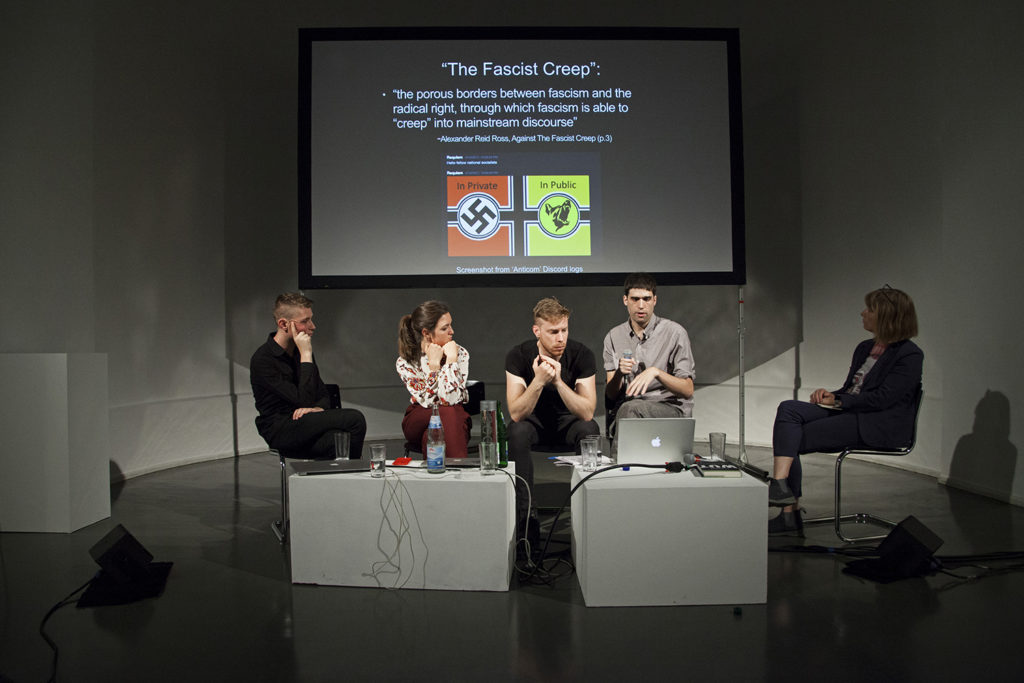
Hermansson described to the audience of the Conference the social aspects animating the group, where members can feel part of a community, make new friends even overcoming political differences until they have anything else outside. Conspiracy theories have a relevant role too. Holocaust denial, addressed as “the biggest PR event in history”, or the chemistry rails, are important part of their theorization. They feel part of a group that is bound together by secrets that allow you to see behind the curtain and make you understand more than the rest of the population. Hermansson pointed out that the activity of infiltrate is a difficult and immoral business. It exploits people’s trust. It is justified by the need to expose techniques of recruitment, data, but we should not romanticize, not to go too far not to be ruthless. Hermansson infiltrated for a purpose, to get a closer image of right extremism and decided to expose the top players of the organisation, musicians and influencers. The most effective part of the activity, he said, was the sabotage. Infiltration makes people point fingers, paranoia spread in the movement and things broke apart. Hermansson explained that it was a conscious decision: the anti-fascist part of the research. The London Forum is not active anymore, people left it showing that the method of exposure is quite effective. He found out that his activity raised the cost of their recruiting process, which is now much tighter.
The panel was concluded by a member of the Unicorn Riot collective, “a decentralized non-profit media organization of artists and journalists, dictated to exposing root causes of dynamic social and environmental issues through amplifying stories and exploring sustainable alternatives in the globalized world.” The investigative journalist Christopher Schiano presented his work of analysing and publishing of leaked messages from white supremacist, neo-Nazi and various alt-right fascist groups in the US – followed by an introduction of the DiscordLeaks platform by the developer Heartsucker, who is working as an affiliated volunteer for the Unicorn Riot. The guests talked about how Unicorn Riot has obtained hundreds of thousands of messages from white supremacist and neo-Nazi Discord chat servers after the events in Charlottesville, and decided to organise and open a far-right activity centre to allow public scrutiny through data journalism.
Discord is a voice-over-Internet Protocol (VoIP) application for video gaming communities, offering text, image, video and audio communication between users in a chat channel. The US non-profit media organisation with its Discord Leaks has exposed hundreds of thousands of chats from alt-right and far-right servers received. Parker was receiving screenshots of real-time communications between alt-right activists involved in planning the Charlottesville rally and got a “general orders” document, along with audio recordings of a planning meeting ahead of the rally. The screenshots kept then coming throughout the following days.
As reported by the Washington Post, Discord allowed the organizers and participants of the rally to convene in private, invite-only threads shrouded in anonymity – with usernames such as “kristall.night” and “WhiteTrash.” On a Discord server called “Charlottesville 2.0,” they planned everything from car pools, dress code and lodging in Charlottesville to how one might improvise weapons in case of a fight. Some suggested using flag poles as a makeshift spear or club. Many of these things took place. The collective received also internal logs, which enabled them to better see the scope of plans for the Unite the Right rally. Since its founding, Unicorn Riot has gained relevance among people looking for alternative news sources, principally covering protests with an on-the-ground perspective that many mainstream outlets miss. Unicorn Riot was for example among the first media outlets to get to the rally in Charlottesville and cover it. Through their investigation they explained how the far right tries to recruit new member via Discord, or they unveiled the attempts of extremists to look like ordinary Trump’ supporters, building a victim narrative to insinuate the idea that they are targeted citizens. Some of them are supporting the police and members of the police force have been exposed for leaking information to far-right members. They exposed the movement Anticom, anti-communist action, active mostly in shitposting, and the group Patriot Front, whose members unite under the motto “we are Americans and we are Fascists.”
At the end of the three the panellists reasoned on the importance of infiltration, as a means to study the extreme right and expose their networks and members, their strategies and tactics. It can also be helpful to try to predict what these groups are about to do, foreseeing their next step. It means getting in touch with them, entering their circles based on comradeship and exchange of personal experiences. Ebner commented that the use of lies and distortion is the cost of it, wondering, however, about what the cost of inaction is instead. Hermansson reported about the effects of infiltration in terms of the desensitisation he went through, taking part in conversations without reacting. The same desensitisation process can be described in the memetic warfare.
As part of the Disruption Network Lab thematic series “Misinformation Ecosystems” (2018), this 3-days-conference concluded the 2018 programme of the Disruption Network Lab. The series began with a focus on hate-news, manipulators, trolls and influencers, that investigated online opinion manipulation and strategic hate speech in the frame of a growing international misinformation ecosystem, and their impact on civil rights. HATE NEWS focused on the issue of opinion manipulation, from the interconnections of traditional and online media to behavioural profiling within the Cambridge Analytica debate. This second conference took the process further by pointing to specific researches and investigations that illustrated how a process has clearly set in motion, whereas radical right is currently working on an international level, building cross-national connections and establishing global cooperation.
Not just Steve Bannon and a galaxy of media outlet and online platforms are pushing for a new authoritarian turnaround, based on discrimination and ultra-nationalism, having factual impact on political systems. On a grassroot level, there are local networks and formations able to unite different realities and backgrounds, melt together under new trendy labels, slogans and influencers. A new scene that is carefully designed to be appealing to moderate-leaning electorate, where you can find hooligans, hipsters, neo-Nazi and politicians dressed in suits and ties, all striving to appear like conscious citizens and decent members of society, part of a new generation of activists. However, beyond the facade, the majority of far-right groups shows to be against an open, multicultural society as well as against inter-religious and inter-cultural togetherness. They play with economic uncertainties, fear, anger and resentment to spread hate, attack opponents and discriminate minorities, often through a meme-driven alt-right humour, designed to cover with dark hilarity their racist propaganda and fascist drives. Jokes are used by public figures and influencers to promote misogyny, homophobia, a distorted idea of masculinity, racism and justify unacceptable statements. Too often mainstream media and newspapers pick up staged news from such misinformation ecosystems, enforcing a revisionist narrative built on manipulated facts and interactions, arrogance and violence.
Conspiratorial and paranoid thinking acts like a catalyst, provoking participation and fascinating individuals, who want to become warriors and custodians of knowledge. Alongside the image of the angry white man, there is a whole narrative of love and solidarity for their chosen group, the community they decide to protect, identified on utilitarian basis.
Despite of what is represented in media, many speakers at the conference pointed out that there is neither something alternative nor innovative in what they are offering. However, mainstream parties and media tend to follow their reactionary narrative, enforcing the idea that it is competitive. The guests of the Disruption Network Lab came from Africa, Europe, North and South America and exposed an intertwined scenario of transnationalism of the radical right. The direct engagement of activists, that decide to infiltrate, together with the work of researchers, journalists and artists, allowed for a clearer image of what is going on at a global as well as local scale, to understand how it is possible to interrupt this process working actively within the civil society. Sabotage and exposure are instruments useful to disrupt and unveil strategies aimed at sending the world back of a hundred years of human rights achievements. Thanks to Tatiana Bazzichelli and the Disruption Network Lab team, who offered a stage to learn about constructive practices that can be activated in order to change the course of things.
–
INFILTRATION: Challenging Supremacism
SEE VIDEO DOCUMENTATION OF THE CONFERENCE
SEE PHOTOS FROM THE CONFERENCE
What happens to the hole when the cheese is gone?
Bertolt Brecht
Transient Hole (Variations) is a hybrid curatorial project and symposium by Viennese artist and curator Alexander Felch. The project`s title refers to a concept for a media artwork, that cannot, properly speaking, be materialized for it deals with a moving void – a transient hole.
Across the floor of a white, three-dimensional room a little black hole is constantly and randomly moving. The hole is simultaneously there and not there. It is a portal to nowhere. But is it really? Might it not lead to transcendence, to another reality, or perhaps our reality can only be understood through this liminal presence of nothingness?
The participants are invited to provide their own interpretation for this problem and develop means to represent it, whether through art or science, to display processes that cannot be depicted in reality. The aim of the project is obviously not to find a solution to this existential paradox but to bring about a reflection on the topic from a myriad of disciplines and different perspectives, which explore the limits of representation. The various responses to the THR problematic will be gathered in a collected volume that is in itself a reflection on the boundary between art and science, reality and fantasy.
The project appears – just like the transient hole – in different cities popping up in various forms and is accompanied by lectures, talks and (sound-) performances.
Contributions by:
Atzgerei Productions, Arnold Berger, Ryan Mc Donagh, Sophie Dvorak, Alexander Felch / Aisek Ifraimov, Mariana Ferreira / Dayjon Edwards, Christoph Höschele, Hrvoje Hirsl, Harald Hund, Sandy Leong, Stefan Lutschinger, Nicholas Moloney, Anja Nowak, Jaysha Obispo, Shinji Toya, Jeroen van Amelsvoort, Anna Vasof, Stefan Voglsinger, Jan Vormann, Yilin Wang, David Wauters, Hui Ye.
Featuring concepts developed by students of Middlesex University London – BA Digital Media and BA Media and Cultural Studies
Monday 12 November – Friday 16 November 2018
Middlesex University
FREE
Saturday 17 November 2018, 11:00 – 16:00
Furtherfield Gallery
FREE
13:00
Opening
14:30
Introduction and Guided Tour
Alexander Felch “Transient Hole Research – Instationarity as an artistic concept / a scientific particularity”
Saturday 17 November 2018, 16:00 – 21:00
Furtherfield Commons
FREE
16:00
Limehouse Hole Atlas Datathon
Navino Evans and Sean McBride (http://histropedia.com/)
18:00
Sound Performances
Karl Salzmann (A) is a sound & visual artist, curator and researcher currently based in Vienna / Austria. Within process-oriented and experimental setups, he develops and presents works that study the materiality of sound and its social, cultural and metaphorical levels of meaning. His artistic activities mainly concern the interaction between sound and visual arts and often relate to works and topics of (sound) art history.
http://www.karlsalzmann.com/
T_A-Z (Paul Gründorfer) (A) is using process-related setups to explore sonic worlds and to realise site specific interventions, developing real time audio systems, that act autonomous or in reference to the spatial constellation. While considering the encounters between analog and digital, structured or improvised elements, he is focusing on the abstract occurrence of sound and its physical impact.
Electronic circuits are interconnected to cause semi-natural entities, autonomous organisms. Voice and articulation are generated through loops in feedback networks. Onomatopoeia.
His artistic activities examine variable connections between transmitter-receiver networks, which function as a conceptual framework for experimentation with sound and transmission of information.
http://tricx.net/
Monsterfrau Lena Wicke Aengenheyster (A/D) – MONSTERFRAU PJ (Performance Jockey) – Part III of the performance serial MONSTERFRAU The voices’ bodies: MONSTERFRAU triggers, mixes and morphes dance music rythms, samples and sounds with her movement. STAATSAFFAIRE: Production of and reflection through artistic projects in music and performance art. Beyond that it is the common optimisation of production environments and network.
http://www.staatsaffaire.com/
–
Visuals:
Simon Sarginson (live coding) (UK)
London edition curated by Alexander Felch + Stefan Lutschinger
Realised in cooperation with Cybersalon, Middlesex University London and the Austrian Cultural Forum London – with kind support by the Federal Chancellery Of Austria.
–
www.facebook.com/transienthole/
www.mdx.ac.uk
www.cybersalon.org
www.furtherfield.org
DOWNLOAD CURATORIAL STATEMENT
SEE IMAGES FROM THE PRIVATE VIEW
Feature image: Jeremy Hutchison, Movables, 2017. Photo courtesy of the artist.
We live in a time of stark and often violent paradoxes: the increasing liberalisation of social values in some parts of the world compared to increasing fundamentalism in others; the wealth of scientific discovery and technological advances in contrast to climate denialism, “post-factual” and conspiracy-driven politics; freedom of movement for goods and finance while individual movement is ever more constricted and subject to law; a drive towards agency, legibility and transparency of process while automation, computerisation and digitisation, render more of the world opaque and remote. At every level, mass movement of peoples and the rise of planetary-scale computation is changing the way we think and understand questions of geography, politics, and national identity.
These ever-increasing contradictions are seen most acutely at the border. Not merely the border between physical zones and between nation states, with their differing legal jurisdictions and requirements for entry and residency, but also the border between the physical and digital, when we apparently – but perhaps misleadingly and certainly temporarily – cross over into a different zone of possibility and expression.
This contradiction is also clear in the balkanisation of newly independent and fragmenting states, and in the rising current of nationalism across Europe, which seems to run in parallel to, and might even be accelerated by, digital connectivity. Some of the most outwardly regressive powers themselves employ what Kremlin theorist Vladislav Surkov has called “non-linear strategy”: a strategy of obfuscation and deliberate contradiction clearly indebted to the convolutions and confusions of the digital terrain – and of art. As ever more varied expressions of individual identity are encouraged, revealed, made possible and validated by online engagement, so at the same time a desperate rearguard action is being fought to codify and restrain those identities – online and off. These new emergent identities are, inevitably and by necessity, transient and contingent, slippery and subject to change and redefinition.
The artists featured in Transnationalisms address the effect of these pressures on our bodies, our environment, and our political practices. They register shifts in geography as disturbances in the blood and the electromagnetic spectrum. They draw new maps and propose new hybrid forms of expression and identity. In this exhibition Transnationalisms acknowledges and even celebrates the contradictions of the present moment, while insisting on the transformative possibilities of digital tools and networks on historical forms of nationalism, citizenship, and human rights. While the nation state is not about to disappear, it is already pierced and entangled with other, radically different forms. Alternative models and protocols of citizenship, identity, and nationhood are being prototyped and distributed online and through new technologies. Transnationalisms examines the ways in which these new forms are brought into the physical world and used to disrupt and enfold existing systems. It does not assume the passing of old regimes, but proclaims the inevitability of new ones, and strives to make them legible, comprehensible, and accessible.
Raphael Fabre CNI, 2017
On April 7th, 2017, Raphael Fabre submitted a request for a French ID card. All of his papers were deemed to be legal and authentic and so the demand was accepted and a new national ID card was issued. In fact, the photo submitted to accompany this request was created on a computer, from a 3D model, using several different pieces of software and special effects techniques developed for movies and video games. Just as our relationship with governments and other forms of authority is increasingly based on digital information, so the image on the ID is entirely virtual. The artist’s self-portrait suggests the way in which citizens can construct their own identities, even in an age of powerful and often dehumanising technologies.
Jeremy Hutchison Movables, 2017
The starting point for this work was a found photograph, taken by police at a border point somewhere in the Balkans. It showed the inside of a Mercedes, the headrests torn open to reveal a person hiding inside each seat. This photograph testifies to a reality where human bodies attempt to disguise themselves as inanimate objects, simply to acquire the same freedom of movement as consumer goods. Movables translates this absurdity into a series of photo collages, combining elements of high-end fashion and car adverts, enacting an anthropomorphic fusion between the male form and the consumer product. The results are disquieting yet familiar, since they appropriate a visual language that saturates our everyday urban surroundings, highlighting the connections between transnational freedoms and limitations, and international trade.
They Are Here
We Help Each Other Grow, 2017
Thiru Seelan dances on an East London rooftop, looking out towards the skyline of the Canary Wharf financial district. His movements are inspired by the dance form Bharatanatyam, traditionally only performed by women and taught to Thiru in secret by his younger sister. Thiru is a Tamil refugee and when he arrived in the UK in 2010, following six months of detention in Sri Lanka during which he was tortured for his political affiliations, Canary Wharf was his first home. His movement is recorded by a heat sensitive camera more conventionally used as surveillance technology and deployed to monitor borders and crossing points, where bodies are recorded and captured through their thermal signature. The song ‘We’ve helped each other grow’, composed and performed by London based Mx World, was chosen with Thiru to soundtrack the performance. Mx is a prefix that does not indicate gender. In the UK, it can be used on many official documents – including passports. The repeated refrain, ‘We’ve helped each other grow’ suggests a communal vision for self and social development.
Daniela Ortiz
Jus Sanguinis, 2016
Jus sanguinis, meaning ‘the right of the blood’, is one of the main ways in which people acquire citizenship: from the blood of their parents. Daniela Ortiz is an artist of Peruvian descent living in Spain, where only babies with Spanish blood are recognized as subjects with the right to the nationality at the moment of the birth. As a result, her child would not have access to Spanish nationality. In this performance, undertaken when Ortiz was four months pregnant, she receives a blood transfusion from a Spanish citizen, directly challenging the racist and nationalist regime of citizenship which would classify her Spanish-born child as an immigrant.
The Critical Engineering Working Group (Julian Oliver and Danja Vasiliev)
VPN, 2018

Virtual Private Networks (VPNs) have come into increasing demand in recent years, providing route encryption through hostile networks. In China, Vietnam, Turkey and Pakistan they also serve to mitigate government censorship, so that foreign sites otherwise blocked by state firewalls are made available to VPN users (Twitter, Facebook, Wikipedia, activist sites and digital libraries being the most common).
Vending Private Network takes the form of a condom vending machine, such as those typically seen in toilets. Equipped with mechanical buttons, a coin-slot and USB ports, it offers 4 VPN routes, each adorned with an animated graphic depicting a fantasy destination. Audiences are invited to insert a USB stick into the slot, and a coin into the machine, then to select a VPN destination by pressing a mechanical button, a unique VPN configuration file is then written onto their USB stick. Special instructions (in the form of a README.txt) will also be copied to the USB stick that explain how to use the VPN in a special ‘sheathed’ mode that evades detection methods (namely Deep Packet Inspection, or DPI) used by corporations and state-controlled infrastructure administrators. This is the only means known to work against state controlled firewalls, for instance and requires an extra install of freely available, open source software and leverage economic and cultural privilege to benefit those not included. With each VPN config generated, another is covertly shipped to contacts in Turkey, China, Vietnam and Iran (and other countries to be confirmed).
Jonas Staal New Unions, 2016
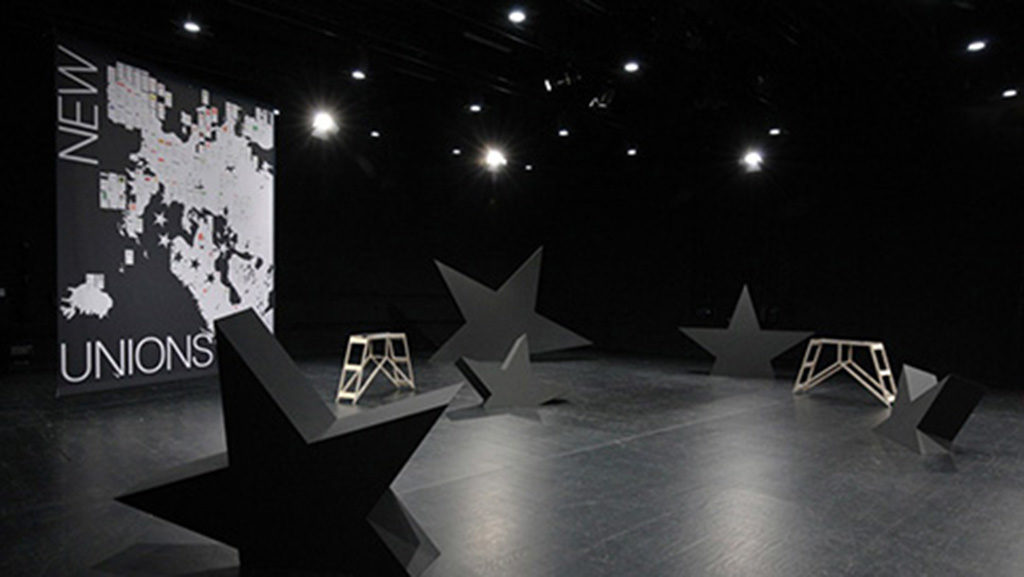
Jonas Staal’s New Unions is an artistic campaign supporting progressive, emancipatory, and autonomist movements all over Europe, and proposing the creation of a “transdemocratic union” which is not limited by the boundaries of nation states. The New Unions map illustrates the recent, massive rise in social movements and new political parties which are creating new models of political assembly and decision making while challenging traditional national and institutional structures. From the civil initiative in Iceland to collectively rewrite the constitution after the economic crash, to regional independence movements and pan-European solidarity groups, these emerging political experiments propose new forms of transdemocratic practices. This map is the first in a series which is continuously updated to reflect the evolving geography of transdemocracy.
The Critical Engineering Working Group is a collaboration between Julian Oliver and Danja Vasiliev. Their manifesto begins: “The Critical Engineer considers Engineering to be the most transformative language of our time, shaping the way we move, communicate and think. It is the work of the Critical Engineer to study and exploit this language, exposing its influence.”
criticalengineering.org
Raphaël Fabre works on the interference of fictions and narrative storytelling in the real world, using techniques ranging from digital 3D technologies to set decoration. Born in 1989, he lives and works in Paris.
raphaelfabre.com
Jeremy Hutchison works with situational performance. Operating in sites of production and consumption, he often collaborates with factory employees, migrant labourers, online workers and jobseekers to examine the structures that limit human existence. How are unequal human relations constructed by global capital? How do consumer products function as portraits of exploitative material structures? In the process of developing these works, each context becomes a stage; a metaphor for the production of reason. To some extent, his projects are rehearsals for an uncertain kind of freedom. He was recently a member of the Whitney Independent Study Program in New York.
jeremyhutchison.com
Daniela Ortiz (Cusco, 1985) lives and works in Barcelona. Through her work, she generates spaces of tension in which the concepts of nationality, racialization, social class and gender are explored in order to critically understand structures of inclusion and exclusion in society. Her recent projects and research revolve around the issue of migration control, its links to colonialism, and its management by Europeanwhite states and societies. At the same time, she has produced projects about the Peruvian upper class and its exploitative relationship with domestic workers. Daniela gives talks and participates in discussions on Europe’s migration control system and its ties to coloniality in different contexts.
daniela-ortiz.com
Jonas Staal lives and works in Rotterdam (NL). He has studied monumental art in Enschede (NL) and Boston (US) and received his PhD for research on Art and Propaganda in the 21st Century from the University of Leiden (NL). His work includes interventions in public space, exhibitions, theater plays, publications and lectures, focusing on the relationship between art, democracy and propaganda. Staal is the founder of the artistic and political organization New World Summit and, together with BAK, basis voor actuele kunst, Utrecht (NL), of the New World Academy.
jonasstaal.nl
They Are Here (f. 2006) is a collaborative practice steered by Helen Walker and Harun Morrison. They are currently based in London and on the River Lea. Their work can be read as a series of context specific games. The entry, invitation or participation can be as significant as the game’s conditions and structure. Through these games, they seek to create ephemeral systems and temporary, micro-communities that offer an alternate means of engaging with a situation, history or ideology. In parallel, they initiate multiyear socially engaged projects that become generative spaces for further works. They Are Here work across media and types of site, particularly civic spaces.
theyarehere.net
James Bridle is an artist and writer working across technologies and disciplines. His artworks and installations have been exhibited in Europe, North and South America, Asia and Australia, and have been viewed by hundreds of thousands of visitors online. He has been commissioned by organisations including the Victoria & Albert Museum, the Barbican, Artangel, the Oslo Architecture Triennale, the Istanbul Design Biennial, and been honoured by Ars Electronica, the Japan Media Arts Festival, and the Design Museum, London. His writing on literature, culture and networks has appeared in magazines and newspapers including Frieze, Wired, Domus, Cabinet, the Atlantic, the New Statesman, and many others, in print and online, and he has written a regular column for the Observer. “New Dark Age”, his book about technology, knowledge, and the end of the future, is forthcoming from Verso (UK & US) in 2018. He lectures regularly on radio, at conferences, universities, and other events, including SXSW, Lift, the Global Art Forum, Re:Publica and TED. He was been a resident at Lighthouse, Brighton, the White Building, London, and Eyebeam, New York, and an Adjunct Professor on the Interactive Telecommunications Programme at New York University.
jamesbridle.com
Furtherfield is an internationally-renowned digital arts organisation hosting exhibitions, workshops and debate for over 20 years. We collaborate locally and globally with artists, academics, organisations and the public to explore digital culture and the changing world we live in. From our unique venues in Finsbury Park we offer a range of ways for everyone to get hands on with emerging technologies and ideas about contemporary society. Our aim is to make critical digital citizens of us all. We can make our own world.
Furtherfield Gallery
McKenzie Pavilion
Finsbury Park, London, N4 2NQ
Visiting Information
This project has been funded with the support from the European Commission. This communication reflects the views only of the author, and the Commission cannot be held responsible for any use which may be made of the information contained therein.
Transnationalisms is realised in the framework of State Machines, a joint project by Aksioma (SI), Drugo More (HR), Furtherfield (UK), Institute of Network Cultures (NL) and NeMe (CY).
The Alternative UK write about Transnationalisms: We live in an age of transnationalisms. At Furtherfield, artists test all the borders
Join Stacco Troncoso & Ann Marie Utratel (Commons Transition) and Ruth Catlow (Furtherfield) to play Commonspoly – the resource-access game where we win by working as a community.
Commonspoly is a hack and a critique of the game Monopoly. Players aim first to re-municipalize private goods and then turn them into a Commons – you’ll learn why this is the best strategy while playing the game.
Rather than compete against each other, players must overcome their conditioning and ‘rational, self-interest’ to instead maximize cooperative behaviours and create a commons-oriented locality. Who wins? Everyone in the community! Unless the speculators take over…which we must fight at all costs. United we stand!
This event at Design Museum in partnership with Furtherfield forms part of Convivial Tools, a programme of talks, debates and workshops exploring new strategies for a more cooperative society, based on the thinking of the late philosopher Ivan Illich.
Stacco Troncoso is the advocacy coordinator for Commons Transition and the P2P Foundation, and a co-founder of the Guerrilla Translation collective. He is the designer and content editor for CommonsTransition.org, the P2P Foundation blog and the Commons Strategies Group website.
Ann Marie Utratel is part of the Commons Transition team, and is a co-founder of the Guerrilla Translation collective. Her work helps connect a widening network of people involved in forward-thinking communities including the Commons and P2P movement, collaborative economy, open licensing, open culture, open cooperativism, and beyond.
Ruth Catlow, artist, curator, and co-founder and co-director of Furtherfield, is a recovering web-utopian and has worked since the mid-90s with network practices in arts, technology and social change.
At Furtherfield we have worked with decentralised network practices in arts and technology since we published our first webpages in 1996 – before the great centralisation – when the web thought it was already distributed and P2P. We took the spirit of punk and DIY in a more collaborative direction inspired by Free and Open Source Software methods and cultures, to build new platforms and art contexts with a playful Do It With Others (DIWO) ethos. We still connect with artists, techies, activists and thinkers from our base in Finsbury Park in North London, and internationally online. In 2015 Furtherfield launched the Art Data Money programme that sought to develop a commons for the arts in the network age.
DECAL – Decentralised Arts Lab is the outcome.
DECAL exists to mobilise crowdsourced research and development by leading artists, using blockchain and web 3.0 technologies for fairer, more dynamic and connected cultural ecologies and economies now.
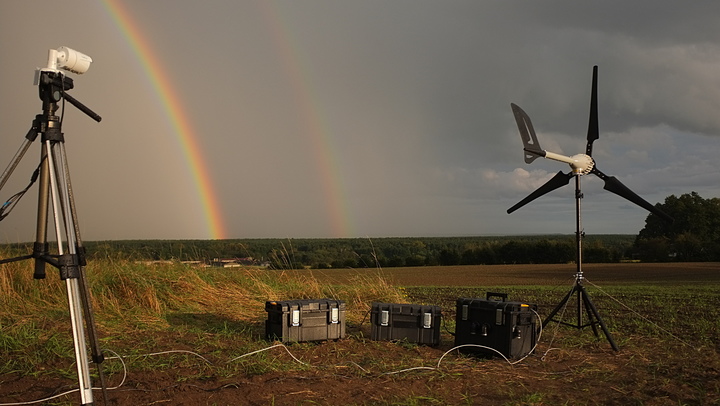
Furtherfield Spring Editorial 2018 – Blockchain Imaginaries
2018
Introduction to Furtherfield Spring season of art and blockchain essays, interviews, events, exploration and critique.
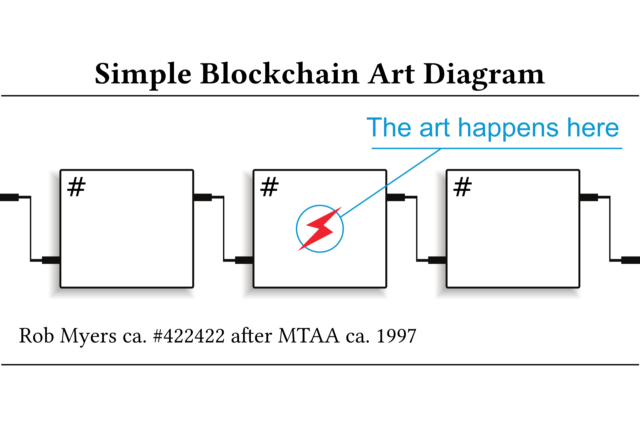
Collected writings by Rhea Myers
2014 – Present
On blockchain geometries, accelerationist art, crypto and DAWCs, art for algorithms, and (Conceptual) Art, cryptocurrency and beyond.
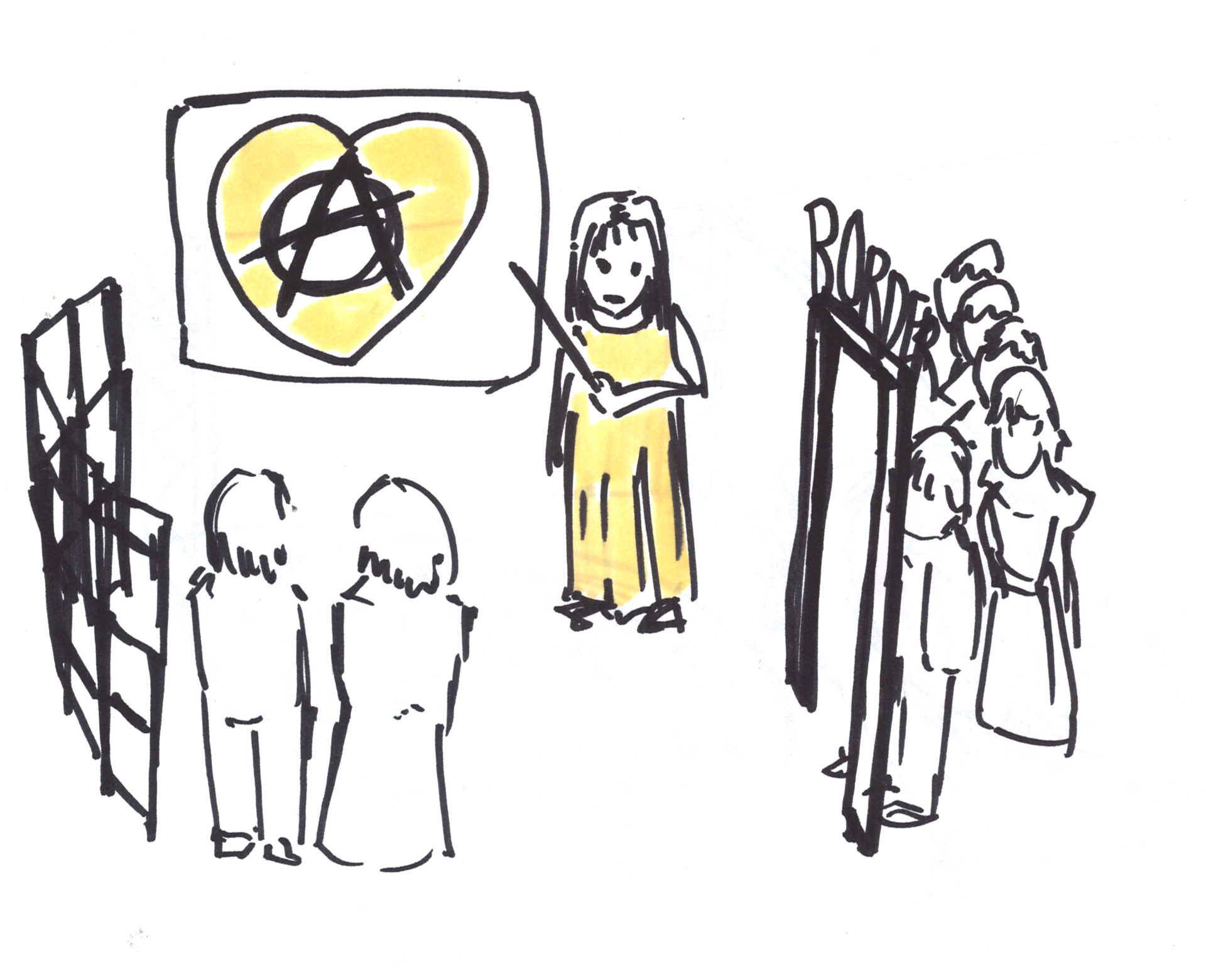
DAOWO – The blockchain laboratory and debate series for reinventing the arts
Oct 2017 – Present
A temporary laboratory for the creation of a living blockchain art laboratory devised by Ruth Catlow and Ben Vickers in collaboration with Goethe Institut, London.
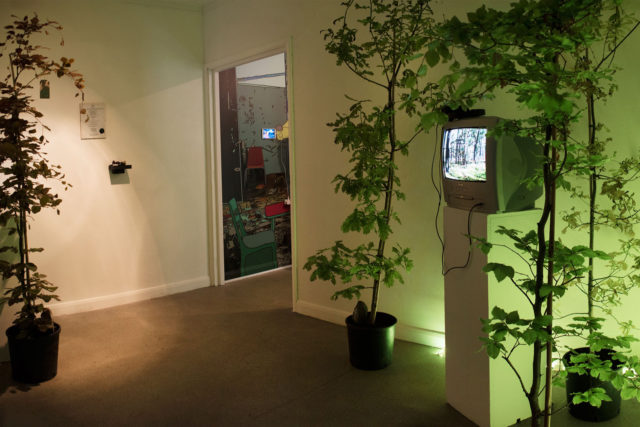
New World Order
2017 – 18
Artists envision a world made by machines, markets and natural processes, without states or other human institutions in an international touring exhibition curated by Furtherfield.
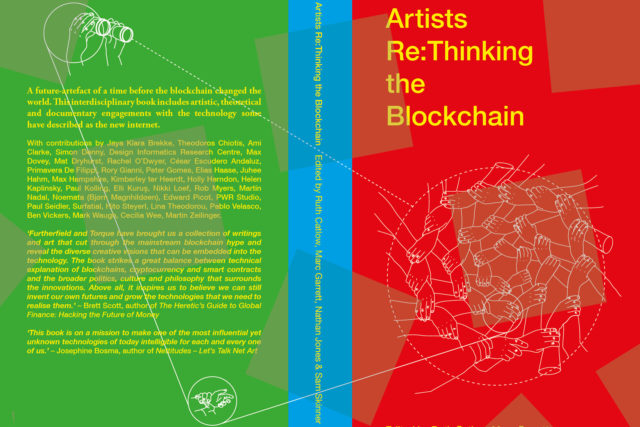
Artists Re:thinking the Blockchain
2017
The first book of its kind, bringing together artistic, speculative, conceptual and technical engagements with blockchains.
Edited by Ruth Catlow, Marc Garrett, Nathan Jones, and Sam Skinner
Jaya Klara Brekke: I saw the Blockchain at the End of The World, turned around, and walked back
2018
Written on the occasion of the New World Order group exhibition for PostScriptUM #31 Series published by Aksioma, edited by Janez Janša
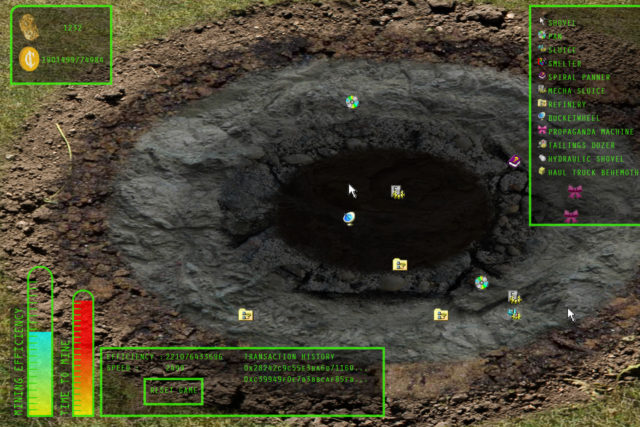
Blockchain Art Commission*
2017
Clickmine by Sarah Friend is a hyperinflationary ERC-20 token that is minted by a clicking game.
A Furtherfield and NEoN Digital Arts Festival Co-commission
Ethereal Summit NY
2018
Commission and exhibition of contemporary artists working with public blockchains as a medium for conceptual and social experimentation. Jurors and curators, Ruth Catlow, Giani Fabricio, Sam Hart, Will King, Saraswathi Subbaraman
The Blockchain: Change Everything Forever
2016
A short film to stimulate cross sector debate around how emerging blockchain technologies change the social contract, directed by Pete Gomes
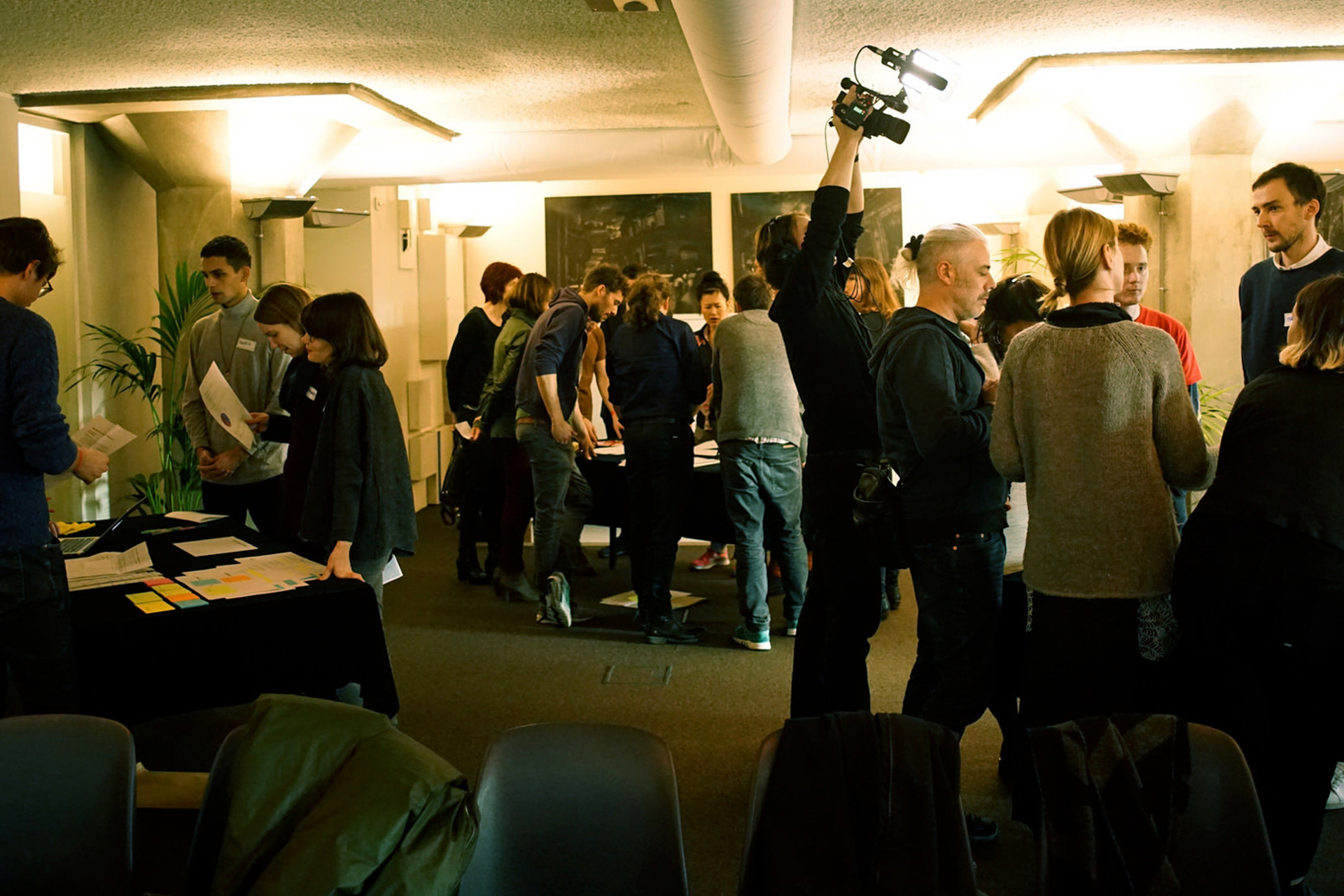
Role Play Your Way to Budgetary Blockchain Bliss
2016
Ruth Catlow and Ben Vickers brought the LARPing tradition to INC’s MoneyLab. Inviting participants to take on generic roles from the business cycle of start up tech companies trying to make the next big thing with the latest technological innovation.
Blockchain’s Potential in the Arts
2016
A gathering of organisations, academics and policy makers in arts and culture to explore blockchain’s potential. Convened by Ben Vickers and Ruth Catlow and hosted by the Austrian Cultural Forum, London.
The Human Face of Cryptoeconomies
2015
An exhibition curated by Futherfield to explore how might we produce, exchange and value things differently for a transformed artistic, economic and social future?
http://rhizome.org/editorial/2018/jun/14/island-mentality/
https://edition.cnn.com/style/article/cryptokitty-blockchain/index.html
http://hyperallergic.com/440936/what-blockchain-means-for-contemporary-art/
https://www.artbasel.com/news/artists-as-cryptofinanciers–welcome-to-the-blockchain
Exhibition, Furtherfield Gallery, London Oct 2015 – Nov 2015
Émilie Brout and Maxime Marion exhibit ornamental Gold and Glitter created with ‘found’ internet GIFs and Nakamoto (The Proof) – a video documenting the artists’ attempt to produce a fake passport of the mysterious creator of Bitcoin, Satoshi Nakamoto. FaceCoin by Rhea Myers is an artwork that is also a machine for mining faces as proof of aesthetic work. His Shareable Readymades are iconic 3D printable artworks for an era of digital copying and sharing. The Museum of Contemporary Commodities by Paula Crutchlow and Dr Ian Cook treats everyday purchases as if they were our future heritage and Jennifer Lyn Morone™ Inc reclaims ownership of personal data by turning her entire being into a corporation. The Alternet by Sarah T Gold conceives of a way for us to determine with whom, and on what terms, we share our data and Shu Lea Cheang anticipates a future world where garlic is the new social currency.
Press:
JJ Charlesworth for Art Review Jan-Feb 2016
Short film, 2016
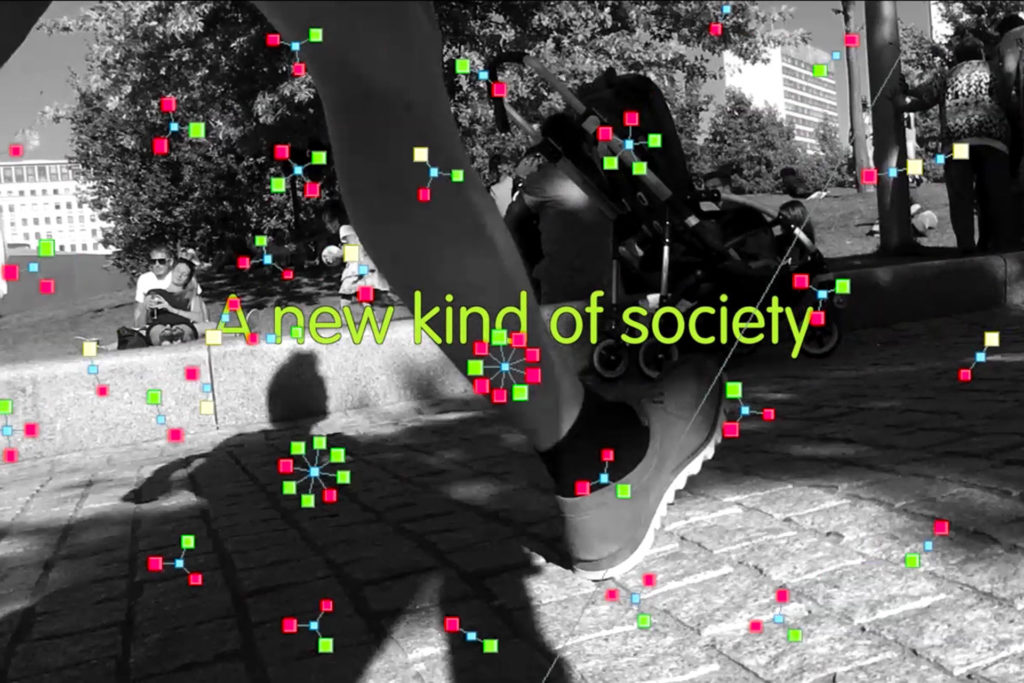
The underpinning technology of digital currencies and smart contracts, the blockchain is reshaping concepts of value, trust, law and governance. This film sets out to diversify the people involved in its future by bringing together leading thinkers, computer scientists, entrepreneurs, artists and activists who discuss:
A Furtherfield film with Digital Catapult London. Directed by Pete Gomes, concept and research by Ruth Catlow. Featuring interviews with: Dr Anat Elhalal; Ben Vickers; Dr Catherine Mulligan; Elias Haase; Irra Ariella Khi; Jaime Sevilla; Jaya Klara Brekke; Kei Kreutler; Pavlo Tanasyuk; Rhea Myers; Sam Davies; and Vinay Gupta
Live Action Role Play, 2016
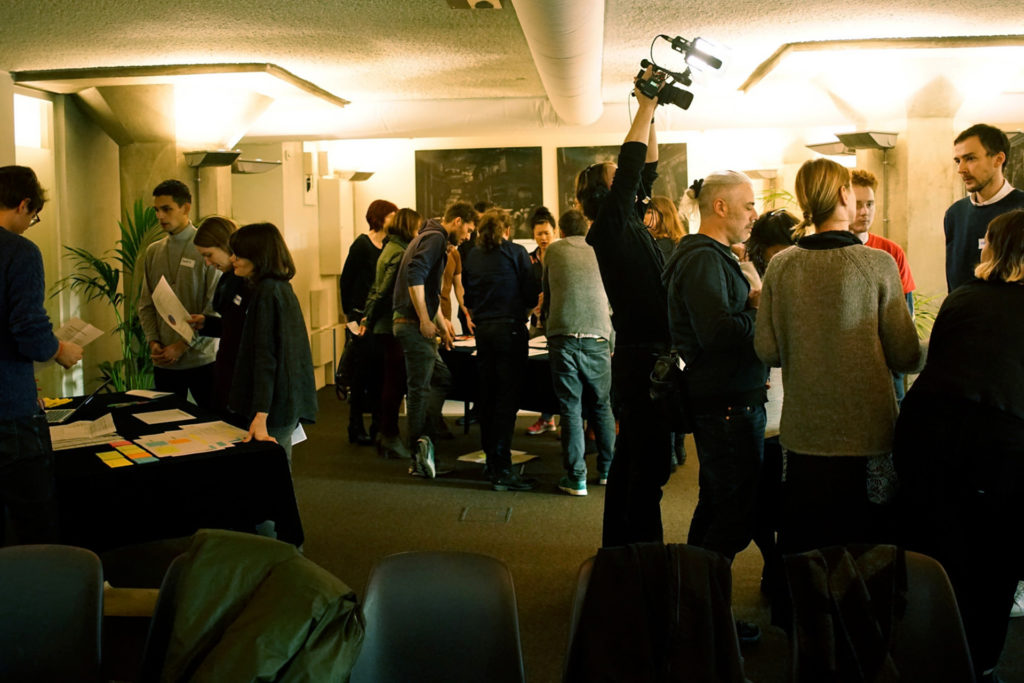
This 2-day start up tech hackathon compressed into 2 hours was aimed at creating Blockchain based businesses ideas that improve the life and future of cats. The workshop critically emulated the extravagant discourse and excitement surrounding the super-automation and hyperconnectivity that comes with blockchain and similar technologies, and the capacity of the technology stakeholders to both increase and diminish global inequity. Devised by Ben Vickers, Ruth Catlow for Institute of Network Cultures’ MoneyLab.
Report:
http://networkcultures.org/moneylab/2016/12/06/role-play-your-way-to-budgetary-blockchain-bliss/
International Touring Exhibition, 2017 – 2018
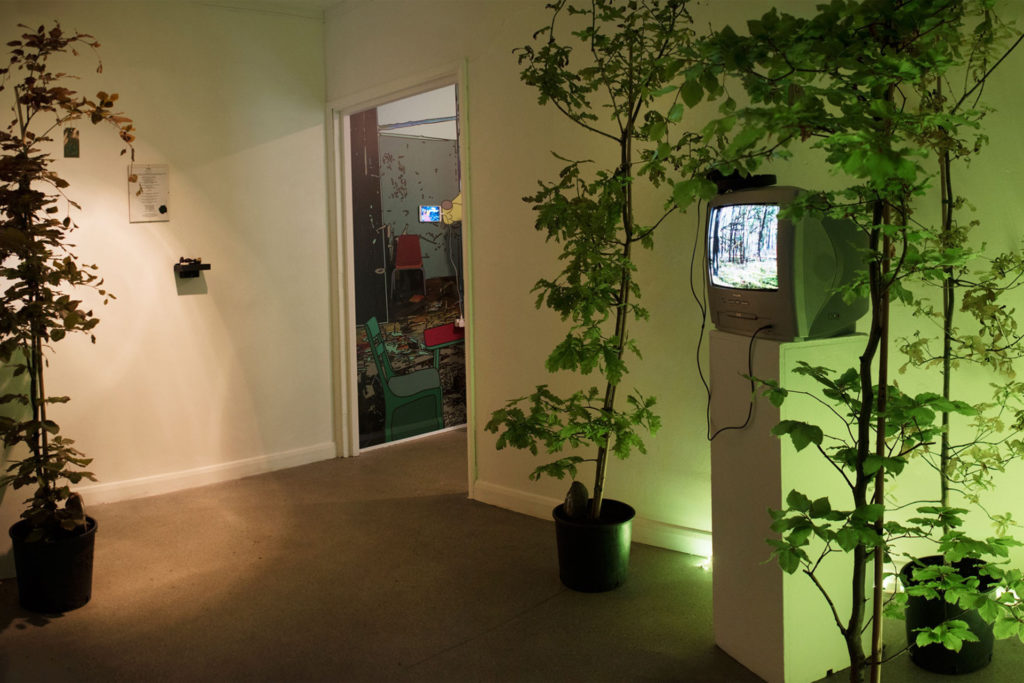
Jaya Klara Brekke, Max Dovey, Pete Gomes, HandFastr, Rhea Myers, Primavera De Filippi of O’Khaos, Terra0, Lina Theodorou and xfx (aka Ami Clarke). Curated by Furtherfield
A self-owning forest with ideas of expansion, a self-replicating android flower, a cryptocurrency rig to mine human breath, a five minute marriage contract, a Hippocratic Oath for software developers; in an exhibition about living with blockchain technologies.
Artists investigate and test the possible consequences of blockchain technologies, and their capacity to embody divergent political ideas. They explore dramatic new conceptions of global governance and economy, that could permanently enrich or demote the role of humans. They portray a world in which responsibility for many aspects of life are transferred, permanently (for better or worse) from natural and social systems into a secure, networked, digital ledger of transactions, and computer-executed contracts.
Produced as part of the State Machines programme*
Press: https://edition.cnn.com/style/article/cryptokitty-blockchain/index.html
Book published by Torque Editions, 2017
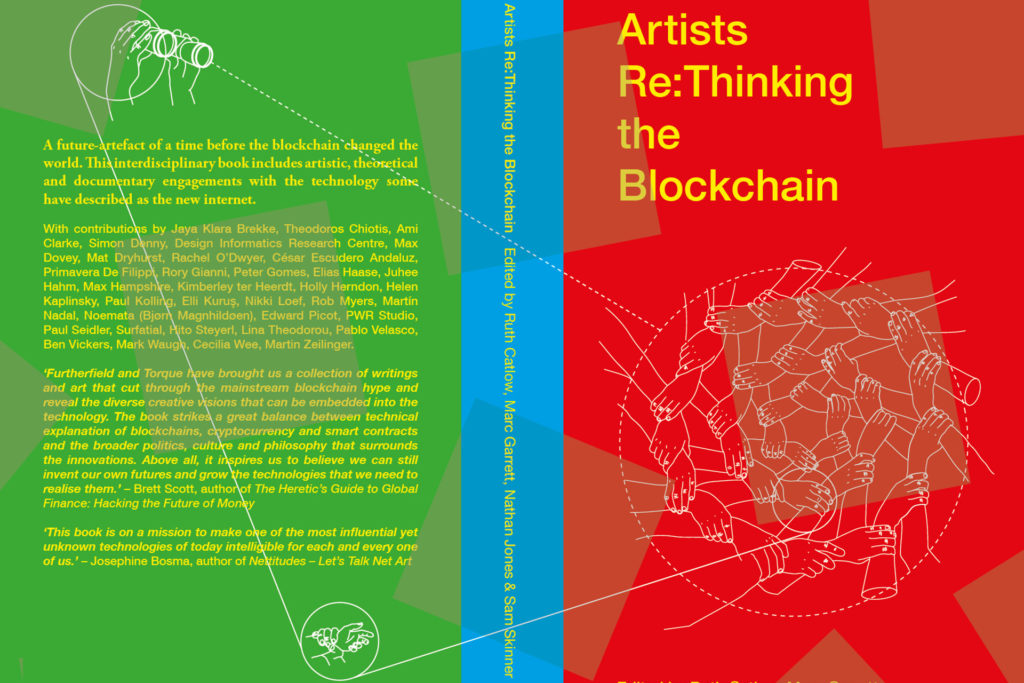
Artists Re:Thinking the Blockchain is the first book of its kind, intersecting artistic, speculative, conceptual and technical engagements with the the technology heralded as “the new internet”. The book features a range of newly commissioned essays, fictions, illustration and art documentation exploring what the blockchain should and could mean for our collective futures.
Artists Re:Thinking The Blockchain
Imagined as a future-artefact of a time before the blockchain changed the world, and a protocol by which a community of thinkers can transform what that future might be, Artists Re:Thinking The Blockchain acts as a gathering and focusing of contemporary ideas surrounding this still largely mythical technology. The full colour printed first edition includes DOCUMENTATION of artistic projects engaged in the blockchain, including key works Plantoid, Terra0 and Bittercoin, THEORISATION of key areas in the global blockchain conversation by writers such as Hito Steyerl, Rachel O’Dwyer, Rhea Myers, Ben Vickers and Holly Herndon, and NEW POETRY, ILLUSTRATION and SPECULATIVE FICTION by Theodorios Chiotis, Cecilia Wee, Juhee Hahm and many more. It is edited by Ruth Catlow, Marc Garrett, Nathan Jones and Sam Skinner.
Along with a print edition, Artists Re:Thinking the Blockchain includes a web-based project in partnership with Design Informatics at University of Edinburgh: Finbook is an interface where readers and bots can trade on the value of chapters included in the book. As such it imagines a new regime for cultural value under blockchain conditions.
This book and surrounding events is produced in collaboration between Torque and Furtherfield, connecting Furtherfield’s Art Data Money project with Torque’s experimental publishing programme. It is supported by an Arts Council England Grants for the Arts, Foundation for Art and Creative Technology and through the State Machines project by the Creative Europe Programme of the European Union.
Buy Artists Re:thinking the Blockchain
Format: Paperback
ISBN number: 978-0-9932487-5-7
Torque and Furtherfield, London, 2017
Distributor: Liverpool University Press
Press:
http://we-make-money-not-art.com/artists-rethinking-the-blockchain/
https://hyperallergic.com/440936/what-blockchain-means-for-contemporary-art/
http://networkcultures.org/moneylab/2018/01/26/artists-rethinking-the-blockchain/
The blockchain laboratory and debate series for reinventing the arts, 2017 – Present
This series brings together artists, musicians, technologists, engineers, and theorists to join forces in the interrogation and production of new blockchain technologies. The focus is to understand how blockchains might be used to enable a critical, sustainable and empowered culture, that transcends the emerging hazards and limitations of pure market speculation of cryptoeconomics.
Devised by Ruth Catlow and Ben Vickers in collaboration with Goethe Institut, London.
Contributors include Ramon Amaro, Jaya Klara Brekke, Ed Fornieles, Jess Houlgrave, Janez Jansa, Helen Kaplinsky, Thor Karlsson, Kei Kreutler, Sarah Meiklejohn, Julian Oliver, Emily Rosamond, Hito Steyerl, Mark Waugh, Laura Willis.
Visit the DAOWO website to view video and pdf resources
Produced as part of the State Machines programme*
Press:
http://rhizome.org/editorial/2018/jan/03/reinventing-the-art-lab-on-the-blockchain/
http://rhizome.org/editorial/2018/jun/14/island-mentality/
*State Machines: Art, Work and Identity in an Age of Planetary-Scale Computation
Focusing on how such technologies impact identity and citizenship, digital labour and finance, the project joins five experienced partners Aksioma (SI), Drugo More (HR), Furtherfield (UK), Institute of Network Cultures (NL) and NeMe (CY) together with a range of artists, curators, theorists and audiences. State Machines insists on the need for new forms of expression and new artistic practices to address the most urgent questions of our time, and seeks to educate and empower the digital subjects of today to become active, engaged, and effective digital citizens of tomorrow.
This project has been funded with the support from the European Commission. This communication reflects the views only of the author, and the Commission cannot be held responsible for any use which may be made of the information contained therein.
On the day of the General Data Protection Law (GDPR) going into effect in Europe, on the 25th of May, the Disruption Network Lab opened its 13th conference in Berlin entitled “HATE NEWS: Manipulators, Trolls & Influencers”. The two-day event looked into the consequences of online opinion manipulation and strategic hate speech. It investigated the technological responses to these phenomena in the context of the battle for civil rights.
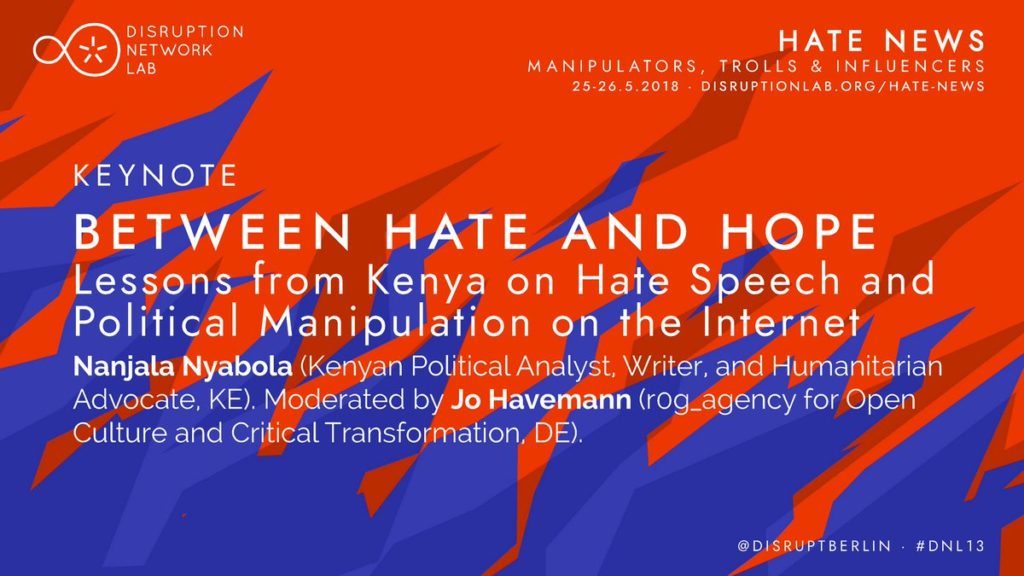
The conference began with Jo Havemann presenting #DefyHateNow, a campaign by r0g_agency for open culture and critical transformation, a community peace-building initiative aimed at combating online hate speech and mitigating incitement to offline violence in South Sudan. More than ten years ago, the bulk of African countries’ online ecosystems consisted of just a few millions of users, whilst today’s landscape is far different. This project started as a response to how social media was used to feed the conflicts that exploded in the country in 2013 and 2016. It calls to mobilize individuals and communities for civic action against hate speech and social media incitement to violence in South Sudan. Its latest initiative is the music video #Thinkbe4uclick, a new awareness campaign specifically targeted at young people.
In Africa, hate campaigns and manipulation techniques have been causing serious consequences for much longer than a decade. The work of #DefyHateNow counters a global challenge with local solutions, suggesting that what is perceived in Europe and the US as a new problem should instead be considered in its global dimension. This same point of view was suggested by the keynote speaker of the day, Nanjala Nyabola, writer and political analyst based in Nairobi. Focusing on social media and politics in the digital age, the writer described Kenya´s recent history as widely instructive, warning that manipulation and rumours can not only twist or influence election results but drive conflicts feeding violence too.
The reliance on rumours and fake news was the principal reason that caused the horrifying escalation of violence following the Kenyan 2007 general election. More than 1,000 people were killed and 650,000 displaced in a crisis triggered by accusations of election fraud. The violence that followed unfolded fast, with police use of brutal force against non-violent protesters causing most of the fatalities. The outbreak of violence was largely blamed on ethnic clashes inflamed by hate speech. It consisted of revenge attacks for massacres supposedly carried out against ethnic groups in remote areas of the country. Unverified rumours about facts that had not taken place. Misinformation and hate were broadcast over local vernacular radio stations and with SMS campaigns, inciting the use of violence, animating different groups against one another.
The general election in 2013 was relatively peaceful. However, ethnic tensions continued to grow across the whole country and ethnic driven political intolerance appeared increasingly on social media, used mainly by young Kenyans. Online manipulation and disinformation proliferated on social media again before and after the 2017 general election campaign.
Nyabola explained that nowadays the media industry in Kenya is more lucrative than in most other African regions, which could be considered a positive aspect, suggesting that within Kenya the press is free. Instead a majority media companies depend heavily on government advertising revenue, which in turn is used as leverage by authorities to censor antagonistic coverage. It should be no wonder Kenyans appear to be more reliant on rumours now than in 2007. People are increasingly distrustful of traditional media. The high risk of manipulation by media campaigns and a duopoly de facto on the distribution of news, has led to the use of social media as the principle reliable source of information. It is still too early to have a clear image of the 2017 election in terms of interferences affecting its results, but Nyabola directly experienced how misinformation and manipulation present in social media was a contributing factor feeding ethnic angst.
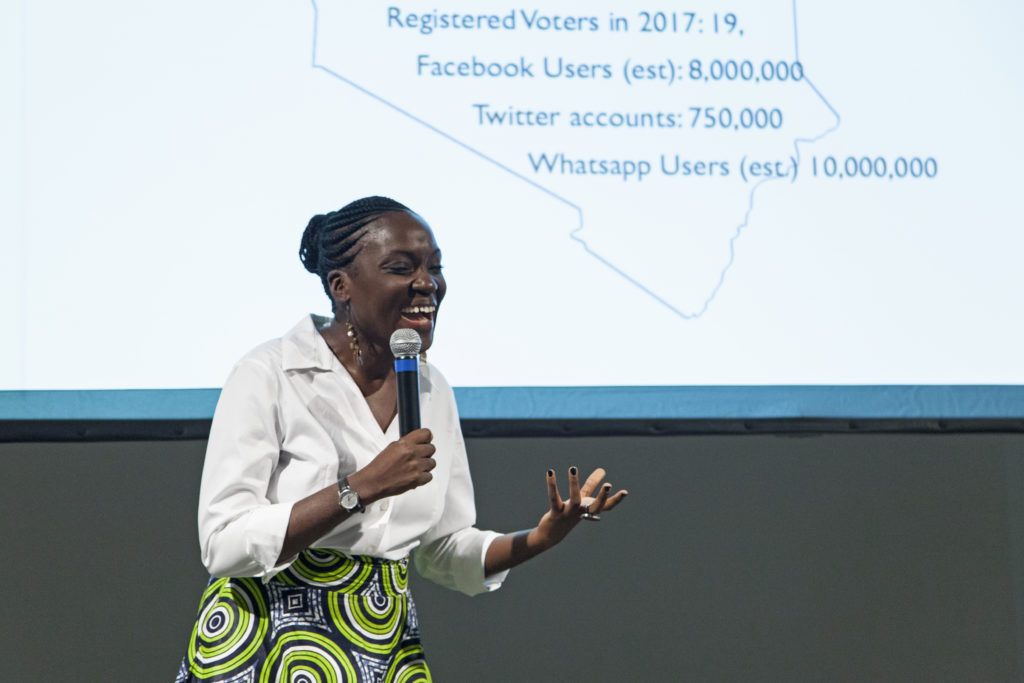
Rafiki, the innovative Kenyan film presented at the Cannes Film Festival, is now the subject of controversy over censorship due to its lesbian storyline. Nyabola is one of the African voices expressing the intention to support the movie’s distribution. “As something new and unexpected, this movie might make certain people within the country feel uncomfortable,” she said, “but it cannot be considered a vehicle for hate, promoting homosexuality in violation of moral values.” It is essential not to confuse actual hate speech with something labelled as hate speech to discredit it. Hate speech is intended to offend, insult, intimidate, or threaten an individual or group based on an attribute, such as sexual orientation, religion, colour, gender, or disability. The writer from Nairobi reminded the audience that when we talk about hate speech, it is important to focus on how it makes people feel and what it wants to accomplish. We should always consider that we regulate hate speech since it creates a condition in which social, political and economic violence is fed, affecting how we think about groups and individuals (and not just because it is offensive).
Nyabola indicated few key factors that she considers able to increase the consequences of hate speech and manipulation on social media. Firstly, information travels fast and can remain insulated. Whilst Twitter is a highly public space where content and comments flow freely, Facebook is a platform where you connect just with a smaller group of people, mostly friends, and WhatsApp is based on groups limited to a small number of contacts. The smaller the interaction sphere is, the harder it is for fact-checkers to see when and where rumours and hate speech go viral. It is difficult to find and stop them and their impact can be calculated just once they have already spread quickly and widely. Challenges which distinguish offline hate speech and manipulation from online ones are also related to the way information moves today among people supporting each other without a counterpart and without anyone being held to account.
Nowadays Kenya boasts an increasingly technological population, though not all rural areas have as yet been able to benefit from the country being one of the most connected ones in sub-Saharan Africa. In this context, reports indicate that since 2013 the British consulting firm Cambridge Analytica had been working in the country to interfere with elections, organizing conventions, orchestrating campaigns to sway the electorate away from specific candidates. It shall be no surprise that the reach of Cambridge Analytica extended well beyond United Kingdom and USA. In her speech, Nyabola expressed her frustration as she sees that western media focus their attention on developing countries just when they fear a threat of violence coming from there, ignoring that the rest of the world is also a place for innovation and decision making too.
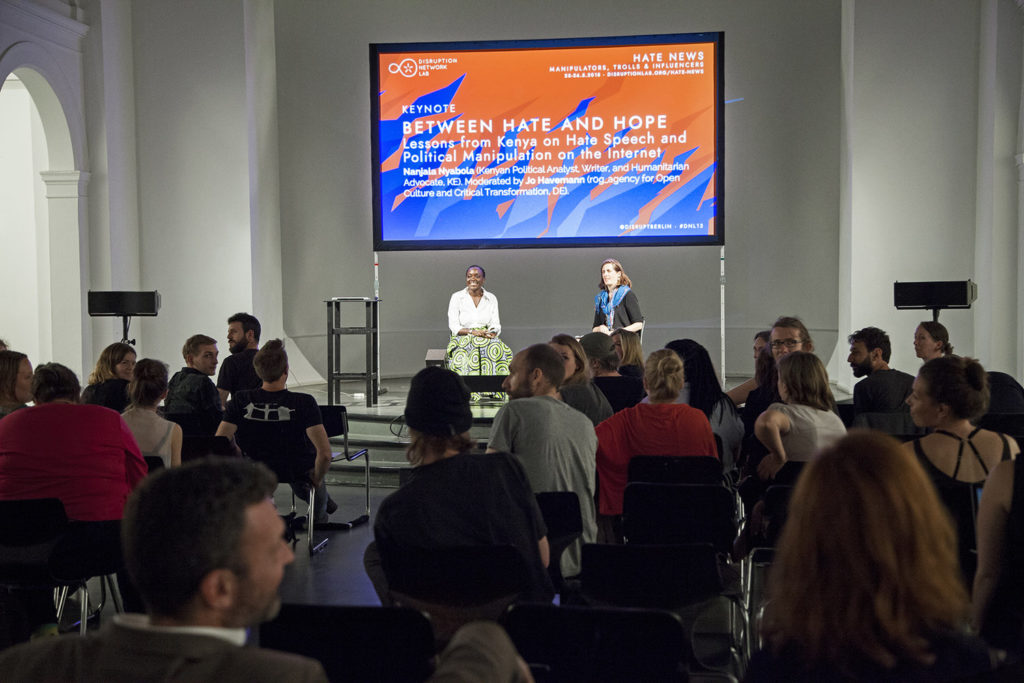
Kenya has one of the highest rates of Internet penetration in Africa with millions of active Kenyan Facebook and Twitter accounts. People using social media are a growing minority and they are learning how to defeat misinformation and manipulation. For them social media can become an instrument for social change. In the period of last year’s election none of the main networks covered news related to female candidates until the campaigns circulating on social media could no longer be ignored. These platforms are now a formidable tool in Kenya used to mobilize civil society to accomplish social, gender and economic equality. This positive look is hindered along the way by the reality of control and manipulation.
Most of the countries globally currently have no effective legal regulation to safeguard their citizens online. The GDPR legislation now in force in the EU obliges publishers and companies to comply with stricter rules within a geographic area when it comes to privacy and data harvesting. In Africa, national institutions are instead weaker, and self-regulation is often left in the hands of private companies. Therefore, citizens are even more vulnerable to manipulation and strategic hate speech. In Kenya, which still doesn’t have an effective data protection law, users have been subject to targeted manipulation. “The effects of such a polluted ecosystem of misinformation has affected and changed personal relationships and lives for good,” said the writer.
On social media, without regulations and control, hatred and discriminations can produce devastating consequences. Kenya is just one of the many countries experiencing this. Hate speech blasted on Facebook at the start of the Rohingya crisis in Myanmar. Nyabola criticized that, as in many other cases, the problem was there for all, but the company was not able to combat the spread of ethnic based discrimination and hate speech.
Moving from the interconnections of traditional and online media in Kenyan misinformation ecosystem, the second part of the day focused on privacy implications of behavioural profiling on social media, covering the controversy about Cambridge Analytica. The Friday’s panel opened with the analyses of David Carroll, best known as the professor who filed a lawsuit against Cambridge Analytica in the UK to gain a better understanding of what data the company had collected about him and to what purpose. When he got access to his voter file from the 2016 U.S. election, he realized the company had been secretly profiling him. Carroll was the first person to receive and publish his file, finding out that Cambridge Analytica held personal data on the vast majority of registered voters in the US. He then requested the precise details on how these were obtained, processed and used. After the British consulting firm refused to disclose, he decided to pursue a court case instead.
As Carroll is a U.S. citizen, Cambridge Analytica took for granted that he had neither recourse under federal U.S. legislation, nor under UK data protection legislation. They were wrong. The legal challenge in British court case that centred on Cambridge Analytica’s compliance with the UK Data Protection Act of 1998 could be applied because Carroll’s data was processed in the United Kingdom. The company filed for bankruptcy not long after it was revealed that it used the data of 87 million Facebook users to profile and manipulate them, likely in contravention of UK law. Professor Carroll could never imagine that his activity would demolish the company.
Cambridge Analytica, working with an election management firm called SCL Group, appears to have been a propaganda machine master, able to manipulate voters through the combination of psychometric data. It exploited Facebook likes and interactions above all. Its technique disguised attempts at political manipulation since they were integrated in the online environment.
Carroll talked about how technology and data were used to influence elections and popular voting for the first time in countries like USA and UK, whereas for a much longer time international campaign promoters were hired to act on an international scale. In Carroll’s opinion Cambridge Analytica was an ‘oil spill’ moment. It was an epiphany, a sudden deep understanding of what was happening on a broader scale. It made people aware of the threat to their privacy and the fact that many other companies harvest data.
Since 2012 Facebook and Google have been assigning a DoubleClick ID to users, attaching it to their accounts, de-anonymizing and tracking every action. It is an Ad-tracker that gives companies and advertisers the power to measure impressions and interactions with their campaigns. It also allows third-party platforms to set retargeting ads after users visit external websites, integrated with cookies, accomplishing targeted profiling at different levels. This is how the AdTech industry system works. Carroll gave a wide description of how insidious such a technique can be. When a user downloads an app to his smartphone to help with sport and staying healthy, it will not be a secret that what was downloaded is the product of a health insurance or a bank, to collect data of potential customers, to profile and acquire knowledge about individuals and groups. Ordinary users have no idea about what is hidden under the surface of their apps. Thousands of companies are synchronizing and exchanging their data, collected in a plethora of ways, and used to shape the messages that they see, building up a tailor-made propaganda that would not be recognizable, for example, as a political aid. This mechanism works in several ways and for different purposes: to sell a product, to sell a brand or to sell a politician.
In this context, Professor Carroll welcomed the New European GDPR legislation to improve the veracity of the information on the internet to create a safer environment. In his dissertation, Carroll explained that the way AdTech industry relates to our data now contaminates the quality of our lives, as singles and communities, affecting our private sphere and our choices. GDPR hopefully giving consumers more ownership over their data, constitutes a relevant risk for companies that don’t take steps to comply. In his analyses the U.S. professor pointed out how companies want users to believe that they are seriously committed to protecting privacy and that they can solve all conflicts between advertising and data protection. Carroll claimed though that they are merely consolidating their power to an unprecedented rate. Users have never been as exposed as they are today.
Media companies emphasize the idea that they are able to collect people’s data for good purposes and that – so far – it cannot be proved this activity is harmful. The truth is that these companies cannot even monitor effectively the Ads appearing on their platforms. A well-known case is the one of YouTube, accused of showing advertisements from multinational companies like Mercedes on channels promoting Nazis and jihad propaganda, who were monetizing from these ads.
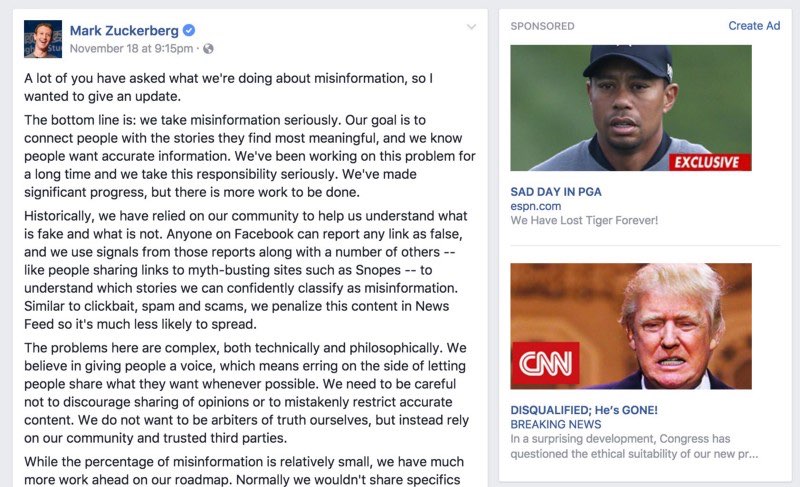
Carroll then focused on the industry of online advertisement and what he called “the fraud of the AdTech industry.” Economic data and results from this sector are unreliable and manipulated, as there are thousands of computers loading ads and making real money communicating to each other. This generates nowadays a market able to cheat the whole economy about 11 billion dollar a year. It consists of bots and easy clicks tailor-made for a user. The industries enabled this to happen and digital advertising ecosystem has evolved leading to an unsafe and colluded environment.
Alphabet and Facebook dominate the advertising business and are responsible for the use of most trackers. Publishers as well as AdTech platforms have the ability to link person-based identifiers by way of login and profile info.
Social scientists demonstrated that a few Facebook likes can be enough to reveal and accurately predict individual choices and ideas. Basic digital records are so used to automatically estimate a wide range of personal attributes and traits that are supposed to be part of a private sphere, like sexual orientation, religious beliefs, or political belonging. This new potential made politicians excited and they asked external companies to harvest data in order to generate a predictive model to exploit. Cambridge Analytica’s audience-targeting methodology was for several years “export-controlled by the British government”. It was classified as weapon by the House of Commons, at a weapons-grade communications tactics. It is comprehensible then that companies using this tech can easily sell their ability to influence voters and change the course of elections, polarizing the people using social networks.
The goal of such a manipulation and profiling is not to persuade everybody, but to increase the likelihood that specific individuals will react positively and engage with certain content, becoming part of the mechanism and feeding it. It is something that is supposed to work not for all but just for some of the members of a community. To find that small vulnerable slice of the U.S. population, for example, Cambridge Analytica had to profile a huge part of the electorate. By doing this it apparently succeeded in determining the final results, guiding and determining human behaviours and choices.
Bernd Fix, hacker veteran of the Chaos Computer Club in Germany, entered the panel conversation describing the development from the original principle of contemporary cybernetics, in order to contextualize the uncontrollable deviated system of Cambridge Analytica. He represented the cybernetic model as a control theory, by which a monitor compares what is happening into a system with a standard value representing what should be happening. When necessary, a controller adjusts the system’s behaviour accordingly to again reach that standard expected by the monitor. In his dissertation, Fix explained how this model, widely applied in interdisciplinary studies and fields, failed as things got more complex and it could not handle a huge amount of data in the form of cybernetics. Its evolution is called Machine Learning (or Artificial Intelligence), which is based on the training of a model (algorithm) to massive data sets to make predictions. Traditional IT has made way for the intelligence-based business model, which is now dominating the scene.
Machine learning can prognosticate with high accuracy what it is asked to, but – as the hacker explained – it is not possible to determine how the algorithm achieved the result. Nowadays most of our online environment works through algorithms that are programmed to fulfil their master’s interests, whereas big companies collect and analyse data to maximize their profit. All the services they provide, apparently for free, cost users their privacy. Thanks to the predictive model, they can create needs which convinces users to do something by subtle manipulating their perspective. Most of the responsibilities are on AdTech and social media companies, as they support a business model that is eroding privacy, rights and information. The challenge is now to make people understand that these companies do not act in their interest and that they are just stealing data from them to build up a psychometric profile to exploit.
The hacker reported eventually the scaring case of China’s platform “social credit,” designed to cover every aspect of online and offline existence and wanted by the national authorities. It is supposed to monitor each person and catalogue eventual “infractions and misbehaviours” using an algorithm to integrate them into a single score that rates the subjective fidelity into accepted social standards. A complex kind of ultimate social control, still in its prototype stages, but that could become part of our global future where socio-political regulation and control are governed by cybernetic regulatory circuits. Fix is not convinced that regulation can be the solution: to him, binding private actors and authorities to specific restriction as a way to hold them accountable is useless if people are not aware of what is going on. Most people around us are plugged into this dimension where the bargain of data seems to be irrelevant and the Big Three – Google, Facebook and Amazon – are allowed to self-determine the level of privacy. People are too often happy consumers who want companies to know their lives.
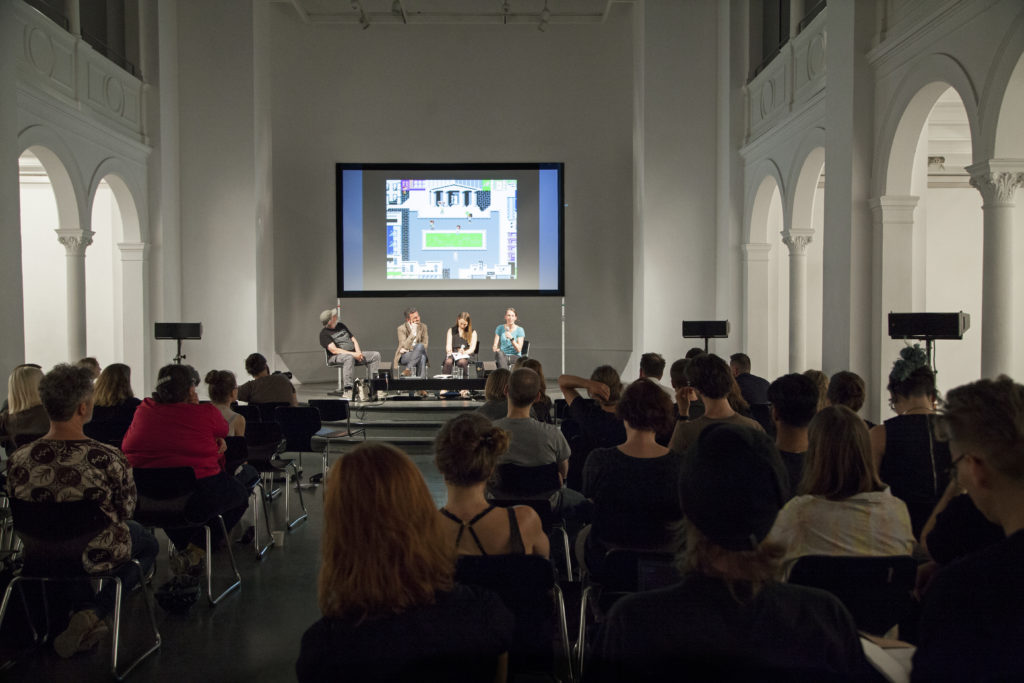
The last panellist of the afternoon was the artist and researcher Marloes de Valk, who co-developed a video game for old 1986 Nintendo consoles, which challenges the player to unveil, recognize and deconstruct techniques used to manipulate public opinion. The player faces the Propaganda Machine, level after level, to save the planet.
“Acid rains are natural phenomena”, “passive smoke doesn’t affect the health,” “greenhouse´s effects are irrelevant.” Such affirmations are a scientific aberration nowadays, but in the ‘80s there were private groups and corporations struggling to make them look like legitimate theorizations. The artist from Nederland analysed yesterday´s and today’s media landscape and, basing her research on precise misinformation campaigns, she succeeded in defying how propaganda has become more direct, maintaining all its old characteristics. De Valk looked, for example, for old documents from the American Tobacco Institute, for U.S. corporations‘leaked documents and also official articles from the press of the ´80s.
What remains is a dark-humoured game whose purpose is that of helping people to orientate inside the world of misinformation and deviated interests that affects our lives today. Where profit and lobbyism can be hidden behind a pseudoscientific point of view or be the reason rumours are spread around. The artist and researcher explained that what you find in the game represents the effects of late capitalism, where self-regulation together with complacent governments, that do not protect their citizens, shape a world where there is not room for transparency and accountability.
In the game, players get in contact with basic strategies of propaganda like “aggressively disseminate the facts you manufactured” or “seek allies: create connections, also secret ones”. The device used to play, from the same period of the misinformation campaigns, is an instrument that reminds with a bit of nostalgia where we started, but also where we are going. Things did not change from the ‘80s and corporations still try to sell us their ready-made opinion, to make more money and concentrate more power.
New international corporations like Facebook have refined their methods of propaganda and are able to create induced needs thus altering the representation of reality. We need to learn how to interact with such a polluted dimension. De Valk asked the audience to consider official statements like “we want to foster and facilitate free and open democratic debate and promote positive change in the world” (Twitter) and “we create technology that gives people the power to build community and bring the world closer together” (Facebook). There is a whole narrative built to emphasize their social relevance. By contextualising them within recent international events, it is possible to broad the understanding of what these companies want and how they manipulate people to obtain it.
What is the relation between deliberate spread of hate online and political manipulation?
As part of the Disruption Network Lab thematic series “Misinformation Ecosystems” the second day of the Conference investigated the ideology and reasons behind hate speech, focusing on stories of people who have been trapped and affected by hate campaigns, violence, and sexual assault both online and offline. The keynote event was introduced by Renata Avila, international lawyer from Guatemala and a digital rights advocate. Speaker was Andrea Noel, journalist from Mexico, “one of the most dangerous countries in the world for reporters and writers, with high rates of violence against women” as Avila remembered.
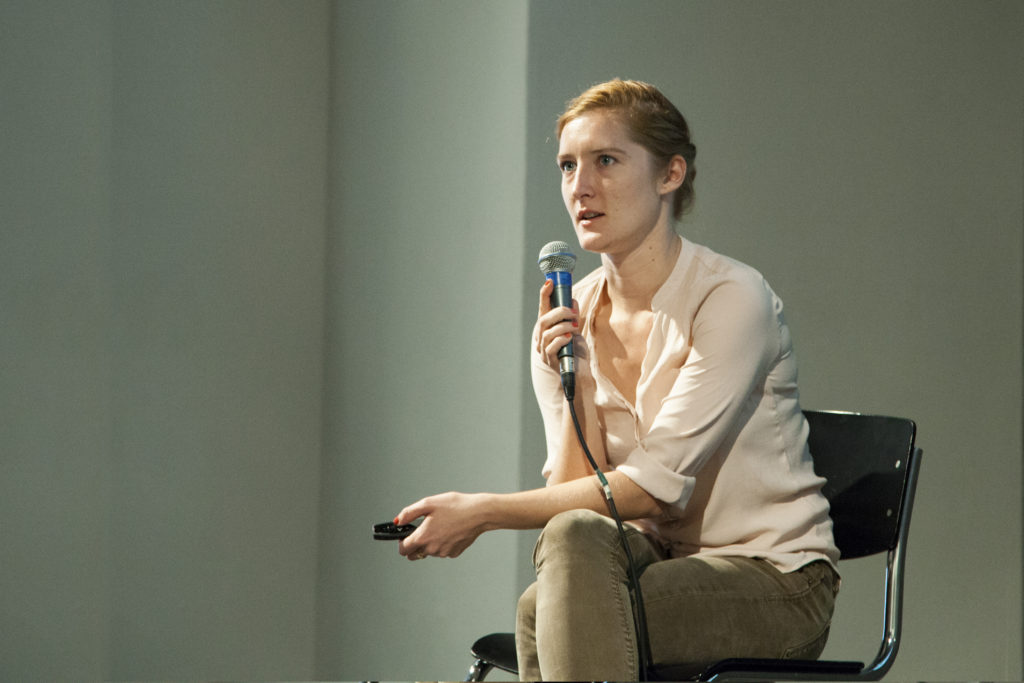
Noel has spent the last two years studying hate speech, fake news, bots, trolls and influencers. She decided to use her personal experience to focus on the correlation between misinformation and business, criminal organizations and politics. On March 8, 2016 it was International Women’s Day, and when Noel became a victim of a sexual assault. Whilst she was walking down the street in La Condesa (Mexico City) a man ran after her, suddenly lifted up her dress, and pulled her underwear down. It all lasted about 3 seconds.
As the journalist posted on twitter the surveillance footage of the assault commenting: “If anyone recognizes this idiot please identify him,” she spent the rest of the evening and the following morning facing trolls, who supported the attacker. In one day her name became trend topic on twitter on a national level, in a few days the assault was international news. She became so subject of haters and target of a misogynistic and sexist campaign too, which forced her to move abroad as the threat became concrete and her private address was disclosed. Trolls targeted her with the purpose of intimidating her, sending rape and death threats, pictures of decapitated heads, machetes and guns.
In Mexico women are murdered, abused and raped daily. They are victims of family members, husbands, authorities, criminals and strangers. Trolls are since ever active online promoting offensive hashtags, such as #MujerGolpeadaMujerFeliz, which translates as ‘a beaten woman is a happy woman’. It is a spectrum of the machismo culture affecting also many Latin American countries and the epidemic of gender-based violence and sexual assault.
Facts can be irrelevant against a torrent of abuse and hate toward journalists. Noel also received hundreds of messages telling her that there was a group of famous pranksters named “master trolls” that used to assault people on the streets in that same way, to make clicks and money out of it. Noel found out that they became best known for pulling down people’s pants and underwear in public, and that this brought them directly to popular tv shows. A profitable and growing business.
The journalist decided to face her trolls one by one and later realized that they were mostly part of an organized activity, not from a TV show but from a political group targeting her, a fact that made everything way more intricate. In two years she “got to know her trolls” as she said, and she studied their ecosystem. The description of the whole story is available on podcast Reply All.
Moving from her story, Noel focused in her second part of dissertation on the relation linking together trolls, criminal organizations, political and social manipulation. She described how, by using algorithms, bots and trolls, it is possible to generate political and election related postings on Facebook and Twitter that go viral. Manipulation comes also by weaponizing memes to propel hate speech and denigration, creating false campaigns to distract public attention from real news like corruption and atrocious cartel crimes.
Marginal voices and fake news can be spread by inflating the number of retweets and shares. Hashtags and trends are part of orchestrated system, where publishers and social media are not held in account for the fraud. Automated or semi-automated accounts, which manipulate public opinion by boosting the popularity of online posts and amplifying rumours. There is a universe of humans acting like bots, controlling hundreds of fake accounts.
Noel is particularly critical against Twitter. Its legal team expressed their engagement facing this “new major problem and novel threats”. The journalist hypothesized that the company had been well aware of the issue since 2010 but decided not to intervene to weed out organized groups manipulating its environment. Moreover, they knew that organized campaigns of discredit can water down the impact of real grassroot spontaneous protests and movements.
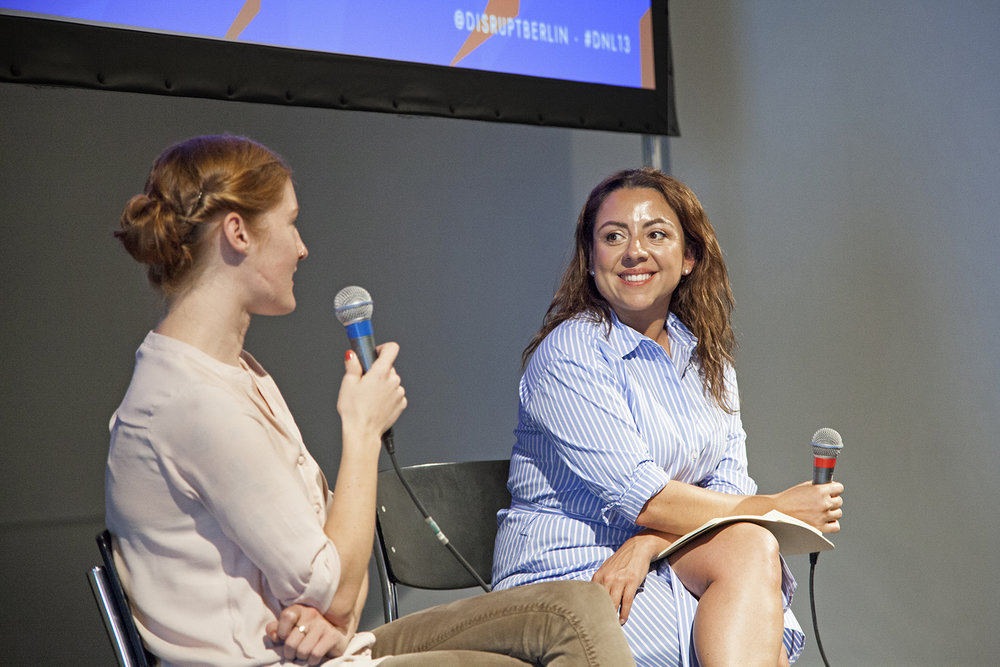
These manipulation techniques are responsible for digitally swaying the 2016 election toward the candidate Peña Nieto, organizing an army of thousands of bots to artificially generate trends on Twitter. Trends on this social media move up and down based on the number of tweets in a topic or hashtag related to the speed of sharing or retweeting. Trolls and bots can easily control the trending topic mechanism with their intense spamming activity.
Noel reported that false stories are shared via WhatsApp too, they are difficult to track and the most challenging to debunk. Her portrayal of social media and information market is not different from the description on the first day of the Conference by the writer Najala Nyabola.
To see the future of social media manipulation in politics we need to look at Mexico. All parties in Mexico have used bots to promote their own campaigns, journalists and opponents are overwhelmed with meaningless spam and denigrating hashtags. Offline, media landscape across Mexico is not free and organised crime has been using propaganda and manipulation to further its own aims. President Peña Nieto’s administration spent hundreds of millions of dollars on advertising, making media dependent and colluded. This system suppresses investigative articles and intimidates reporters.
The next general election is scheduled for July 1st. Andrea Noel warned that manipulation, trolls and bots are already irreversibly polluting the debate, in a country where more than 100 candidates have already been murdered (at the time of the Conference) and a history of corruption makes media and authorities unreliable in the eyes of people.
As a response, universities and NGOs formed an anti-fake news initiative called “Verificado” a platform that encourages people to forward stories found on social media using the hashtag #QuieroQueVerifiquen, ‘I want you to verify this’. The researchers of this project answer with fact-checking and publish their findings online. When asked, Noel expressed appreciation for the efforts of organizations and civil society. However, she is becoming increasingly disillusioned. She can see no immediate prospect of finding solutions able to slow or halt the impact of misinformation and hate speech online. In her opinion projects like Verificado can be easily hijacked. On the other side genuine social media campaigns are still an effective tool in the hands of civil society but the lack of trust in media fed by corruption often undermines all efforts to mobilize society, leading the public to routinely dismiss initiative to fight injustice.
When asked about the possibility to shut down social networks as a solution, Noel could not say she did not think of it. A first step could be to oblige media like Twitter and Facebook to guarantee users a safe environment where the economic interest comes after the need of a hate speech and manipulation free environment. The way they operate confirms they are content platforms and as such media entities they lack of transparency and accountability. These companies shirk their obligation for publishing responsibly. They should be held to account when they spin lies and allow groups to act unethically or against target single or communities.
The program of the second day continued with the presentation of the documentary The Cleaners, by Hans Block and Moritz Riesewieck, a project started in 2013 and in the cinemas at the time of the Conference. Initially, the authors wanted to learn more about the removal of pedo-pornographic content and sexualised images of children on Facebook. Social networks have largely pledged to work harder to identify and remove illegal, offensive and improper content, to limit violations and deny hate speech. But how does it work? Who decides what shall be cancelled and on what basis? These questions arose frequently during the first part of the Hate News conference and the German authors could answer it in relation to the social media Facebook, subject of their documentary.
The choice about what shall and what shall not belong the internet is a subjective one. Content moderators, who censor postings and content on platforms like Facebook, have indeed a controversial and central role. Their work is subject to almost no open scrutiny. However, it shapes attitudes and trends of both individuals and social groups, impacting the public discourse and the cultural dialectic. When a social network decides to censor content and delate videos about the effects of drone bombings, since by showing civilian victims Daesh builds its propaganda, it makes a choice that affects the narration of events and the perception of facts.
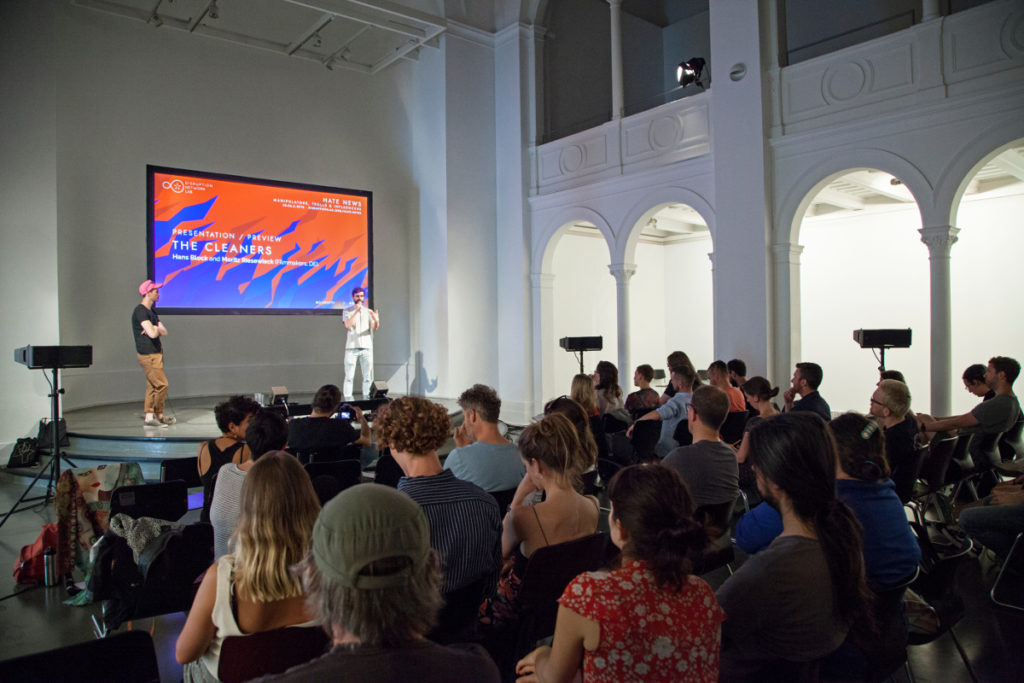
Investigating how the social media platform Facebook polices online content, and the direct impact of these decisions on the users’ interactions, Block and Riesewieck ended up in the Manila, where Facebook boasts its biggest department for content moderation, with more than 10,000 contractors. The Cleaners shows how this platform sees its responsibilities, both toward people moderating and censoring the content and its users. Based on interviews with Philippine content moderators at work, the documentary contributes to the debate about the public responsibilities of social media and online platforms for publishing, from political manipulation and propaganda to data protection.
Humans are still the first line of content moderation and they suffer horrible consequences and traumas for they see daily the worst of the web. Companies like Facebook have developed algorithms and artificial-intelligence tools able to work as a first level, but the most of this technology cannot substitute human capabilities. Certain content moderators describe themselves as custodians of moral values, as their work turns into decisions that can shape social media and consequently society. There are indeed countries where people consider Facebook as the Internet, ignoring that the world wide web is much more than that social media.
The authors go beyond, showing that Manila cleaners are influenced by their cultural background and social believes. They build a parallel between Philippines’ Catholicism and discourse about universal enslavement of humans to God and sacrifice, photographed in the years of the government of Rodrigo Duterte, controversial president who is leading a war against drugs and moral corruption, made of extrajudicial killings and a violent, abusive approach.
Despite denials by the company, cleaners in Manila also moderate Europeans’ posts and they are trained for that. A single world, a historical reference, together with a picture can make all the difference between an innocent joke and hate speech. Whilst memes can be used as weapons, for example by the alt-right groups or by reactionary movements against gender equality, cleaners have just few seconds to decide between removing and keeping a content, checking more than 35,000 images per day. The authors of the documentary explained how it is almost impossible for them to contextualize content. As a result, there is almost no control over their work, as a team leader can just proof 3% of what a cleaner does.
The last panel closing the conference on the second day was moderated by the curator, artist and writer Margarita Tsomou. American independent online harassment researcher Caroline Sinders focused her dissertation on online protests and political campaigns in the frame of the hate speech discourse. She recalled recent events able to pollute the public debate by creating chaotic and misleading messages to enhance a reactionary anti-progressive culture. Misogyny thrives on social media and hatred of women and entrenched prejudice against them are everywhere in the Internet. Fake online campaigns are often subtly orchestrated targeting women.
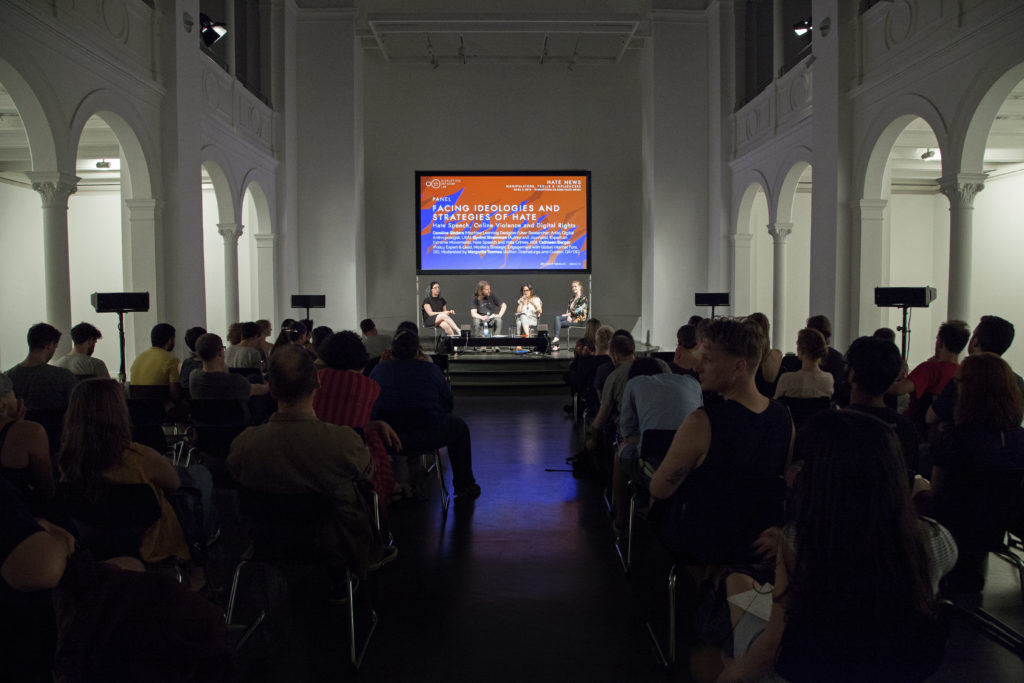
In 2014 on social networks appeared an organised action associated with the hashtag #EndFathersDay, presented as a feminist political campaign to eradicate the celebration of Father’s Day as a “celebration of patriarchy and oppression”. That campaign had nothing to do with feminism and grassroots movements, it was a harassment campaign against women, a fake with manipulated images and hundreds of trolls to feed a sentiment of hatred and hostility against activists for civil rights and equality.
It is not the only case of its genre. The #Gamergate campaign, that in 2014 targeted several women from the video game industry (on Twitter, Reddit, 4chan, and 8chan) falls into this context. The campaign was not immediately perceived as a harassment instrument due to attempts of making it appear as a movement against political correctness and bad journalistic ethics. It was though a misogynistic reactionary campaign against female game developers, that soon revealed its true face as right-wing sexist backlash. Under this hashtag women were indeed victims of doxing, threats of rape and death.
Sinders explained that in the last several years we have seen a shift from a sectorial market to a global dimension where we are all potentially identifiable as gamers. Video games and gaming culture are now mainstream. People are continuously connected to all kind of devices that enable the global gaming industry to generate more than 100 billion dollar every year. The Gamergate controversy reopened the debate that gaming is a world for (white) males, pointing out how the video game industry has a diversity problem, as sexism, racial and gender discrimination in video game culture appear to be a constant factor.
A relevant aspect of the controversy is related to how trolls organised and tried to reframe the narrative of the harassment campaign. Instead of a misogynistic and violent action, they claimed it was about journalistic integrity and candid reviewing, thus denouncing a collusion between the press and feminists and social critics. Most of the trolls and supporters were anonymous, ensuring that the campaign be defined merely by the harassment they have committed against women and as a reaction to what they reported as the increasing influence of feminism on video game culture.
Sinders concluded her speech explaining that organised actions and campaigns like those described above are structured on precise tactics and harassment techniques that have already entered in our vocabulary. Words like doxing, swatting, sealioning and dogpiling are neologisms that describe strategies of hate speech and harassment nowadays common.
The Norwegian journalist Øyvind Strømmen, author and managing editor of Hate Speech International, has extensively researched and written about how extreme right movements and religious fundamentalism are able to build an effective communication online and use the web as an infrastructure to strategically enhance their activities. He joined the panel explaining that despite his intense international activity, he has never been subjected to harassment and death threats like his female colleagues, whilst he finds daily-organised activities to sow hatred and intolerance to repress women.
Cathleen Berger, former International cyber policy coordination staff at the German Foreign Office and currently lead of Mozilla’s strategic engagement with global Internet fora, closed the conference with an analyses of the new German NetzDG legislation, defined by media as an extreme example of efforts by governments to make social media liable for what circulates on their pages. The law was adopted at the end of 2017 to combat illegal and harmful content on social media platforms. It is defined also as anti-hate-speech law as it was written in the historical context of the refugees’ mass migration to Europe and the new neo-nazi propaganda from political formations like the Alternative for Germany (AfD). At the time, fake news and racist material were shared online on several mainstream channels for the first time, with relevant impact on public opinion.
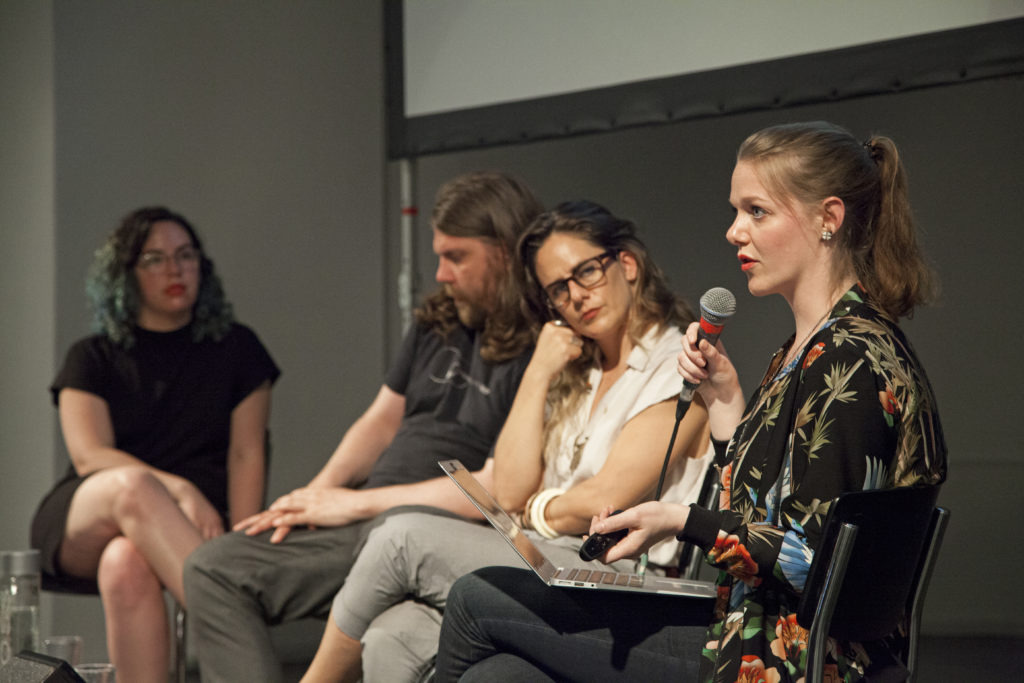
The new German law requires social media companies to provide users with a wide-ranging complaints structure to make sure that discriminatory and illegal posts can quickly be reported. It is left to social media platforms to decide if a certain reported content represents a promotion of or an incitement to terrorism, child abuse, hate or discrimination of any kind.
The law forces social media to act quickly too. Under NetzDG, social media platforms with more than 2 million users in Germany have 24 hours to remove posts reported by users for being illegal. Facebook, Twitter and YouTube seem to be the law’s main focus. Failure to comply with the law carries a fine up to € 50 million.
The German government’s Network Enforcement Act has been criticised for its risks of controversial inadvertent censorship, limiting legitimate expressions of opinion and free speech. Once again private companies, that are neither judges nor any kind of public authority, have the power to decide whether reported content is in fact unlawful.
All credit is due to Tatiana Bazzichelli and the Disruption Network Lab, who provided once again a forum for discussion and exchange of information that provokes awareness on matters of particular concern from the different perspectives of the guests – especially women – able to photograph with their international activities and their researches several topical issues.
This 13th Conference (https://www.disruptionlab.org/hate-news/) was a valid opportunity to discuss and rationalise the need for civil society to remain globally vigilant against new forms of hate speech, manipulation and censorship. Ideological reasons behind hate speech and online manipulation are on the table and the framing is clear enough to hold online media and publishing companies accountable for the spread of frauds, falsehood and discrimination within their networks.
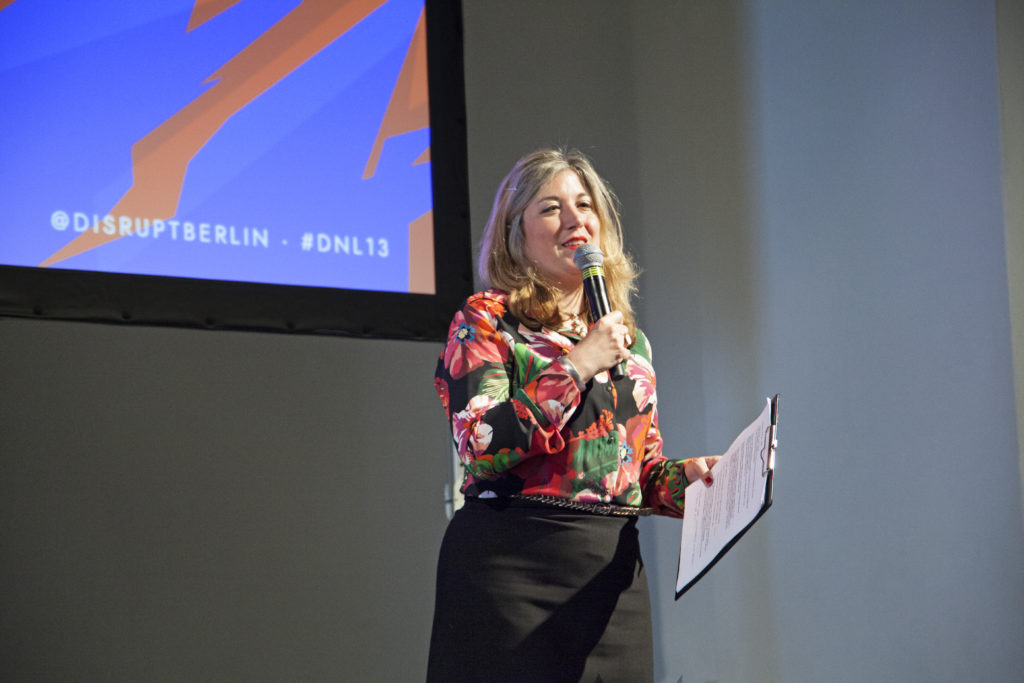
Companies like Facebook and Twitter have demonstrated their inability to recognise real threats and appear to be thinking of profit and control without considering the repercussions that their choices have. However, we are delegating them the power to define what is legal and what is not. Their power of censorship shapes society, interfering with fundamental rights and freedoms, feeding conflicts and polarization. This legal response to hate speech and manipulation in the context of the battle for privacy and civil rights is completely inadequate.
Propaganda and hate speech have historically been tools used in all countries to influence decision making and to manipulate and scare public opinion. Forms of intrusive persuasion that use rumours or manipulation to influence people’s choices, beliefs and behaviours are now occupying the web too. Individuals should be able to give due value to their online interactions, focusing on the risks that they run when they click on something. There is too little awareness of how companies, aggressive trolls, criminals, private groups and advertisers subtly manipulate online environment for political and economic interest.
Such a corrupted online ecosystem – where almost nothing of what we meet can be trusted and where individuals and communities are exposed to private interest – generates often hate campaigns targeting women and minorities, normalising crimes, reactionary gender stereotyping and deplorable cultural customs. As all speakers suggested, Cyber-ethnography can be a worthwhile tool as an online research method to study communities and cultures created through computer-mediated social interaction. It could be helpful to study local online exchanges and find local solutions. By researching available data from its microcosmos, it is possible to prevent ethnic, socioeconomic, and political conflicts linked to the online activity of manipulators, destructive trolls and influential groups, to disrupt the insularity of closed media and unveil the economic and political interest behind them.
HATE NEWS: Manipulators, Trolls & Influencers
May 25-26, 2018 – Kunstquartier Bethanien, Berlin
disruptionlab.org/hate-news/
Info about the 13th Disruption Network Lab Conference, its speakers and thematic is available online here:
https://www.disruptionlab.org/hate-news
To follow the Disruption Network Lab sign up for its Newsletter and get informed about its Conferences, ongoing researches and projects. The next Disruption Network Lab event is planned for September. Make sure you don´t miss it!
The Disruption Network Lab is also on Twitter and Facebook
Photocredits: Maria Silvano for Disruption Network Lab
Our times are characterized by the accelerating collapse and redrawing of multiple borders: between nation states, personal identities, and the responsibilities we have for each other. Also between the old distinctions, work and pleasure.
Some leaders as part of the new world order, tell us through their political actions and their fashion accessories, that they “Just Don’t Care”. This “political art-form”[note]Rebecca Solnit: Not Caring is a Political Art Form: On Melania Trump and the Politics of Disconnection lithub.com/rebecca-solnit-not-caring-is-a-political-art-form/[/note] of not caring permits an insidious spread of hatred online and on the ground. In recent times, the digital condition has lent it’s networks and platforms to this poisonous, rhetorical hyperbole, turning against immigrants, and others who do not fit into the framework of a western world, oligarch orientated vision. Mass extraction and manipulation of social data has facilitated the circulation of fake news and the production of fear, anxiety and uncertainty. Together these fuel the machine of structural violence adding to the already challenging conditions created by Austerity policies, growing debt and poverty.
In the face of these outlandish difficulties our digital tools and networks – taken up with a spirit of cultural comradeship. More inspiring narratives are emerging from across disciplines and backgrounds, to experiment with new solidarity-generating approaches that critique and build platforms, infrastructures and networks, offering new possibilities for reassessing and re-forming citizenship and rights.
The exhibition and labs for Playbour – Work, Pleasure, Survival, have created new contexts for collaboration. Artists (from the local area and internationally), game designers and architects, come together with researchers from psychology and neuroscience addressing the data driven gamification of life and everything.
In her interview, the curator Dani Admiss discusses how they reassess the power relationships of the gallery, park users and the local authorities, asking who owns the cultural infrastructure and public amenities – and so create a polemic to open up questions of public value. The exhibition is open every weekend through 14 July to 19 August 2018.
The artists featured in Transnationalisms exhibition curated by James Bridle address the effect on our bodies, our environment, and our political practices of unstable borders.
“They register shifts in geography as disturbances in the blood and the electromagnetic spectrum. They draw new maps and propose new hybrid forms of expression and identity.”[note]Transnationalisms. Aksioma – Institute for Contemporary Art, Ljubljana, Slovenia.
aksioma.org/transnationalisms/[/note]

“Thiru Seelan, a Tamil refugee who arrived in the UK in 2010 following detention in Sri Lanka during which he was tortured for his political affiliations, dances on an East London rooftop. His movements are recorded by a heat sensitive camera more conventionally often used to monitor borders and crossing points, where bodies are identified through their thermal signature.”[note]Regine Debatty. We Make Money Not Art. Democracy, locative, politics, Transnationalisms – Bodies, Borders, and Technology. Part 1. The exhibition. May 14, 2018. we-make-money-not-art.com/transnationalisms-bodies-borders-and-technology-part-1-the-exhibition/[/note]
The show opens at Furtherfield from September 14th to October 26th 2018, touring as part of State Machines the EU cooperation which investigates the new relationships between states, citizens and the stateless made possible by emerging technologies.
We have another interview with artist and activist Cassie Thornton, where we discuss her current project Hologram, which examines health in the age of financialization, and works to reveal the connection between the body and capitalism. Her interview focuses on a series of experiments that actively counter the effects of indebtedness through somatic – or body – work including her focus on the way in which institutions produce or take away from the health of the artists and workers they “support”.
“In my work for the past decade, I have been developing practices that attempt to collectively discover what debt is and how it affects the imagination of all of us: the wealthy, the poor, the indebted, financial workers, babies, and anyone in-between.” Thornton
Finally I interview Tatiana Bazzichelli, artistic director and curator of the Disruption Network Lab, in Berlin, questions about art as Investigation of political misconducts and Wrongdoing. Since 2015, the Disruption Network Lab has cultivated a stage and a sanctuary for otherwise unheard and stigmatised voices to delve into and explore the urgent political realities of their existence at a time when the media establishment has no investment in truth telling for public interest.
“When the speakers are with us and open their minds to our topics, I feel that we are receiving a gift from them. I come from a tradition in which communities, networks and the sharing of experience were the most important values, the artwork by themselves.” Bazzichelli.
The programme creates a conceptual and practical space in which whistleblowers, human right advocates, artists, hackers, journalists, lawyers and activists are able to present their experience, their research and their actions – with the objective of strengthening human rights and freedom of speech, as well as exposing the misconduct and wrongdoing of the powerful.
To conclude, all one needs to say is…
“Whether in the variety of human, backgrounds and perspectives, biodiversity or diversity of technologies, coding languages, devices, or technological cultures. Diversity is Proof of Life.” Ruth Catlow, 2018.
In this interview with Tatiana Bazzichelli, artistic director and curator of the Disruption Network Lab, in Berlin, we discuss questions about art as a process for investigating political misconduct and wrongdoing.
Disruption Network Lab is an ongoing platform of events and research focused on art, digital rights, hacktivism and disruption. So far, they have hosted twelve conference events in Berlin and one in London. The programme creates a conceptual and practical space in which whistleblowers, human right advocates, artists, hackers, journalists, lawyers and activists are able to present their experience, their research and their actions – with the objective of strengthening human rights and freedom of speech, as well as exposing the misconduct and wrongdoing of the powerful. The programme has been covering topics such as the drone war, whistleblowing, counter-surveillance, ISIS media propaganda, hate speech, and artistic and activist strategies in times of increased geopolitical control (see: disruptionlab.org).
Marc Garrett: Why do we need the Disruption Network Lab now?
Tatiana Bazzichelli: The goal of the Disruption Network Lab is to present and to generate new possible routes of social and political action within the framework of hacktivism, digital culture and information technology, focusing on the disruptive potential of artistic practices. We aim to investigate projects that disrupt the field of information technology in unexpected ways, shedding light on interventions that provoke political and social change from within closed systems. The curatorial strategy aims to connect and to bring into dialogue experts that unfold inner structures of political, economical and technological systems, therefore promoting an in-depth understanding of digital culture in everyday life and society.
I believe that the Disruption Network Lab is necessary because we create a dialogue among people and practices that not necessarily meet often. For example, we connect whistleblowers and artists, policy makers and hackers, investigative journalists and activists. Most of the time, these people are acting within specific scenes, without having occasions of exchange. The curatorial methodology is based on a montage of practices, as well as of fieldwork, to create a conceptual network of multiple points of view.
Each event starts with an in-depth investigation of a subject that is pressing and urgent, and that sometimes needs to be revealed or exposed to the general public. It is not only about organising events, but also to research on what is important to cover according to what is happening in politics, culture and society at a specific moment.
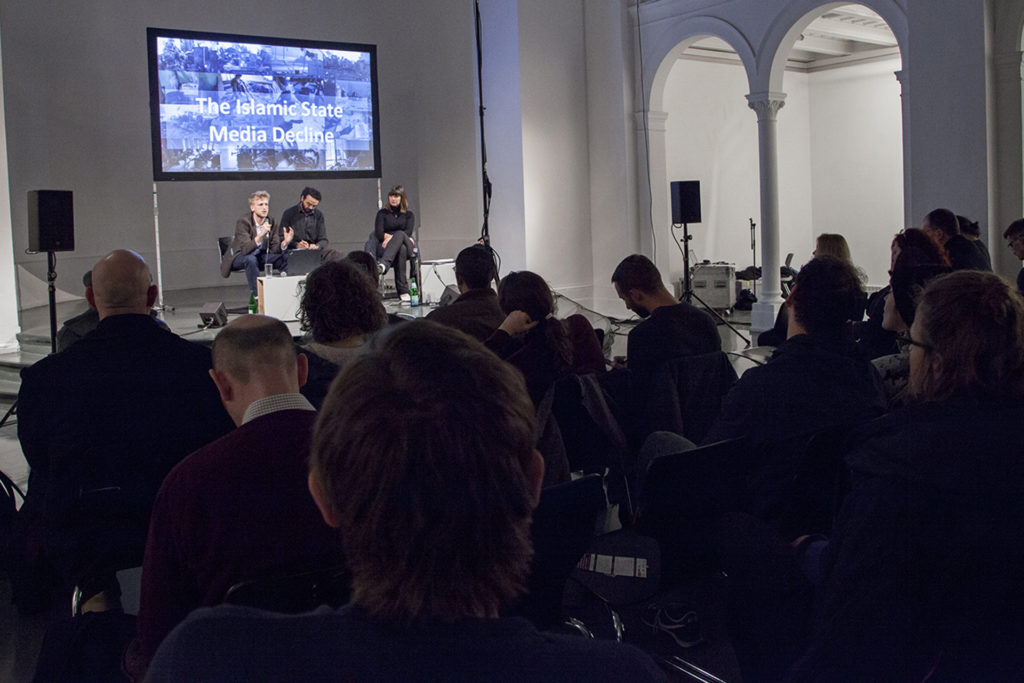
MG: An aspect I find really interesting about DNL is its investigative approach. It deals with those current issues usually tackled by journalism, but manages to go much deeper through the lab and conference formats. It also bridges other political, economical and technological systems, and digital culture. I’m wondering why you’ve chosen an investigative approach?
TB: Our aim is not only to comment on subjects of analysis, but to invite people that experience such subjects themselves, often at a high personal risk, and are able to offer to the public concrete advice and countermeasures that go beyond theoretical speculation. Our objective is to provoke change: change of opinion, practical change in our everyday life, and change in political and cultural terms.
At the core of my curatorial and research analysis is the reflection on practices that work from the inside of social, political and technological systems, questioning such systems themselves. This research path follows my theoretical investigation initiated with my PhD research “Networked Disruption: Rethinking Oppositions in Art, Hacktivism and the Business of Social Networking” (published in 2013 by the Digital Aesthetic Research Centre of Aarhus University in Denmark, and followed by a traveling exhibition in various European venues: aksioma.org/networked.disruption).
Since the first conference in April 2015, the Disruption Network Lab has been investigating the concept of whistleblowing, bringing attention to abuses of governments and large corporations, involving speakers such as Laura Poitras, Brandon Bryant, John Kiriakou, Annie Machon, Cian Westmoreland, Mustafa Al-Bassam, Abdalaziz Alhamza, Trevor Paglen, Henrik Moltke, a.o.
I come from a practical and theoretical background that combined art, hacking and political activism, but since 2014 my attention has been oriented to art as a act of investigation, thanks also to the work of Laura Poitras that deeply inspired me. I am progressively getting interested in artistic practices and investigations that provoke concrete outcomes, that are even difficult to be defined as “art”. Hacker art was my field of interest since the emergence of hacker culture in the 1990s, but thanks to the Disruption Network Lab activity I got even more concrete, and I started being passionate about the field of investigative journalism.
My intent is to combine the culture of investigation with artistic practice, or even operate a conceptual shift, by starting to define investigative journalism and whistleblowing as art.
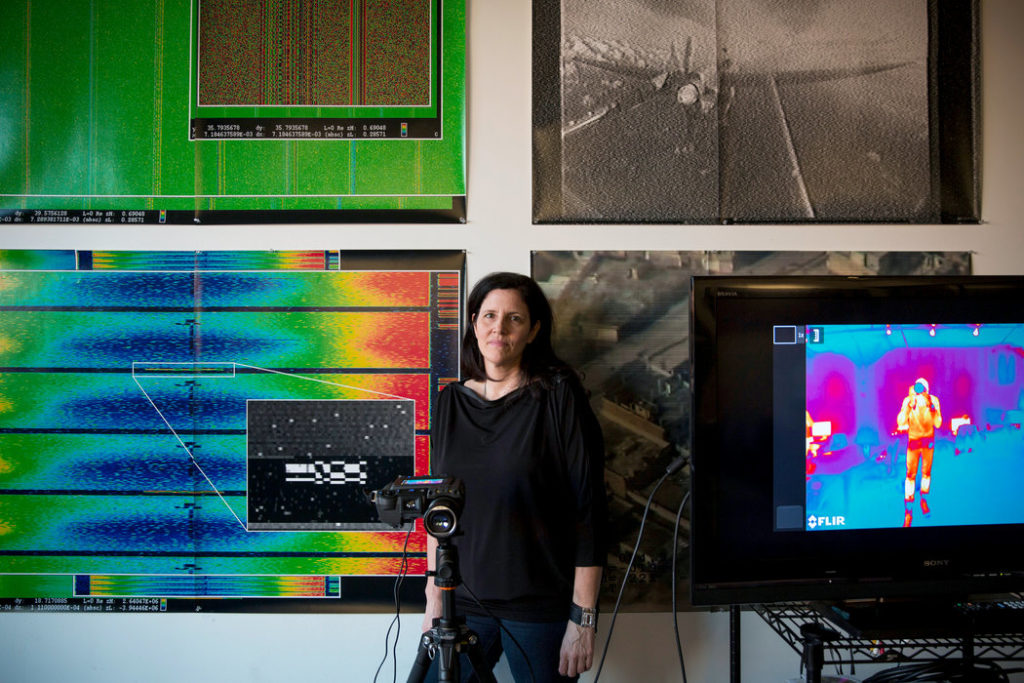
In the act of whistleblowing is embedded a deep change of perspective, where the unexpected emerges. This search for a radical change of point of views, which results in a deep disruption of individual life is something extremely valuable not only in political and cultural terms, but also on an artistic level. It is the contemporary Avant-garde, the search for a profound unexpected gesture that interferes with society and politics at a global level.
The investigative approach is necessary not only in the realm of journalism and whistleblowing, but also in the art context. It is thanks to an artistic approach that many discoveries can be done because artists are able to see reality as a challenge, and in a sense there is an important thread that connects them with whistleblowers. When I brought together these expertise during the Disruption Network Lab conferences, I could really see how it was possible to combine such methodologies and how whistleblowers and artists were intellectually benefiting from each other.
MG: To what degree does your investigative approach stem from what in the media art world has been termed as Tactical Media or Post-Tactical Media?
TB: There is for sure a connection with the tradition of tactical media strategies, and the discourse of post-digital interventions. The idea is to go beyond the digital per se, to focus on the impact of technology on the everyday life, culture, society and politics. However, I like to involve people that do not necessarily theorise on the methods, but that are coming from concrete fields of investigation and would never define themselves as “artists”. It is my conceptual “pleasure” to define them as such, but I know that for them it is not really necessary to present their practices via such definition.
A whistleblower wants to provoke real change, she/he/they is a person that was part of a specific institution or organisation and often is a person that believes in systemic structures. It is perhaps because this person believes so much in them that gets frustrated and decides to disrupt an entire life to reveal a wrongdoing. I find this gesture something impressive, it is a work of art by itself. My question would be how much many established artists would be able to risk to provoke changes. Is actually contemporary art able to provoke concrete changes? For sure the meaning of artistic practice is making us reflect on the concept of change, but I feel that nowadays we need more than that. Power is becoming stronger and more pervasive, my opinion is that art needs to have a stronger and more pervasive impact, beyond distribution of ephemeral privileges.
Just to say something about this curatorial approach: it is absolutely not easy. I see the difficulties when I am looking for funds for the Disruption Network Lab. Cultural funders have difficulty to understand how investigative journalism might be considered useful in the realm of art; alongside, political funders don’t like us to use the word art because they want to give money to something that appears more impactful on society. I like to connect dots, and to be in between, because it is thanks to this liminal zone that change can really emerge and that we can provoke it. Therefore I am choosing the most difficult path, but luckily until now we managed…
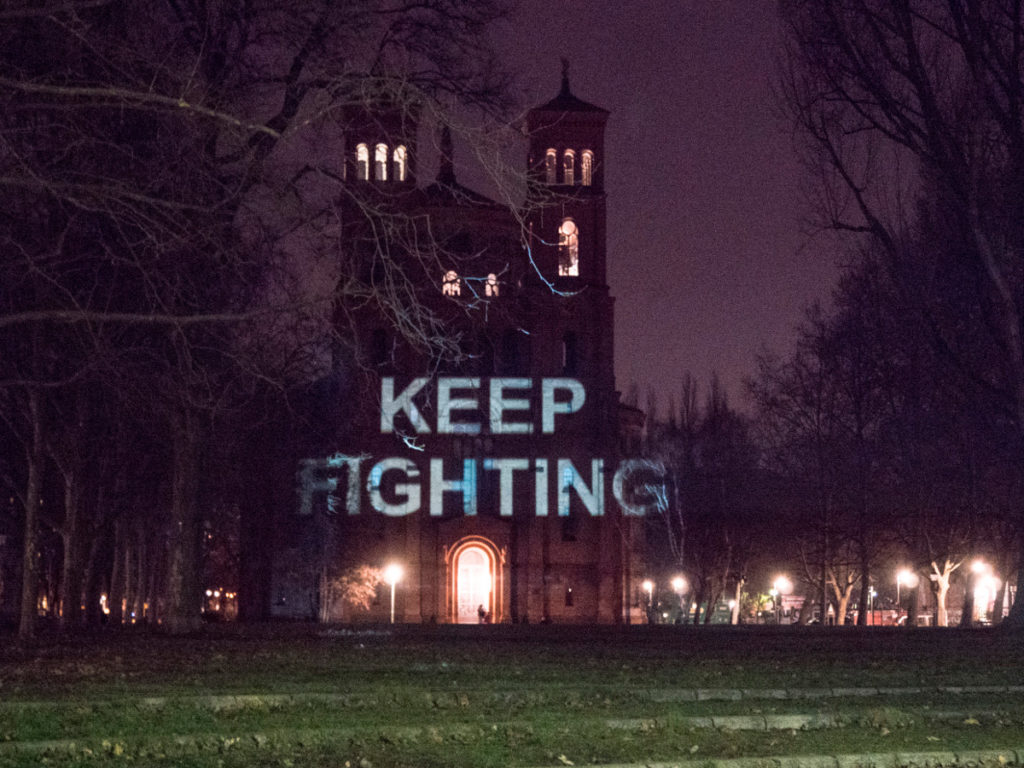
MG: What values are you trying to communicate through this way of working with others?
TB: We want to provide challenging debates within local and international communities, developing a context of critical reflection and analysis beyond what is usually communicated by mainstream media. The format of two-days events with a keynote and a panel each day encourages a very strong community sharing, which works on two levels: first, between the participants altogether, as they often know each other’s work, allowing them to meet for the first time in person and engage in actual discussions about their research; second, among the audience, that is usually formed by real experts working on the topics under analysis, as well as by people interested in getting a deep insight.
This unique combination of expertise creates a solid space for critical questions and discussions during the collective moments of sharing, as well as during breaks and dinners, which add to the Lab’s credibility to handle and discuss sensitive topics in a safe context.
Since each of our events requires a deep content research before the finalisation of the programme, it is extremely important to us to feel supported by organisations that we can trust and allow our research becoming concrete. The challenge of being independent while also looking for funding is very hard, and often some team members have to handle parallel jobs and sustainability struggles. Considering that we work with whistleblowers and people at risk, as it happened in the November 2017 event “TERROR FEEDS”, in which we needed to hire private security, having precarious finances is a severe challenge to the realisation of the project. This is the reason why we try to sensitise our network to sustainability issues in culture production.
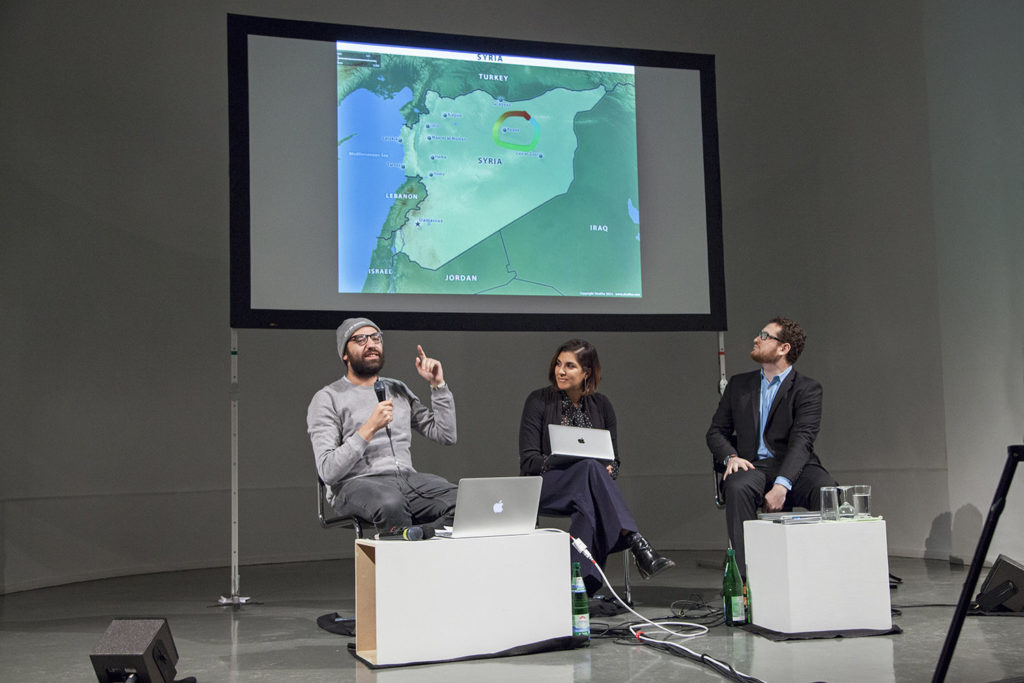
Since 2014 I have been working with wonderful and competent women in my team: Daniela Silvestrin, Kim Voss and Nada Bakr (Project Managers), Claudia Dorfmüller and Rahel Währer (Project Managers and Administration Officers), and with Jonas Frankki that has been shaping the visual identity of the conference programme since the start.
The Disruption Network Lab project was founded in 2014, and since 2016 it is a registered non-profit association in Germany (Disruption Network Lab e.V. – gemeinnütziger eingetragener Verein). The Disruption Network Lab e.V. produces the Disruption Network Lab programme.
The founding of the association was a solid step towards presenting and promoting the topic of digital culture in Berlin and internationally. We evolved from a single, private initiative, to an organisation devoted to digital culture and its applications on politics, technology, and society, locally and internationally. The grounding of the association was supported in 2016 by the Open Society Foundations (OSF) with a structural funding. For the organisation of the events, however, the association has been dependent on external private and (mostly) public funding. The first series of events in 2015 started thanks to the support of the Capital Cultural Funds of Berlin.
I want to be open on these details because they are really important for the way we shape our work. Often organisations in our field do not speak about the “making of”, but to be transparent it is part of our values. In our organisation we unfortunately do not benefit regularly of structural grants, and we have to search for grants event after event. During the production of our conferences, we have to undertake fundraising activities and this makes our lives very precarious.
While in 2015, 2016 and 2018 we got funding support from the City of Berlin, this did not happen in 2017. This pushed us to look for international funds, which was a very complex task while being busy with production – thing that almost compromised the whole conference series. This search opened us toward international foundations that are working with human rights, social justice and investigative journalism, such as the Reva and David Logan Foundation, the Bertha Foundation and the Mozilla Advocacy Fund, which supported us in 2017 (and in the case of the Reva and David Logan Foundation, also afterward). This pushed me to research more extensively the field of investigative journalism, because I understood that there was a concrete need for such practices and approaches in the cultural production scenario, and at an international level.
MG: Could you give us an idea of what the composition of the audiences at the DNL conferences
TB: The audience of our conferences is formed by activists, artists, journalists, computer experts, cultural producers, human right and whistleblower advocates, students and researchers. Entrance ticket is very accessible, only 5 Euro per day. After the conference, we provide a video documentation of the events to reach a broader international audience (youtube.com/c/DisruptionNetworkLab).
We have been collecting a lots of video material in the past four years. At the moment I am researching possible grants to see if we will be able to support the activity of archiving such contents in a systematic way, providing additional references and creating useful infographic. This would be something really important to offer to our public in the future.
MG: I was fortunate enough to be asked to chair two different DNL conferences. The one which affected me most, was “DRONES: Eyes from a Distance” which took place in April 2015, at Kunstquartier Bethanien in Berlin. The keynote speaker Brandon Bryant, was whistleblower and former drone-operator. It all felt very intense. The space was full, and the audience were very inquisitive, they wanted to know more. The length of the panels and discussions are longer than usual panel discussions. Yet, strangely, they go very quickly.
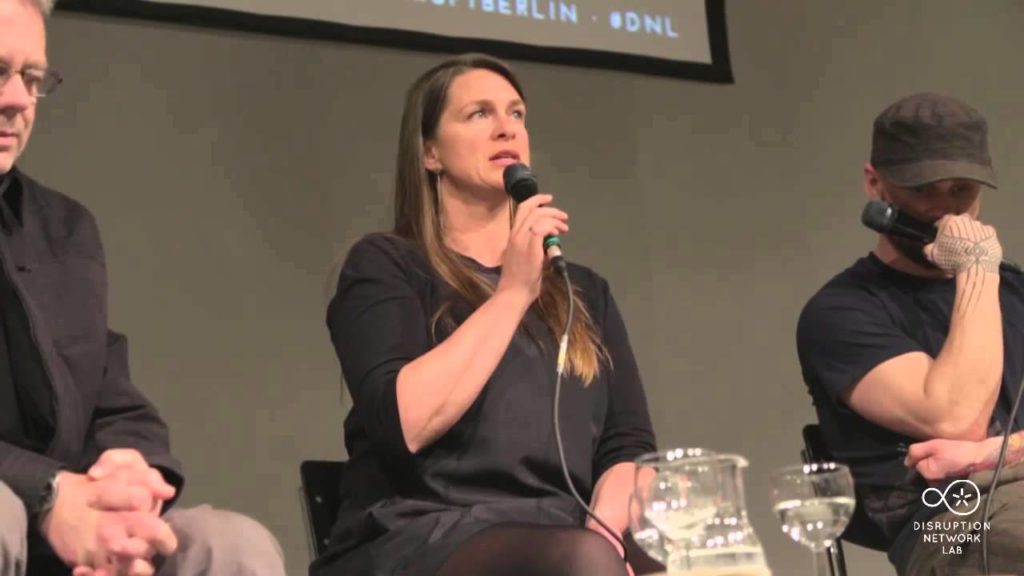
Could you expand on how and why you choose this way of presenting a cultural forum as a platform?
TB: Since 2015 the Disruption Network Lab e.V. produced thirteen conference events (in Germany, UK and Austria). The conference “DRONES” with keynote Brandon Bryant was the first of the series. After that we kept investigating on related subjects, such as activist and resistance strategies after the Snowden-Leaks (“SAMIZDATA”: keynotes Laura Poitras and Jacob Appelbaum); whistleblowing (“TRUTH-TELLERS”: keynotes Grace North and Mustafa Al-Bassam; “PRISONERS OF DISSENT”: keynote John Kiriakou), the ISIS media propaganda (“TERROR FEEDS”: keynotes Charlie Winter, Sue Turton, and Abdalaziz Alhamza): hate speech and political misinformation (“HATE NEWS”: keynotes Nanjala Nyabola and Andrea Noel).
Currently we are working on developing a new conference on the subjects of populism, right-wing extremism, and alt-right, and the effects of such phenomena in art, media, politics and society, under the title of INFILTRATION: Challenging Supremacism (September 7-9 in Berlin at Kunstquartier Bethanien).
Each conference requires a previous research, and an analysis of the topics that are important at the moment. This allows us to be exactly on time for the investigation of current phenomena. It was the case of the last conference, HATE NEWS, which was the result of a funding application done in December 2017, but since the production started later in 2018, I could focus on the “hot news” of the Cambridge Analytica debate, and be really fortunate to have with us David Carroll and Nanjala Nyabola.
Sometimes the topics are also the result of a common sharing within my own community (which actually crosses many communities). It was the case for the first conference event “DRONES” in April 2015. During some months I was sharing ideas with my friends and colleagues Chantal Meloni (criminal lawyer at the ECCHR in Berlin) and Laura Lucchini (freelance journalist) about the topic of the consequences both on military networks and civil society of an increasing automatism of conflicts. Chantal Meloni suggested me to contact former drone operator Brandon Bryant, that at the moment was not well-known as today – she saw him speaking at the ECCHR during an event related to human rights and the drone war. I reached out to him and we decided together how to shape his Keynote – you saw the results. Brandon Bryant was really important for the start of the Disruption Network Lab, his gesture of coming to us was really brave, generous and impactful. In a sense, it was the beginning that shaped the future of our activity.
MG: What responses have you received from your audiences in respect of this way of presenting and the content being explored?
TB: Our audience is usually really committed. I am always impressed when after four hours of discussions, at the Q&A in the late evening, I see people asking very deep, incredibly detailed and specific questions. I have to say that this has been my deep surprise in Berlin since I moved here 15 years ago, to experience that people are so committed, critical and well-informed during events. But of course at the Disruption Network Lab the feedback it brings a more intense value, because I have the feeling that people are enjoying the unexpected connections that I put together after hard work. And the most fulfilling result is when they got them!
However, it is not always easy to keep the public interested in such deep topics, especially because in Berlin the competition with openings, clubs, and parties during the weekend is tough. In the past 4 years we have been shaping our community of passionate people that are regularly coming and following us, even from abroad. The challenge for me now it is to open up more, and to reach new people that are constantly flowing in the city. The support of our close community is important also for this scope, we need to support each other to keep doing what we do.
MG: Since starting DNL what highlights do you remember that have made you feel you are part of something special?
TB: The work before each conference is hard, we are only five people, and in the past we were just three. So at a production level, there is a lots of work which implies fundraising, press and communication, the whole organisation of the logistic and speakers presence. Plus of course, the curatorial work and the research beforhead. We often arrive to the conference very excited but also really tired. However, every time, it is thanks to the speakers and the audience that we get our energy back. In the past conferences we had really unique and wonderful speakers that shared with us their stories, many of them really difficult, heartbreaking and a real challenge to be communicated. This was the case of (among others) Brandon Bryant, Cian Westmoreland, John Kiriakou, Laura Poitras, Jake Appelbaum, Annie Machon, Andrea Noel, Grace North, Mustafa Al-Bassam, Abdalaziz Alhamza, and the constant very important presence of the Chelsea Manning Initiative before Chelsea Manning was released.
I felt that all these people were trusting us and our public by sharing their stories with us. Each conference has been offering an important context at a human level, a moment of reflection, revelation, and also the sensation to belong to a community. With some people I am still in contact, other entered in contact with each other and are still working together on other projects. This is for me the most important result, to see that the Disruption Network Lab is useful not only to inform, but also to make people feel part of something in common.
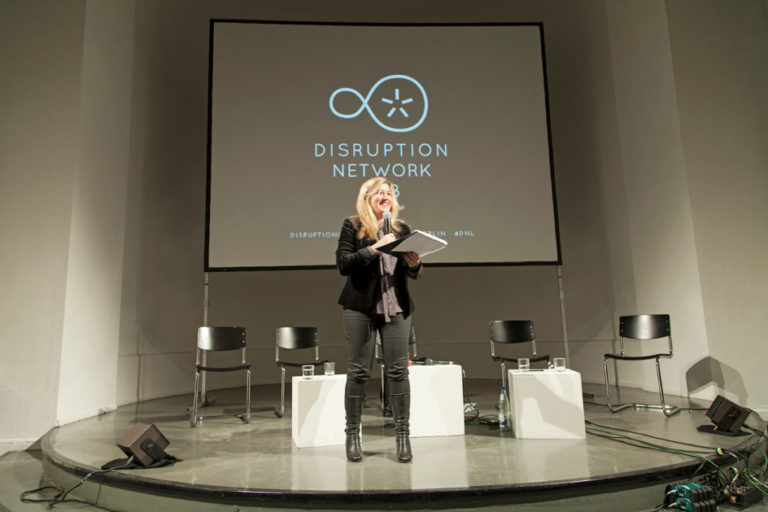
When the speakers are with us and open their minds to our topics, I feel that we are receiving a gift from them. I come from a tradition in which communities, networks and the sharing of experience were the most important values, the artwork by themselves. By combining all these expertise, I feel the responsibility of creating each time the context for a collective artwork, And this is something special, especially nowadays in which the discourse of networking has been completely commercialised. I feel to thank all these people, not only the ones that worked with me and supported us, but also all the people that shared their experiences and the ones that came to listen to them. I am sure that this path will go on, either with us, or among the people that found themselves related thanks to our conferences.
Tatiana Bazzichelli (1974, Rome) is artistic director and curator of the Disruption Network Lab, a program of conference events at Kunstquartier Bethanien in Berlin. She is currently visiting lecturer at the Fachhochschule Potsdam at the Department of Applied Culture. She has been based in Berlin since 2003. Bazzichelli received a Ph.D. in Information and Media Studies (2011) at Aarhus University in Denmark. In 2012–2014 she was postdoctoral researcher at the Centre for Digital Cultures, Leuphana University of Lüneburg. She founded the networking project Activism-Hacking-Artivism in Rome in 2001 and managed the aha@ecn.org mailing list on art activism. She was program curator at transmediale festival, where she developed the year-round initiative reSource transmedial culture berlin and curated several conference events, workshops and installations (2011–2014). Bazzichelli wrote the books Networking (2006), Networked Disruption (2013), and co-edited Disrupting Business (2013). She curated exhibitions such as Hack.it.art (2005), HACK.Fem.EAST (2008), Networked Disruption (2015), and SAMIZDATA (2015).
The next Disruption Network Lab conference event is INFILTRATION: Challenging Supremacism, as part of the 2018 thematic series “Misinformation Ecosystems”, scheduled on September 7-8, 2018, at Kunstquartier Bethanien in Berlin.
The conference wants to reflect on the practice of political, investigative and activist infiltration as a form of betterunderstanding aims, lifestyles and methods of right-wing extremist groups. What is the reason for people to join extremist groups? How can we analyse their dynamics from the inside? What are the reasons of fascination among young generations of right-wing propaganda and supremacist outrage?
Among the confirmed speakers are Daryl Davis (Musician & Author, USA) famous for being a black American befriending members of the KKK since the 1990s and making possible to convert around 200 of them (the film “Accidental Courtesy:Daryl Davis, Race & America” will be screened at the DNL event on September 9). Other participants are Patrik Hermansson (Anti-racist Activist, “Hope Not Hate” Researcher, SE/UK), Julia Ebner (Terrorism and Extremism Researcher and Author, DE/UK), Stewart Home (Artist and Author, UK), Florian Cramer (Research Professor in New Media at Hogeschool Rotterdam, DE/NL), Janez Jansa (artist, SI), and others. Stay tuned at: disruptionlab.org/newsletter/
Main Image: Brandon Bryant, Former US-Drone Operator speaks at Disruption Network Lab, DRONES, April 17 2015, Berlin. Photo by Nadine Nelken.
Tatiana Bazzichelli is the artistic director and founder of the Disruption Network Lab. Former programme curator at transmediale festival in Berlin from 2011 to 2014, she developed the year-round ‘reSource transmedial culture berlin’ project and curated several conference events. She was visiting lecturer at the Fachhochschule Potsdam at the
Department of Applied Culture in 2016 and 2017, where she taught classes about art, hacktivism and whistleblowing. You can read more about her here.
INFILTRATION: Challenging Supremacism
September 7-8 · Studio 1
Kunstquartier Bethanien · Mariannenplatz 2 · Berlin
Partner Event @ Spektrum · September 9
More info: disruptionlab.org/infiltration

 Furtherfield content is published