
By Ruth Catlow and Elly Clarke
Elly and Ruth have been organising workshops and conversations for Furtherfields’ latest project in Felixstowe, Reimagine This Coastal Town. This correspondence followed a 2-day workshop that took place in December 2025 at Hamilton MAS with artists and young visionaries from Felixstowe and East Anglia, exploring crossovers in art and ecology, and possible futures of the town. Creative Participants: Ruth Catlow (Furtherfield) and Elly Clarke (co-curators and hosts); Lora Aziz Josh Hall (Possible Worlds) and Simon Read. Young Visionaries: Lily Hammond, Courtney Hessey and Stan Willey.
Elly: Monday 5th January, 2026
It’s not yet been a month since our two-day co-creation workshop in December, but it already feels so long ago. Christmas happened. Betwixmas happened. And the New Year happened. And then the Venuzeulan president was kidnapped in an extraordinary Stranger Things-style military ambush led by the US president, and the world is waiting for the next rupture [which turned out to be the violently suppressed uprising in Iran.] This is the world we live in, breathe in, are trying to survive in, trying to remain calm in, keep healthy in, care in, look after our bodies and the bodies of others and other species in. But it is also the world we are resilient in. The world we are creating in, imagining in, dreaming in, loving in and living in. The unignorable multiple troubles of our current era – ecological, political, economic, and technological – mean that more and more people are talking about the things that are not working… And these, I believe, are the cracks where (to reference Leonard Cohen) the light can get in. Discussion about the desire for change is entering more and more conversations – and that is a good thing.
For me, and I think for the others, the workshop provided a moment of pause, of calm, of happy being together-ness with people I knew, and people I didn’t. We intentionally structured the workshop only loosely, to give space and time to acknowledge the many ills of our times, but also, importantly, to feel what we actually are feeling in this context. The result was the embodied, palpable sense that so long as we keep meeting and being together over a selection of teas, oranges, and Stan’s delish homemade curry, and forget about the 1-hour meeting format with strictly prescribed lists of actions, we might just be ok.
Thinking together, and sharing collective experiences with people aged in their 20s to 70s made time expand in a way that most templates of organisation today do not allow. Through Simon, we were taken to 1980s Thatcher’s London with the closing down of art spaces. As he was talking I thought of Derek Jarman’s films from that period, and earlier – [for example, Studio Bankside, 1971, which shows the gritty post-industrial site of what is now Tate Modern, occupied by queer punks gleefully cavorting around burning barrels] – even though I don’t think he was part of that scene. Meanwhile, Courtney, who has lived in Felixstowe all her life, speaks for the people she meets. She asks, “but when are we actually going to do these things? What is the action?”
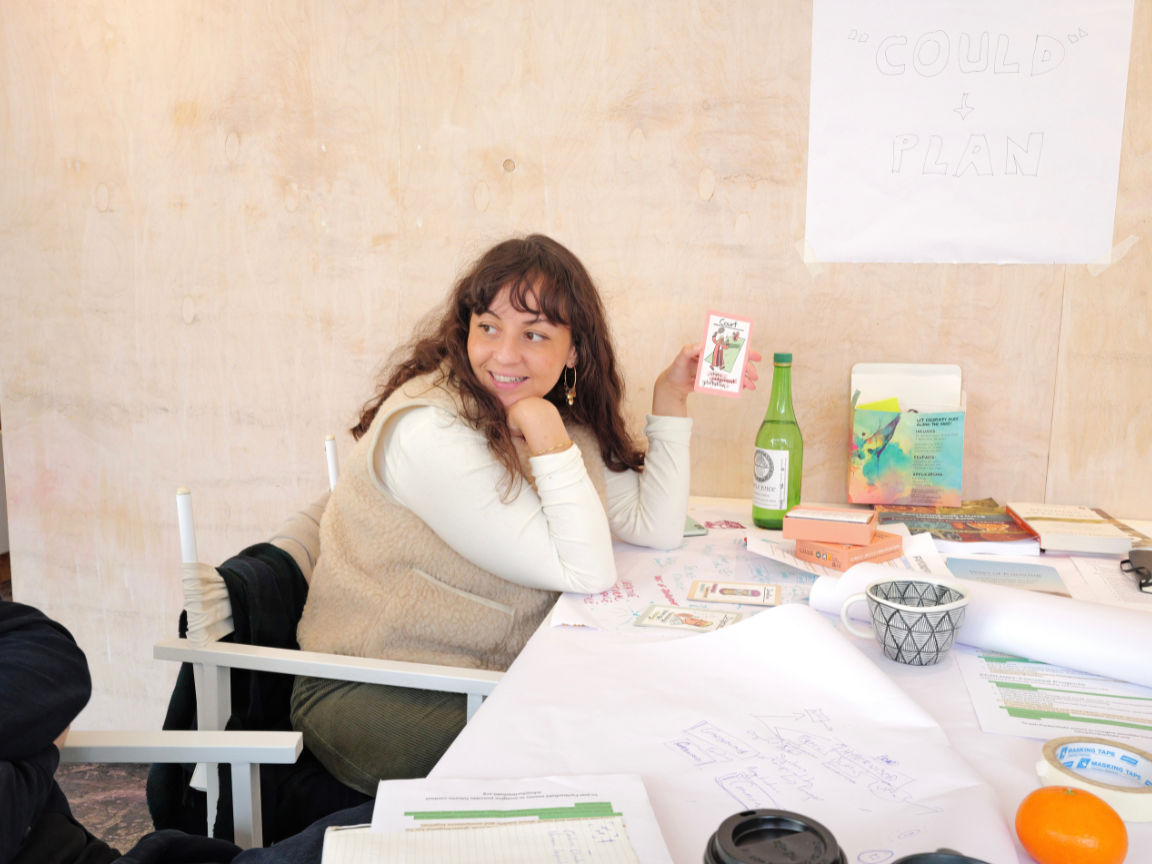
Workshop lunch – Reimagine This Coastal Town Co-creation workshop in Felixstowe, December 2025
Ruth: Thursday 8th January
Yes Elly, I was struck too, by Courtney’s sense of urgency for action.
I’ve just got back from the Listening to the Land Day, a symposium dedicated to artistic and scientific animist practices (as part of the Oxford Real Farming Conference for agroecology and food sovereignty). There, I was reminded that imagination is the place where reality starts for us, and from where we create the blueprint for our actions. When we discuss our hopes and desires with others, we seed patterns in the imaginal realm.
During our workshop at Hamilton MAS, we seeded patterns for future conversations, imaginings, and action not only with other townspeople but also the more-than-human life in the town and its surroundings.
Everyone made crucial contributions to the development of our upcoming public art commission in Felixstowe. The ideas flowed and grew between us as we discussed the proposal by one of our younger LARP participants last spring called Rewilding the Ruins. This proposal also inspired and enthused visitors to our exhibition last summer. The act of ceding sites abandoned by humans to other creatures of the town honours human heritage while recognising the biodiverse communities that emerge and thrive there. Lora suggested the term “renaturing” rather than “rewilding,” as we are prioritising biodiversity in relatively small sites rather than introducing apex predators to large areas of land.
Hopefully, the artwork that Lily goes on to make will not only inspire everyone in the town to get involved in our creative activities and other practical environmental actions, but also support a conversation about how everyone can make simple but important nature-connections – just by turning curious attention to the other lives that thrive in these places.
Life loves to be appreciated! Noticing and appreciation are the first steps to caring.
There was a moment in the workshop where I heard you talk about the importance of love. We were talking about political developments down the English East coast and the wider Earth crisis, and how to “stay with the troubles”.
You asked, “How can we care for anything if we don’t first love it?”
This really struck me because after years of working with critical practice in the artworld I was shocked to realise how rare it is to hear someone talk about love. And when the embers of love fade, the world becomes arid, and our eyes and hearts dull.
Noticing and appreciating the brambles that provide food and shelter for insects and birds around the old military placements of Landguard, and the peacock butterflies that overwinter there, and loving the magical foxes that make their homes in the quiet spaces of abandoned railway stations might be the most important thing anyone can do.
There’s already such a spirited mutualism here in places like Cuppa, our community cafe, and community growing project Edible Felixstowe. And plans are afoot for other inspiring projects to create new pathways for young people to make this town their own in imaginative and creative ways. By generating loving attention and care for other beings, we aim to create the conditions necessary to support these emerging plans for coordinated, human and more-than-human action in the town.
And so the things that remain with me from that day are: Josh’s rage for the cruelty of the politics on the streets of Great Yarmouth and the creative and loving social engine, he and his partner Gabby have established to counter that cruelty, with good food served at a mutual aid cafe (visit the Bakehouse) and bitingly funny poster campaigns; the light in Lora’s eyes, she talked about clambering through barbed wire and brambles to the source of her beloved local river, and the importance of regular encounters with that spring to her spirit. Also, the joy of introducing a group of school children to plum trees, having them pick and taste them for the first time; Lily’s calm love of beauty, pattern and colour in the lives of other beings; Stan’s quick, imaginative, and inspiring transformation of proposals into plans he would like to realise for a local permaculture, growing, and anarchist zine production project. Simon’s slow (years-long) conversations with the estuary are based on a deep ecological knowledge and relationship gained over decades. All contrasting with, and complemented by, Courtney’s sense of urgency.
I realise there is something we can do right now – all of us – and that is to greet the birds as friends every morning. Get to know individuals, observe their ways, learn what they do and what they like, and where they live. We can do that already – all of us – without any additional money, resources, knowledge, plans – and we will probably find ourselves more connected and alive.
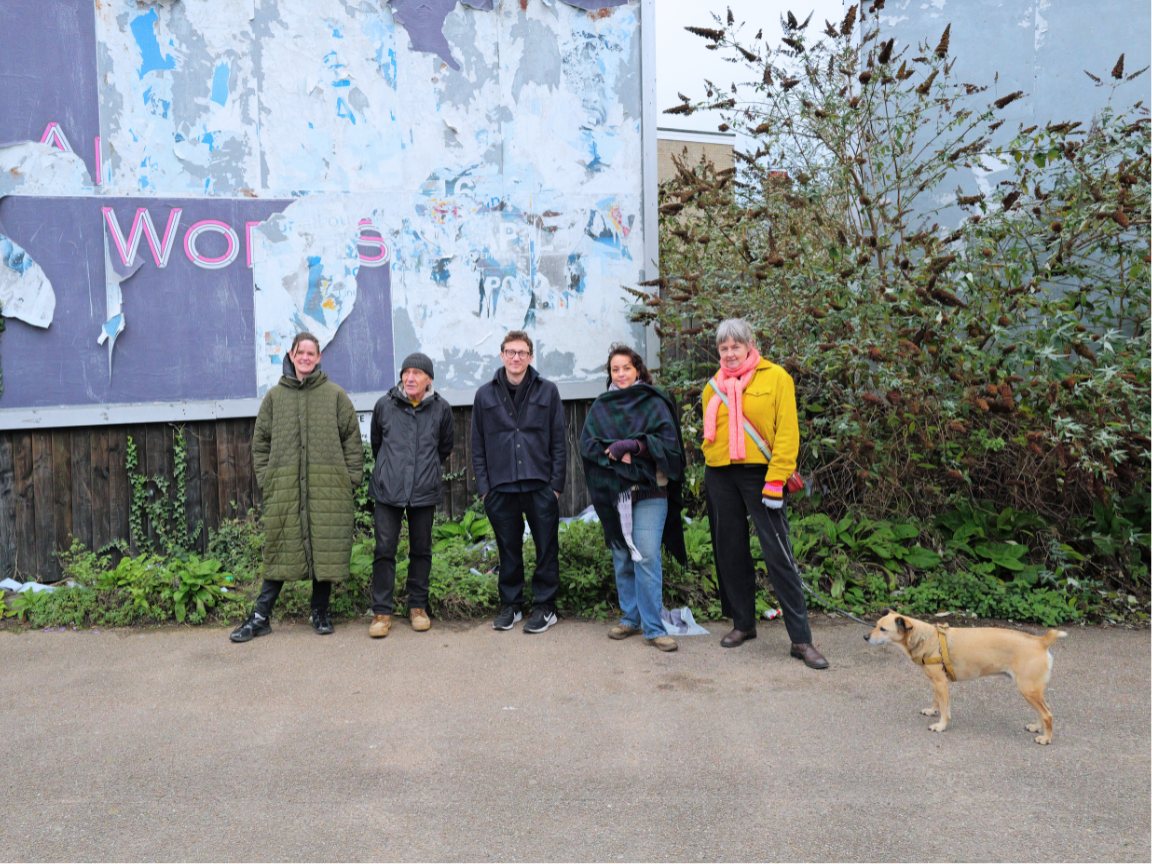
Billboards in Felixstowe – with artists Elly Clarke, Simon Read, Josh Hall, Lora Aziz, Ruth Catlow, with Nick the dog.
Elly: Saturday 20th Jan
Hi Ruth,
This sentence: imagination is the place where reality starts for us, and from there we create the blueprint for our actions. is where I want to start… Because I love the poetry of the fact that it was at a Real Farming Conference that you were reminded of imagination being a blueprint for everything. Because to nurture growth – of plants, of ideas, and of communities of all species – requires a balance of care and knowledge, but is also subject to many factors beyond anybody’s control: the weather, climate, labour, health and, increasingly, politics. In the case of Yarmouth, where Josh and his project are literally feeding love to the local community through food, space and shelter, love meets and has to (try to) negotiate with [the largely unloving views of] the right-wing whose flag/ging erections repeatedly signpost their presence. Whilst Felixstowe is not currently suffering this degree of extremism, it would be remiss of us, and irresponsible, not to acknowledge that this is part of the wider context (and climate) our project is landing in.
Your descriptions of Lora’s joy at the climbing over barbed wire to her beloved spring, (and the video of her dipping her child’s feet into it); Stan’s zines and Simon’s slow, ongoing encounters with life (and lives) of the estuary – and Courtney’s urgency, alongside the spirit of mutualism you highlight – are all fuelled by love. As I said in the workshop, I do think that love never gets enough acknowledgement or space when discussing art and nature, and the climate crisis. Love is about noticing – as you say, the brambles, the birds, others around you. It is about at/tending to what is around us. Love naturally inspires and invokes interest and curiosity, which is crucial to the desire and labour of building a better world. So perhaps if Love got more of a look in, if s/he could be part of our group with a name badge pinned to hir chest, we could ensure s/he was involved in all aspects of planning and dreaming, which could offer some important signposting when we need it….
And Lily, when delivering the final edits to her incredible artwork these past days, spoke passionately about how the work was created out of ‘so much love’ – which is evident and palpable. So love is in the work we are doing here. The mentor species are wearing it. The colours are showing it. The fox’s steady gaze holds it. The ruins of Felixstowe are receiving it.
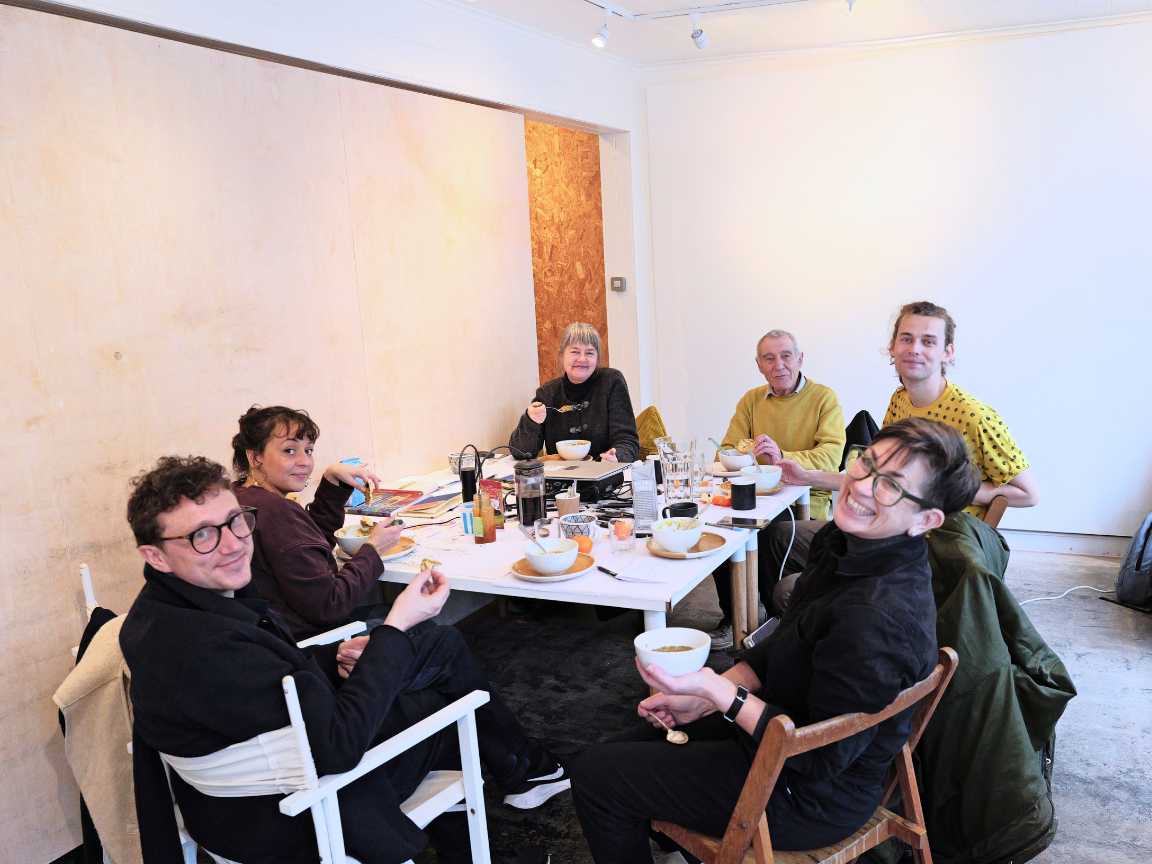
Lunch with Bryony Graham, Director of Hamilton MAS, with Ruth Catlow, Simon Read, Stan Willey, Josh Hall and Lora Aziz.
Ruth: Wednesday 31 January
Yes, Elly, yes!
And to close, I want to reflect on a familiar criticism: that directing our imaginative attention toward interspecies thriving somehow diminishes or distracts from the urgent political struggles of humans across the globe. As if care were a choice, and as if we must decide between loving other people and loving other beings on this planet.
After six or seven years of working with creative practices for interspecies justice, I have learned the opposite. When we come to understand our well-being as bound up with that of other species, we gain sharper insight into the many dimensions and mechanisms of oppression that operate within human societies as well. And we discover that love is not a zero-sum game – not a finite resource. Loving other beings opens new ways of loving, new imaginaries for care and new capacities for justice.

 Furtherfield content is published