What is a device? What is multispecies connection? Why is multispecies connection important? What devices could we design and devise to help facilitate tangible, visceral and even magical/spiritual connections between humans and other species? How can we think better with, rather than just about other species? And how could this help us to think and act more holistically, and with less despondency, about climate warming and environmental degradation? What conversations could such a devising inspire?
These are some of the questions that inspired our second co-creation workshop in Felixstowe at the end of April as part of Furtherfield’s place-based, eco-social project Reimagine This Coastal Town. Through a series of immersive fictions in the form of Live Action Role Plays (LARPs), interspecies meditations and active collaborations and creative conversations with local and global artists, the project is about working with the town’s residents to ignite imagination in a way that, after childhood, ordinary life often doesn’t leave a lot of room for. And yet, if we cease to imagine, to speculate, to wonder, to dream, there can be no change. But too often we make no time to do this. Systems of living – from the food we eat to the structure of our working days, from our relationship with nature to the way we live together – are scripted according to templates which, in a time of climate collapse, biodiversity loss and AI, are rapidly proving to be disastrous. Every key moment of change – as Martin Luther King so famously put it – begins with a dream. Rather than separating imagination from action, this project is about bringing them together, Being brave enough to imagine the world we want, and then take steps to move towards it.
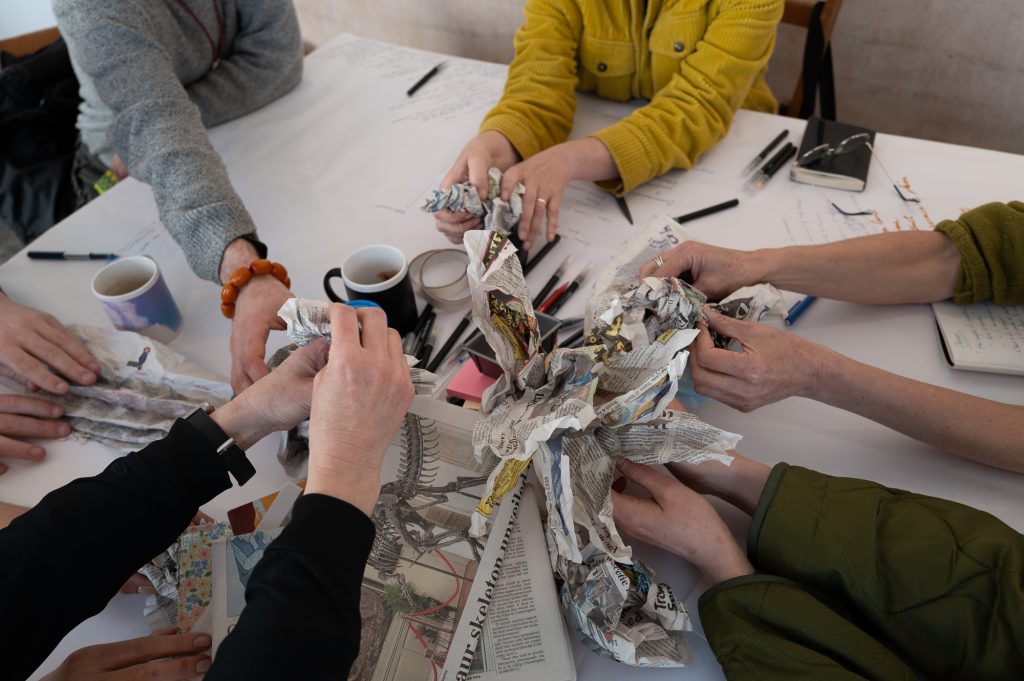
Still from Rebecca Hall’s workshop, where we got to create a species we had closely observed outside before creating it with a single sheet of newspaper. Rebecca’s step-by-step prompts culminated in all the ‘species’ moving, and interactions between them. Photo: Elly Clarke
Ruth Catlow and I invited a group of creative, nature-engaging humans to gather at Hamilton MAS in Felixstowe for two intentionally spacious, loosely-structured days to explore some of these questions. With an invitation to talk, present, demonstrate, or show some aspect of our research and practice for about 20 minutes each, our remit was simply:
to exchange creative and imagination-driven approaches to connecting with other life-forms, to help shape a public co-creation day in which local participants could make their own multispecies connection devices to see the world through other species’ perspectives.
The people at the table were East Anglia-based artist Michelle Brace, organic land worker Tom Doherty, The New Wolsey Theatre, Ipswich’s youth engagement facilitator Rebecca Hall, parakeet whisperer and artist Christie Swallow and self-described ‘recovering fashion designer’ Geraldine Wharry. Furtherfield Community Convenor Stanley Willey was also present (and kept us deliciously fed over the two days!), along with myself and Ruth. During lunch on the second day we had input from our Youth Empowerment Consultant Courtney Hessey and our Coordinator Charlie Pattinson-Boulton, both of whom listened to what we had been discussing over the previous day and a half, and fed back.
After Ruth introduced the theme of the workshop and the urgency of tending to biodiversity loss, Tom Doherty spoke about the shift he made from working in the arts to becoming a land worker on an organic farm in Sussex where he grows flowers and veg and sells them at market. He spoke about the extractivist history of supermarkets, and shared a film he made on the farm alongside some incredible documentation of a fashion show he organised last summer, of outfits created from organic materials, modelled by an intergenerational mix of rural and urban friends, fabulously parading down a homemade cat walk. Queerness is not confined to the urban after all, nor, indeed, to humans.
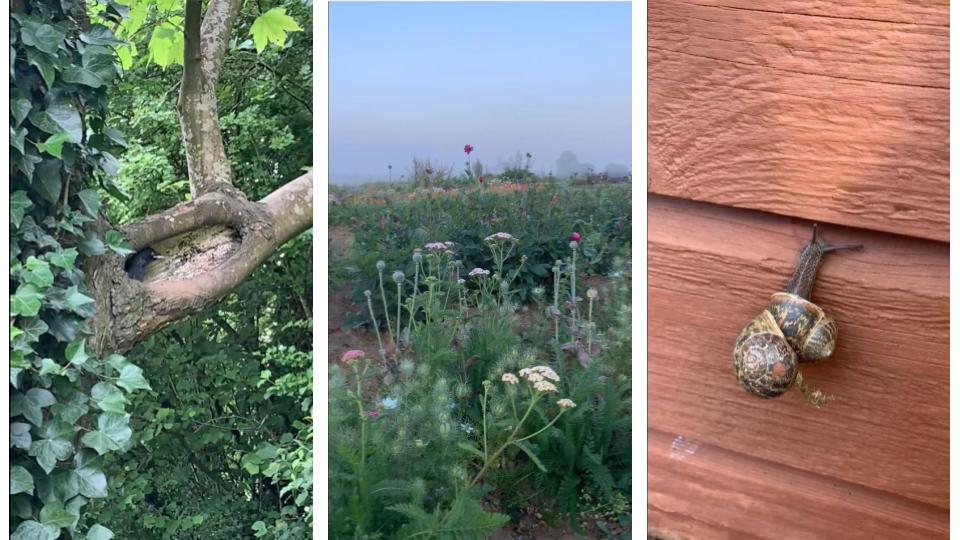
Stills from Thomas Doherty’s film Farm as living organism, 2026, shown as part of his presentation.
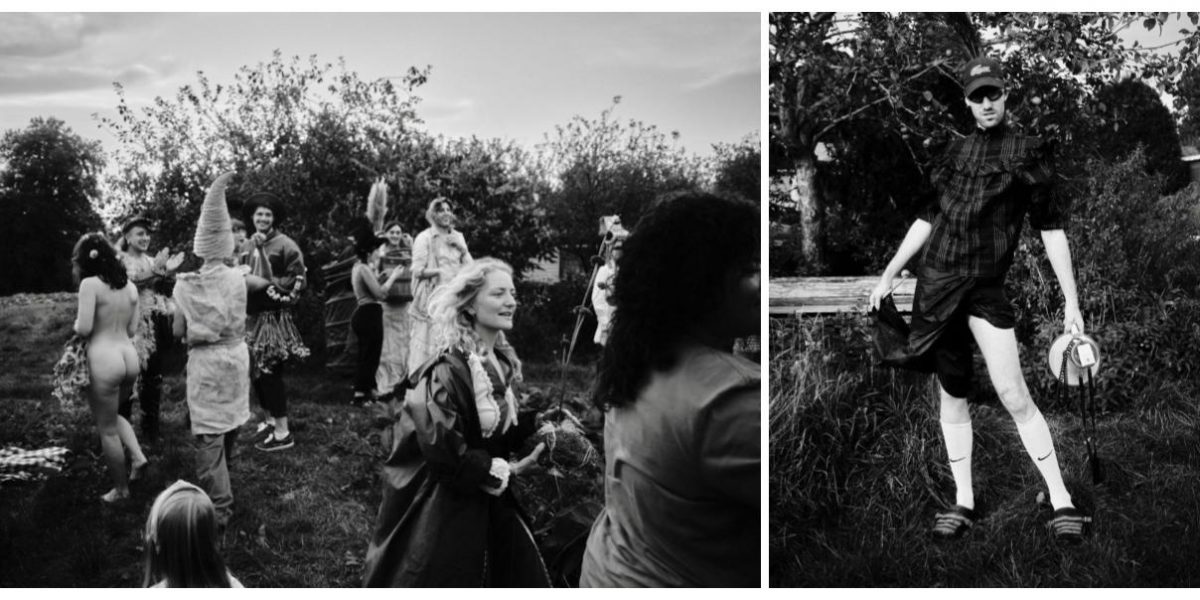
LainesFW produced by Rosa Farber + Tom Doherty. Photography by Scott Gallagher, 2025
Michelle Brace spoke about her practice in relation to mental health conditions – exhaustion and wonder. She introduced the concept and method of finding a sit spot – a place in nature you can return to, to learn the patterns, players, and personalities in the neighbourhood of beings that call it home. Thinking towards the interspecies devices we were yet to explore, she spoke about human sensing devices – barometers, clocks, and fit bits – and how they can be used to increase and extend our sensitivity to the environment as well as of ourselves within it.
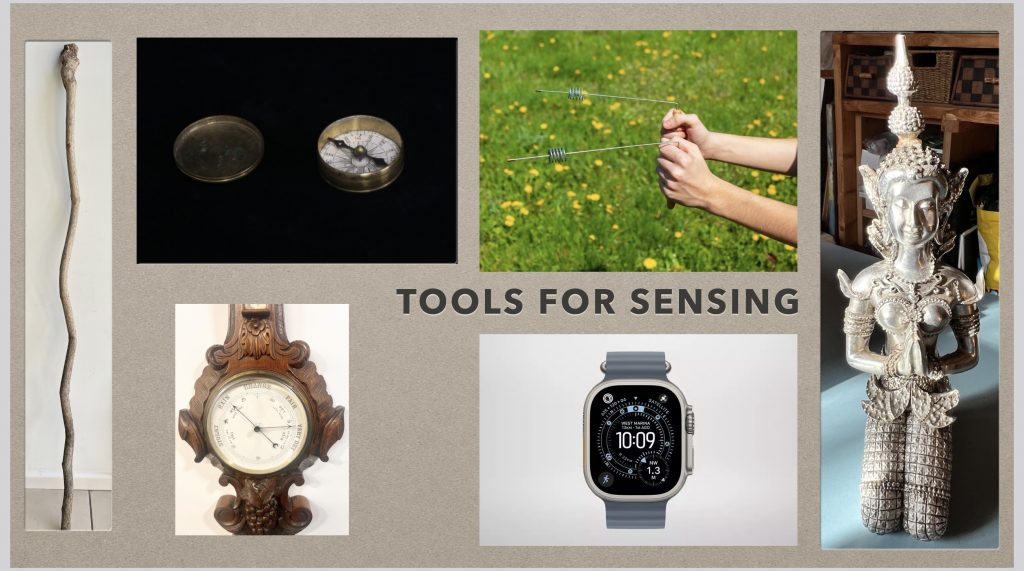
Slide from Michelle Brace’s presentation.
Armed with some beautiful quilts and collages created in various community settings, Christie Swallow focussed on the work they have been doing with parakeets. Challenging the view of these birds as an invasive species that can do no good, Swallow demonstrated how groups of parakeets in different places have different accents. They consider ecology as both a topic and a thinking method. And quilt making a mode of bringing people together.
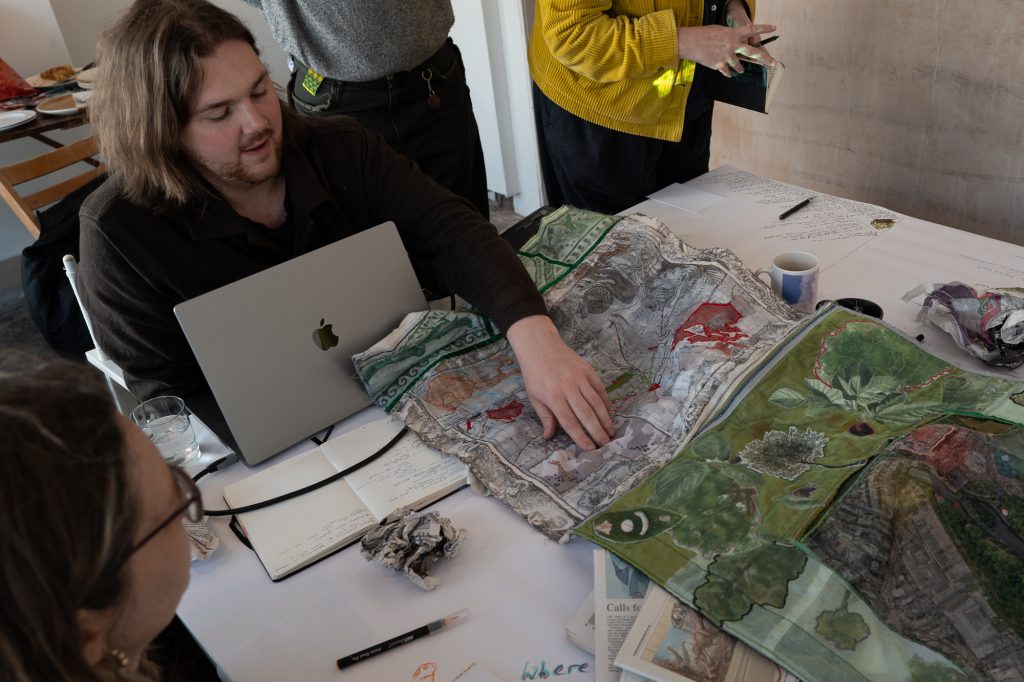
Christie Swallow with one of their community-made quits. Photo: Elly Clarke
After Stan’s brilliant lunch, Rebecca Hall brought the thinking back to the body. We left the workshop space and went outside to observe in detail a plant or animal on the beach. We returned and, provided with one sheet of newspaper, created the species we had observed with our hands, and later gave it movement. This moment of sitting in silence working with our hands and laughing as the forms of the creatures slowly became apparent, (so little data for so much resonance!) shifted both our thinking processes and the dynamic in the room. As did that moment of being outside. In our documentation of the event, the difference in our expressions before & after this outdoor moment is palpable.
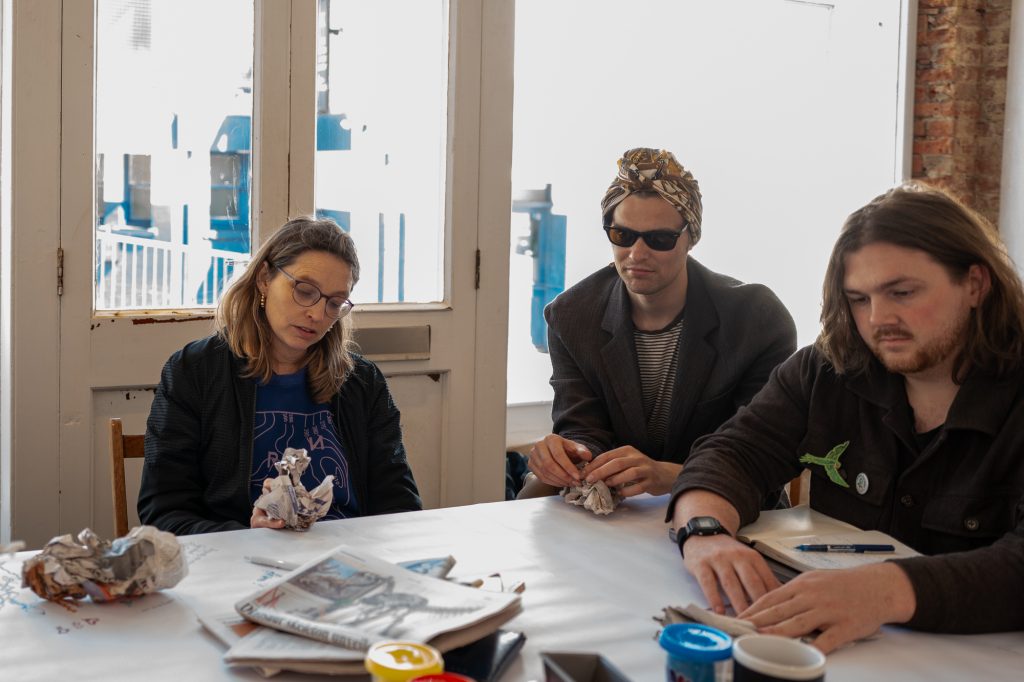
Rebecca Hall leading her mini workshop, with Stanley Willey and Christie Swallow. Photo: Elly Clarke.
Geraldine Wharry followed this by speaking about her career in fashion followed by her disillusionment with it due to its unsustainability, and her work raising awareness of this.
I rounded up this first day by introducing my concept of Drag/ging as a mode of resistance and the work I did with CHASE Climate Justice Network, including the Climate Conversation Card Game I helped devise. With each person randomly picking one of the seven mentor species we have selected for this project, we wrote quietly on the RisePad to consider how we could carry what we had learned, observed and felt into the next day. And what we can learn from our mentor species about their needs and talents, and how best we can, in return, (take) care for them.
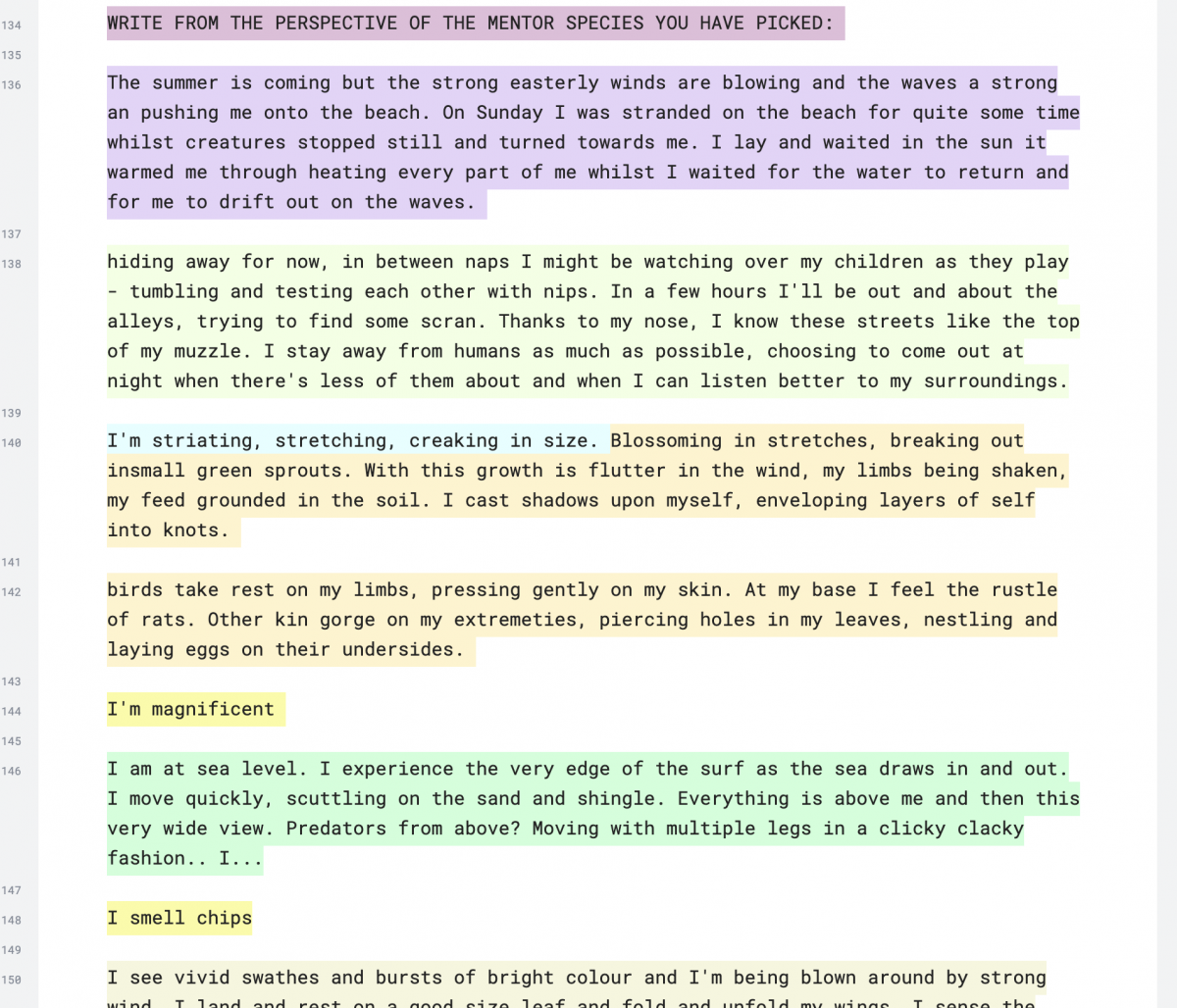
Screenshot from RIsePad with all writing from the perspective of the Mentor Species participants had randomly picked.
The second day was about working, thinking and playing together in small groups to explore tangible, doable approaches to creating multispecies devices connection devices for a public workshop taking place two weeks later, called Creature Mode! Michelle and I decided that Sea Kale, which is green, verdant, plump and – literally! – delicious in the summer, but brown, collapsed and utterly died-back in the winter, could be understood as a metaphor for different sides of ourselves, or our energy cycles; Sea Kale as a therapist almost. In the public Creature Mode! workshop two weeks later, in which every mentor species had its own dedicated device creation table, we invited those interested in Sea Kale to paint both sides of the plant on pebbles – the plump on one side; the died-back on the other. Issac (age 6) did a particularly good job of this.
Meanwhile, back in the co-creation workshop, Rebecca and Ruth sized up the crab’s claws, gait, and natural body armour, picturing a wildlife obstacle course where these traits would make or break her struggle to carry hundreds of eggs. On the other side of the room, Tom, Christie and Stan proposed an outfit for the seal that would bind the feet together and the elbows to the side, to affect movement akin to the creature that was inspiring it. Some of these ideas (not all!) were carried forward to the public workshop. But the freedom sensed in the room though this playing, experimenting and working with analogue materials to think of things way beyond them, reflects the mode of thinking we hope to encourage throughout our work in Felixstowe.
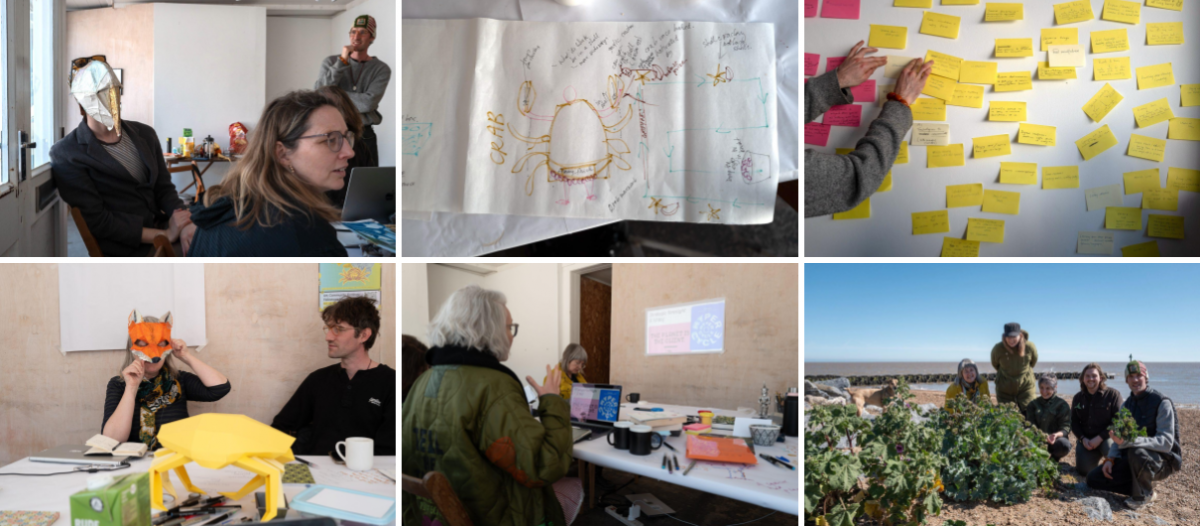 Stills from the co-creation workshop in April. Photos: Elly Clarke
In an age of rapidly changing weather patterns, startling levels of biodiversity loss, wildfires, warming oceans and threats to food security – alongside political polarisation, fake news, AI generated content and rapidly and radically shifting work cultures (including the prospect of substantial changes in employment at the Port of Felixstowe as AI reshapes operations), it is becoming increasingly apparent that the systems we’ve relied on until now are no longer working – for humans or for other species. To find those that will work better – for today and tomorrow – we need to dream, play, talk, imagine, and experiment. This workshop was an attempt to do this. And did conjure up ideas that were indeed taken forward in the public Mentor Species Device making session two weeks later.
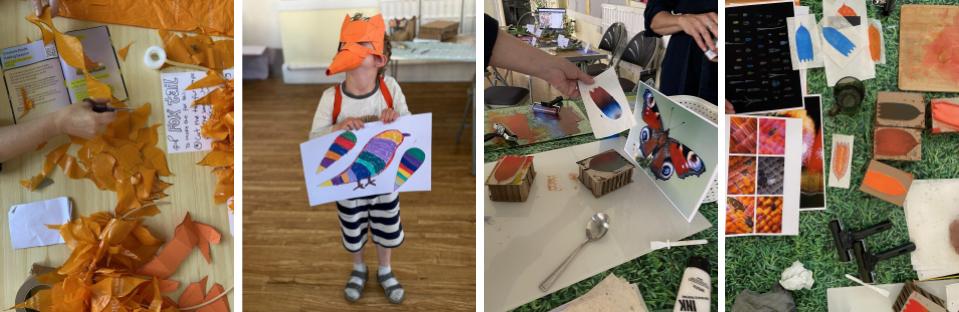
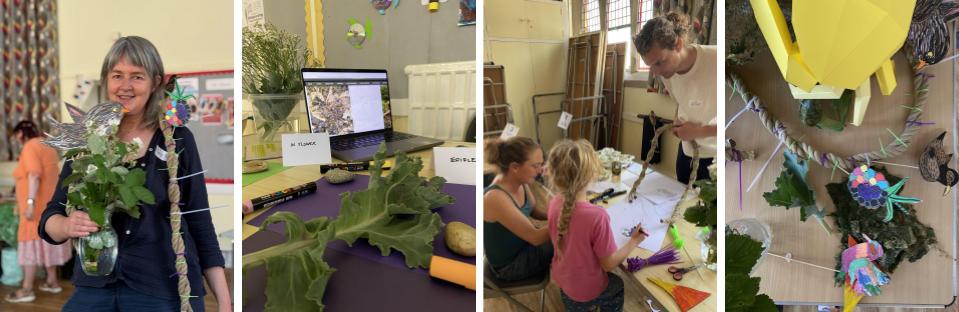
Images from Creature Mode! in May 2026. Photos: Elly Clarke
Creature Mode workshops are now taking place at various times throughout the year and we would love it if you could join us to continue the co-creation – and testing out! – of multi-species communication devices. What we can learn and sense of and with other species via the re/fashioning of an old Sainsbury’s carrier bag, a pebble, some old twine or a cardboard made printing block? How can these gestures, this imagination and these experimentally and collaboratively made devices help us feel the deep interconnectedness we have with other species? And how can this, in turn, feed back to our lives and the ways in which we choose to live them?
For me, it’s definitely the crab and the shedding of her shell to make room for a new one that is not yet completely hardened that is giving me the strongest mentor vibes right now. And you?
Many thanks to all our participants for their generous, creative, stimulating contributions! Follow the events page to find out what’s happening next. Join us?
What is a device? What is multispecies connection? Why is multispecies connection important? What devices could we design and devise to help facilitate tangible, visceral and even magical/spiritual connections between humans and other species? How can we think better with, rather than just about other species? And how could this help us to think and act more holistically, and with less despondency, about climate warming and environmental degradation? What conversations could such a devising inspire?
These are some of the questions that inspired our second co-creation workshop in Felixstowe at the end of April as part of Furtherfield’s place-based, eco-social project Reimagine This Coastal Town. Through a series of immersive fictions in the form of Live Action Role Plays (LARPs), interspecies meditations and active collaborations and creative conversations with local and global artists, the project is about working with the town’s residents to ignite imagination in a way that, after childhood, ordinary life often doesn’t leave a lot of room for. And yet, if we cease to imagine, to speculate, to wonder, to dream, there can be no change. But too often we make no time to do this. Systems of living – from the food we eat to the structure of our working days, from our relationship with nature to the way we live together – are scripted according to templates which, in a time of climate collapse, biodiversity loss and AI, are rapidly proving to be disastrous. Every key moment of change – as Martin Luther King so famously put it – begins with a dream. Rather than separating imagination from action, this project is about bringing them together, Being brave enough to imagine the world we want, and then take steps to move towards it.
Still from Rebecca Hall’s workshop, where we got to create a species we had closely observed outside before creating it with a single sheet of newspaper. Rebecca’s step-by-step prompts culminated in all the ‘species’ moving, and interactions between them. Photo: Elly Clarke
Ruth Catlow and I invited a group of creative, nature-engaging humans to gather at Hamilton MAS in Felixstowe for two intentionally spacious, loosely-structured days to explore some of these questions. With an invitation to talk, present, demonstrate, or show some aspect of our research and practice for about 20 minutes each, our remit was simply:
to exchange creative and imagination-driven approaches to connecting with other life-forms, to help shape a public co-creation day in which local participants could make their own multispecies connection devices to see the world through other species’ perspectives.
The people at the table were East Anglia-based artist Michelle Brace, organic land worker Tom Doherty, The New Wolsey Theatre, Ipswich’s youth engagement facilitator Rebecca Hall, parakeet whisperer and artist Christie Swallow and self-described ‘recovering fashion designer’ Geraldine Wharry. Furtherfield Community Convenor Stanley Willey was also present (and kept us deliciously fed over the two days!), along with myself and Ruth. During lunch on the second day we had input from our Youth Empowerment Consultant Courtney Hessey and our Coordinator Charlie Pattinson-Boulton, both of whom listened to what we had been discussing over the previous day and a half, and fed back.
After Ruth introduced the theme of the workshop and the urgency of tending to biodiversity loss, Tom Doherty spoke about the shift he made from working in the arts to becoming a land worker on an organic farm in Sussex where he grows flowers and veg and sells them at market. He spoke about the extractivist history of supermarkets, and shared a film he made on the farm alongside some incredible documentation of a fashion show he organised last summer, of outfits created from organic materials, modelled by an intergenerational mix of rural and urban friends, fabulously parading down a homemade cat walk. Queerness is not confined to the urban after all, nor, indeed, to humans.
Stills from Thomas Doherty’s film Farm as living organism, 2026, shown as part of his presentation.
LainesFW produced by Rosa Farber + Tom Doherty. Photography by Scott Gallagher, 2025
Michelle Brace spoke about her practice in relation to mental health conditions – exhaustion and wonder. She introduced the concept and method of finding a sit spot – a place in nature you can return to, to learn the patterns, players, and personalities in the neighbourhood of beings that call it home. Thinking towards the interspecies devices we were yet to explore, she spoke about human sensing devices – barometers, clocks, and fit bits – and how they can be used to increase and extend our sensitivity to the environment as well as of ourselves within it.
Slide from Michelle Brace’s presentation.
Armed with some beautiful quilts and collages created in various community settings, Christie Swallow focussed on the work they have been doing with parakeets. Challenging the view of these birds as an invasive species that can do no good, Swallow demonstrated how groups of parakeets in different places have different accents. They consider ecology as both a topic and a thinking method. And quilt making a mode of bringing people together.
Christie Swallow with one of their community-made quits. Photo: Elly Clarke
After Stan’s brilliant lunch, Rebecca Hall brought the thinking back to the body. We left the workshop space and went outside to observe in detail a plant or animal on the beach. We returned and, provided with one sheet of newspaper, created the species we had observed with our hands, and later gave it movement. This moment of sitting in silence working with our hands and laughing as the forms of the creatures slowly became apparent, (so little data for so much resonance!) shifted both our thinking processes and the dynamic in the room. As did that moment of being outside. In our documentation of the event, the difference in our expressions before & after this outdoor moment is palpable.
Rebecca Hall leading her mini workshop, with Stanley Willey and Christie Swallow. Photo: Elly Clarke.
Geraldine Wharry followed this by speaking about her career in fashion followed by her disillusionment with it due to its unsustainability, and her work raising awareness of this.
I rounded up this first day by introducing my concept of Drag/ging as a mode of resistance and the work I did with CHASE Climate Justice Network, including the Climate Conversation Card Game I helped devise. With each person randomly picking one of the seven mentor species we have selected for this project, we wrote quietly on the RisePad to consider how we could carry what we had learned, observed and felt into the next day. And what we can learn from our mentor species about their needs and talents, and how best we can, in return, (take) care for them.
Screenshot from RIsePad with all writing from the perspective of the Mentor Species participants had randomly picked.
The second day was about working, thinking and playing together in small groups to explore tangible, doable approaches to creating multispecies devices connection devices for a public workshop taking place two weeks later, called Creature Mode! Michelle and I decided that Sea Kale, which is green, verdant, plump and – literally! – delicious in the summer, but brown, collapsed and utterly died-back in the winter, could be understood as a metaphor for different sides of ourselves, or our energy cycles; Sea Kale as a therapist almost. In the public Creature Mode! workshop two weeks later, in which every mentor species had its own dedicated device creation table, we invited those interested in Sea Kale to paint both sides of the plant on pebbles – the plump on one side; the died-back on the other. Issac (age 6) did a particularly good job of this.
Meanwhile, back in the co-creation workshop, Rebecca and Ruth sized up the crab’s claws, gait, and natural body armour, picturing a wildlife obstacle course where these traits would make or break her struggle to carry hundreds of eggs. On the other side of the room, Tom, Christie and Stan proposed an outfit for the seal that would bind the feet together and the elbows to the side, to affect movement akin to the creature that was inspiring it. Some of these ideas (not all!) were carried forward to the public workshop. But the freedom sensed in the room though this playing, experimenting and working with analogue materials to think of things way beyond them, reflects the mode of thinking we hope to encourage throughout our work in Felixstowe.
Stills from the co-creation workshop in April. Photos: Elly Clarke
In an age of rapidly changing weather patterns, startling levels of biodiversity loss, wildfires, warming oceans and threats to food security – alongside political polarisation, fake news, AI generated content and rapidly and radically shifting work cultures (including the prospect of substantial changes in employment at the Port of Felixstowe as AI reshapes operations), it is becoming increasingly apparent that the systems we’ve relied on until now are no longer working – for humans or for other species. To find those that will work better – for today and tomorrow – we need to dream, play, talk, imagine, and experiment. This workshop was an attempt to do this. And did conjure up ideas that were indeed taken forward in the public Mentor Species Device making session two weeks later.
Images from Creature Mode! in May 2026. Photos: Elly Clarke
Creature Mode workshops are now taking place at various times throughout the year and we would love it if you could join us to continue the co-creation – and testing out! – of multi-species communication devices. What we can learn and sense of and with other species via the re/fashioning of an old Sainsbury’s carrier bag, a pebble, some old twine or a cardboard made printing block? How can these gestures, this imagination and these experimentally and collaboratively made devices help us feel the deep interconnectedness we have with other species? And how can this, in turn, feed back to our lives and the ways in which we choose to live them?
For me, it’s definitely the crab and the shedding of her shell to make room for a new one that is not yet completely hardened that is giving me the strongest mentor vibes right now. And you?
Many thanks to all our participants for their generous, creative, stimulating contributions! Follow the events page to find out what’s happening next. Join us?

 Furtherfield content is published