All welcome
The Embroidered Digital Commons is a collectively stitched version of ‘A Concise Lexicon of/for the Digital Commons’ by the Raqs Media Collective (2003). The project seeks to hand-embroider the whole lexicon, term by term, through workshops and events as a practical way of close-reading and discussing the text and its current meaning.
Part of the Being Social exhibition at Furtherfield Gallery.
Would you like to stitch the Digital Commons with us?
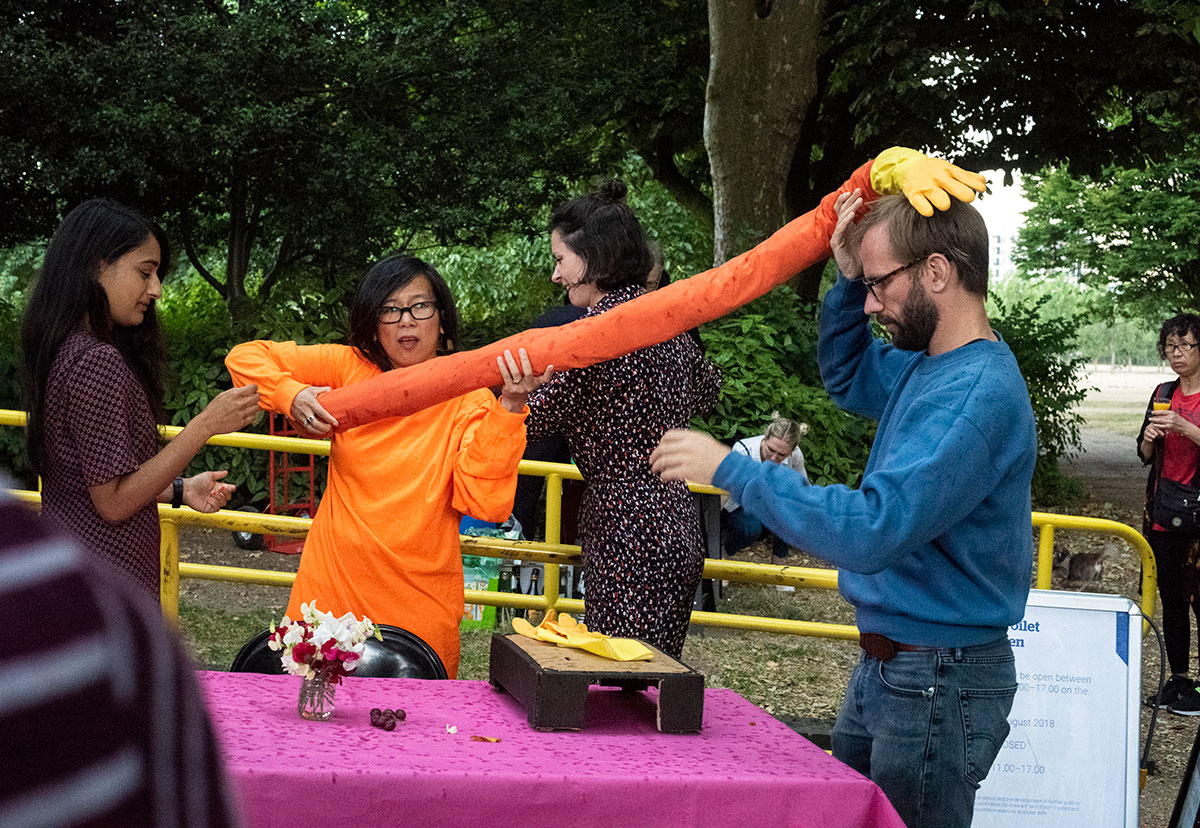
Furtherfield invites all gallery visitors to take part in one or more of our Saturday morning embroidery sessions and come together to stitch the term 'Meme' from the lexicon for the Digital Commons, chosen in relation to the theme Being Social. A cultural ‘meme’ is the way in which an idea spreads through social networks.
We are inviting crafters, programmers, artists, makers, and people interested in working collaboratively, or taking part in participatory projects to each stitch a few words of the term meme, as described below. The resulting patches will then be turned into a short film depicting the sequence of embroideries.
Saturday workshops schedule
3 March – Facilitated by Ele Carpenter and Emilie Giles with Special Meme Guest: Holly Clarke. Holly is Group Head of UK Operations at Unruly, and has managed over 450 social video campaigns since starting with the company 3 years ago. She is constantly researching new web culture, netiquette and applying this to memetic theory and considers herself 'from the internet'.
10 March – Facilitated by Emilie Giles with Special Guests: Unwooly Knitting and Crafters Circle
17 March – Facilitated by Emilie Giles
24 March – Facilitated by Ale Scapin from Furtherfield
31 March – Facilitated by Ele Carpenter with Special Dorkbot guests!
(7 April: CLOSED For Easter)
14 April – Facilitated by Ale Scapin from Furtherfield
21 April – Facilitated by Ele Carpenter
28 April – Facilitated by Ele Carpenter and Emile Giles, with Special Guest Sophie McDonald. Sophie and Emilie will be running a MzTEK workshop for women to embellish their meme embroidery with electronic features. FROM 12-5pm.
For more information about the workshops or to sign up to one or more sessions please visit Ele's blog or contact Alessandra Scapin ale@furtherfield.org
All workshops will take place at Furtherfield Gallery, McKenzie Pavilion in Finsbury Park.
Free workshop admission.
About the Project
In 2003 the Raqs Media Collective wrote ‘A Concise Lexicon of/for the Digital Commons’. The full lexicon is an A-Z of the interrelationship between social, digital and material space. It weaves together an evolving language of the commons that is both poetic and informative. The terms of the lexicon are: Access, Bandwidth, Code, Data, Ensemble, Fractal, Gift, Heterogeneous, Iteration, Kernal, Liminal, Meme, Nodes, Orbit, Portability, Quotidian, Rescension, Site, Tools, Ubiquity, Vector, Web, Xenophilly, Yarn, and Zone.
The concept of the digital commons is based on the potential for everything that is digital to be common to all. Like common grazing land, this can mean commonly owned, commonly accessed or commonly available. But all of these blurred positions of status and ownership have complex repercussions in the field of intellectual property and copyright. The commons has become synonymous with digital media through the discourse surrounding free and open source software and creative commons licensing. The digital commons is a response to the inherent 'copy n paste' reproducibility of digital data, and the cultural forms that they support. Instead of trying to restrict access, the digital commons invite open participation in the production of ideas and culture. Where culture is not something you buy, but something you do.
MEME
"Meme: The life form of ideas. A bad idea is a dead meme. The transience as well as the spread of ideas can be attributed to the fact that they replicate, reproduce and proliferate at high speed. Ideas, in their infectious state, are memes. Memes may be likened to those images, thoughts and ways of doing or understanding things that attach themselves, like viruses, to events, memories and experiences, often without their host or vehicle being fully aware of the fact that they are providing a location and transport to a meme. The ideas that can survive and be fertile on the harshest terrain tend to do so, because they are ready to allow for replicas of themselves, or permit frequent and far-reaching borrowals of their elements in combination with material taken from other memes. If sufficient new memes enter a system of signs, they can radically alter what is being signified. Cities are both breeding grounds and terminal wards for memes. To be a meme is a condition that every work with images and sounds could aspire towards, if it wanted to be infectious, and travel. Dispersal and infection are the key to the survival of any idea. A work with images, sounds and texts, needs to be portable and vulnerable, not static and immune, in order to be alive. It must be easy to take apart and assemble, it must be easy to translate, but difficult to paraphrase, and easy to gift. A dead meme is a bad idea."
About the Artists
Ele Carpenter
Ele Carpenter is a curator based in London. Her creative and curatorial practice investigates specific socio-political cultural contexts in collaboration with artists, makers, amateurs and experts. She is a lecturer in Curating at Goldsmiths College, University of London.
Since 2005 Ele has facilitated the Open Source Embroidery project using embroidery and code as a tool to investigate the language and ethics of participatory production and distribution. The Open Source Embroidery exhibition (Furtherfield, 2008; BildMuseet Umeå Sweden, 2009; Museum of Craft and Folk Art, San Francisco, 2010) presented work by over 30 artists, including the finished Html Patchwork now on display at the National Museum of Computing at Bletchley Park. Ele is currently facilitating the ‘Embroidered Digital Commons’ a distributed embroidery exploring collective work and ownership 2008 – 2013.
Emilie Giles
Emilie Giles is an alumnus of MA Interactive Media: Critical Theory and Practice at Goldsmiths College. Since graduating in 2010 her time has been spent co-organising MzTEK, a women's technology and arts collective, as well as completing an internship with arts group Blast Theory and working for social video distributors Unruly. She is currently involved with TESTIMONIES, a project which explores oral history in relation to the 2012 Olympic and Paralympic Games largely through social media.
Emilie's own practice revolves around notions of pervasive gaming, married with urban exploration and psychogeography. Her most recent focus lies in taking fundamental gaming principles from Geocaching and exploring the consequences of adding an emotional dimension.
Reference
Raqs Media Collective, 2003, A Concise Lexicon of/for the Digital Commons. In: Sarai Reader 03: Shaping Technologies, ed. Monica Narula, Shuddhabrata Sengupta, Jeebesh Bagchi, Ravi Vasudevan, Ravi Sundaram + Geert Lovink, Sarai-CSDS Delhi/WAAG Amsterdam, 2003. p365. Available at: http://www.raqsmediacollective.net/texts4.html
Furtherfield Gallery is supported by Haringey Council and Arts Council England
Furtherfield Gallery opening hours
Being Social exhibition: 25 February - 28 April 2012
Open Thursday to Saturday 12 noon - 3pm (closed 6-7 April)
Free admission to exhibition and events
Free activities (booking advisable) Saturday 11-1pm (except Saturday 07 April)
Opening Event: Saturday 25 February 2012, 1-4pm
RSVP: info@furtherfield.org
Location
Furtherfield Gallery
McKenzie Pavilion, Finsbury Park
London N4 2NQ
T: +44 (0)20 8802 2827
E: info@furtherfield.org

Comments